Congressional hearings seem made for TV. Executives whose companies are under fire or nominees for public office take an oath to tell the truth and settle in for hours of withering questions from lawmakers. To many at home, those questions and answers may sound more like speeches.
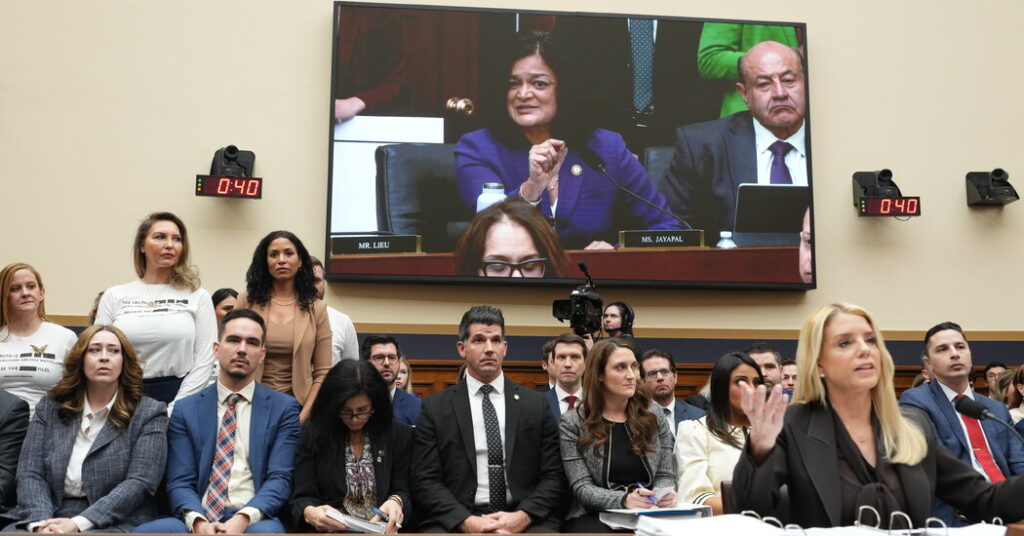
Last week brought three more contentious hearings. One featured Attorney General Pam Bondi and focused mostly on the Jeffrey Epstein files. The others, involving Homeland Security officials, explored immigration enforcement in Minnesota.
How does The New York Times approach covering hearings as news events? What happens when things don’t go as planned?
For answers to those questions, we turned to colleagues who frequently oversee hearing coverage: Margaret Ho, the Justice Department and fact-checking editor; Sandhya Somashekhar, a domestic policy editor; and Julie Hirschfeld Davis, the congressional editor. These are edited excerpts from our online conversation.
Moments from these hearings can often feel like efforts to generate viral social media clips. Have you noticed changes over the years in how those participating conduct themselves?
JULIE HIRSCHFELD DAVIS: There has always been a fair amount of grandstanding by lawmakers in congressional hearings. They’re televised opportunities for members of Congress to show how tough they can be and how they’re using their positions to hold power to account, and they typically prepare their questions with an eye toward what will draw the most attention.
But in the age of social media, that dynamic has been supercharged. Everyone is looking to go viral with a particularly contentious exchange or “gotcha” moment, and what used to be considered the rules of decorum can go out the window in those moments. What is a bit different in recent days is the sheer vitriol and disdain from Trump administration officials toward members of Congress during these hearings. Many of them come to Capitol Hill seemingly primed to attack and insult lawmakers.
What’s the point of a big public hearing?
HIRSCHFELD DAVIS: Congressional hearings can still at times yield important revelations from witnesses who appear under oath, or generate public awareness of a little-understood issue. The tobacco hearings in the late ’90s were a good example, where after testifying under oath that nicotine wasn’t addictive, the big companies had to come back and admit that actually they knew it was — and lied about it. That was a long time ago, but big hearings can still serve a purpose and drive action.
The Jan. 6 hearings deepened the public’s understanding of what happened that day and what precipitated it. Confirmation hearings for cabinet nominees can also yield commitments or questions that can shape their tenure (including if, as in the case of Robert F. Kennedy Jr.’s Senate confirmation process for the role as health secretary, they later go back on their word).
Last week’s immigration hearings yielded some important information, including that top ICE and Customs and Border Protection officials did not characterize an American citizen fatally shot by a federal immigration agent last month as a “domestic terrorist.” Top administration officials claimed at the time that C.B.P.’s initial assessment did make that characterization.
Margaret, our readers see paragraph-by-paragraph reporter updates during hearings. What makes for a strong update? Do we ever decide not to publish one?
MARGARET HO: A strong update offers sharp analysis or critical context to whatever is unfolding. Ideally, a live blog would double as an annotation of sorts that points readers to notable statements and facts. Like anything The Times publishes, editors are reviewing and revising updates as they are filed, typically with an eye on clarity. We don’t use every one, particularly when multiple reporters are watching a hearing at any given time and they may end up stating similar things around the same time. Or we’ll hold off and combine it with additional analysis that someone has shared.
Julie, you began editing hearings coverage after reporting on them earlier in your career. How do you prepare?
HIRSCHFELD DAVIS: It’s really important to have done your reporting ahead of time about what the witnesses have said, or what their record is on the issues that are most likely to be asked about, so you can have a base line for evaluating what they say. So it’s a lot of reading of past transcripts, speeches and interviews so you’re in a position to fact check or add context in real time, rather than just regurgitating what is being said.
The same goes for the members of Congress. You want to figure out ahead of time what their lines of questioning are going to be, or the issues they’re most likely to bring up, so you can prepare to write knowledgeably about them and give readers a sense of why a particular member is homing in on this particular thing.
All of that being said, you have to be careful not to get buried too deep in those weeds because one of the most important things you can do when you are covering a big hearing is to really watch for those spontaneous moments and listen for the exchanges that will ultimately be most important to helping people understand the issue or political dynamic (or both) at play.
When an official says something untrue or misleading, how do we evaluate it?
SANDHYA SOMASHEKHAR: I don’t think just pretending it didn’t happen and not publishing it is an option in this day and age. These hearings are public, and clips get around on social media and elsewhere. We want people to be able to look to The Times to find out if there’s any truth to what they’ve just heard. So, we’ll opt to cite what they’ve said but immediately, in the same breath, truth-squad it by saying what we know to be true or untrue.
When something doesn’t go as planned, how do we react? Take us through an example of a time when we were thrown for a loop.
SOMASHEKHAR: We love being thrown for a loop! That means something interesting and newsworthy happened during an event that can often feel so staged. An example that jumps to mind is the January 2024 Senate hearing in which Mark Zuckerberg, the chief executive of Meta, and several other tech leaders were called to be grilled about child safety. Mr. Zuckerberg was asked if he’d like to apologize to parents in the audience whose children were harmed by social media. To my surprise, he responded, “I’m sorry for everything you’ve all gone through, it’s terrible.”
Describe the scene inside a hearing.
HIRSCHFELD DAVIS: There’s a lot going on off camera. Lawmakers usually make an effort to attend the beginning of these sessions, when they are allowed to make opening statements, and to be there when it is their turn in the queue to ask questions. But they have busy schedules and get bored when things drag on, like everyone else. So there is a lot of getting up and leaving during the proceedings. Sometimes they will go off to other meetings or to vote on the floor. Other times, they will duck into the anterooms behind the hearing room — each party has one on its side of the room — to make calls or eat a snack. Their staff typically line up behind the dais or on the sides of the room and can be seen trotting over at various points to slip the members notes or, occasionally, to point out something in their prepared questions or remarks. By the end of the hearing, attendance is usually pretty sparse.
How does this work for the reporters and photographers?
HIRSCHFELD DAVIS: I consider it very important for a reporter to be in the room, watching the body language, the exchanges or sidebars that happen away from where the cameras may be pointed, and in position to be able to get up and follow a lawmaker or witness out of the room to follow up on something.
Public hearings on Capitol Hill are accessible to the press, and reporters are allowed to have their laptops and cellphones with them. For bigger, more high-profile hearings, I will sometimes team reporters together so there is somebody in the room and someone watching on a livestream. That way, they can tag-team the writing and listening, which can be difficult to do all at once.
Pam Bondi and committee members spent a lot of time sparring. What goes into reporting that?
HIRSCHFELD DAVIS: It’s really about providing context to what is being said. It’s not about taking sides. But as subject-matter experts, it’s important for us to give readers the insight, for instance, that it is unusual for an attorney general of the United States to hurl insults at duly elected members of Congress. Likewise, we have to explain to people why she is accusing Democrats of being responsible for the crimes of undocumented immigrants, groundless as that was. And it’s equally important to break down their criticism of her for her handling of the Epstein files.
If we find ourselves just sending live updates that amount to “he said, she said,” we are really failing our readers. But if we can use some of these exchanges to help people understand what the underlying issues are, then we are doing them a service.
Mike Abrams is the deputy editor for Trust, working to help readers understand The Times and its journalistic values.
The post How Three Editors Handle the Congressional Hearing Circus appeared first on New York Times.