We’re making this story accessible to all readers as a public service. Support our journalism by becoming a member today.
We spend a lot of time talking to strangers online these days. But how are our neighbors down the street doing? Is there something they could use a little help with? A way they need to be supported? That’s the focus of mutual aid.
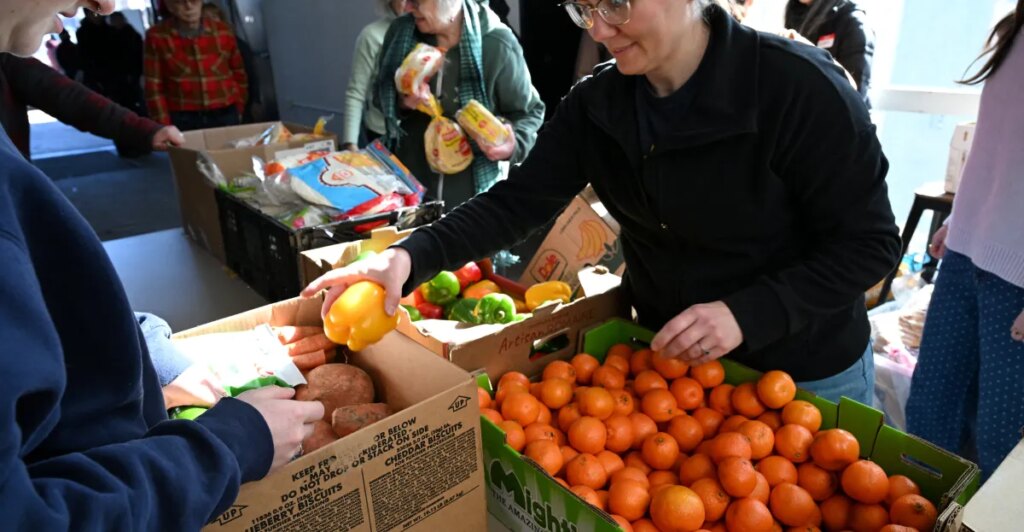
This kind of hyper-local assistance covers a wide range of actions: collecting food and funds for those in need, organizing free item exchanges, or walking a child to and from school because of immigration raid fears.
Humans have been helping each other out as long as we’ve been around. But Fordham University associate professor Tyesha Maddox says we can trace the tradition in the US back to early immigrant communities. She details this history in her book A Home Away from Home: Mutual Aid, Political Activism, and Caribbean American Identity. We look at the history in the latest episode of Explain It to Me, Vox’s weekly call-in podcast.
Below is an excerpt of our conversations, edited for length and clarity. You can listen to the full episode on Apple Podcasts, Spotify, or wherever you get podcasts. If you’d like to submit a question, send an email to [email protected] or call 1-800-618-8545.
Where did the term “mutual aid” even come from in the first place?
That’s kind of controversial only because this idea of mutual aid is one that’s not new. Many communities, particularly immigrant communities of color, have always followed mutual aid ideology. In my book, I talk about Caribbean societies following a mutual aid ideology that they inherited from groups in West Africa. However, the terminology for mutual aid comes from the 1800s with Peter Kropotkin, who was an activist and anarchist who coined the term “mutual aid.”
How did Kropotkin define the term?
He was thinking of mutual aid as an egalitarian, self-directed project. It’s a form of political change or participation in which people take responsibility for themselves. This is particularly common when government institutions are not involved in helping out with everyday needs of the people, so the people have to take it upon themselves to take care of their daily needs.
Who were the earliest communities to practice mutual aid in America?
In African-American communities, particularly those in Antebellum society, we have examples of mutual aid. In the north, there were free black societies that participated in mutual aid, particularly around schools for free people or the formerly enslaved. In places like Philadelphia and New York, in the late 19th century, we see immigrant groups such as Chinese and Jewish communities. In all of these groups, we see examples of things like providing insurance for each other, particularly workers’ comp, when workers’ comp was not a thing. And so if you got sick on the job and you couldn’t go to work, they provided a portion of your wages to you.
For many people who come as immigrants, they usually come by themselves. And so mutual aid provided connection for immigrants who are in a new city, in a new country. Another really important function of these mutual aids that we see across many of the groups, particularly in the US, in the Chinese, Caribbean, and Jewish groups, are collective funds which members paid into. In the Caribbean communities, they were called “susu,” and what they were were rotating credit practices. Everyone put in a certain amount of money and then you had a chance to take out that money to use for small loans in order to pay household expenses and mortgages or their rent or just to survive. These associations were really important for financial as well as moral support for immigrant groups.
How do we see mutual aid ebb and flow throughout history?
We see a rise particularly in the period that I study. I follow 1890 to 1940, and we see mutual aid expand exponentially in this period, particularly before World War II. Then we see a weaning-back of mutual aid once we have more government institutions that are being implemented. I think that takes away the need for some of the groups, but not all of them, and so many of them persist. There are Caribbean immigrant mutual aids that I follow that are still in existence today — and have been in existence since the 1920s.
I would say we see the ideology of mutual aid being applied in many of the social movements in the 1950s and the 1960s in particular. I think one of the most popular examples would be that of the Black Panther Party. The Black Panthers were not a mutual aid group, but they definitely practiced many of the ideals of mutual aid. There was a free ambulance program, they had free clothing and shoes. They had legal aid education. They provided a free breakfast program in schools for children in various cities. I think many of the more modern social justice movements have all had an aspect of mutual aid as part of them.
Are there any other differences in the way mutual aid functions now versus the way it’s functioned in the past?
I would say the major difference is the way in which the groups are connected. So as opposed to being based on where you’re from, the groups that have formed in more recent years tend to be based on current communities or neighborhoods. They don’t have as long of a history, but I think the ideals are the same: in looking within the group and helping members out for things that they need in order to keep going.
What do you think draws people to mutual aid in this particular moment that we’re in now?
I think there is this sense that no one is going to save us but ourselves, and we have to be responsible for our communities — particularly when we don’t see the government stepping in to fill these needs of the group. So for instance, there was a reduction in FEMA assistance, so these impacted communities take it upon themselves to help their neighbors. I think this reliance on ourselves has increased, particularly in 2020 at the start of the Covid-19 pandemic when the government didn’t have a plan for people and how we were going to care for each other, but we saw many of our neighbors in need.
If someone wants to start participating in mutual aid, where do they begin?
I would start with trying to see if there are mutual aid groups that are in your neighborhood or in your community, because in many cases, there actually are. And so you don’t have to reinvent the wheel. You look to the older groups who are already there and join those. And if there aren’t, then you take it upon yourself to try to start those groups, get together with a few of your neighbors, pool some resources and see what are the needs of your community, and then start by trying to fill those needs in the ways that you can.
The post How communities rally when the government fails them appeared first on Vox.