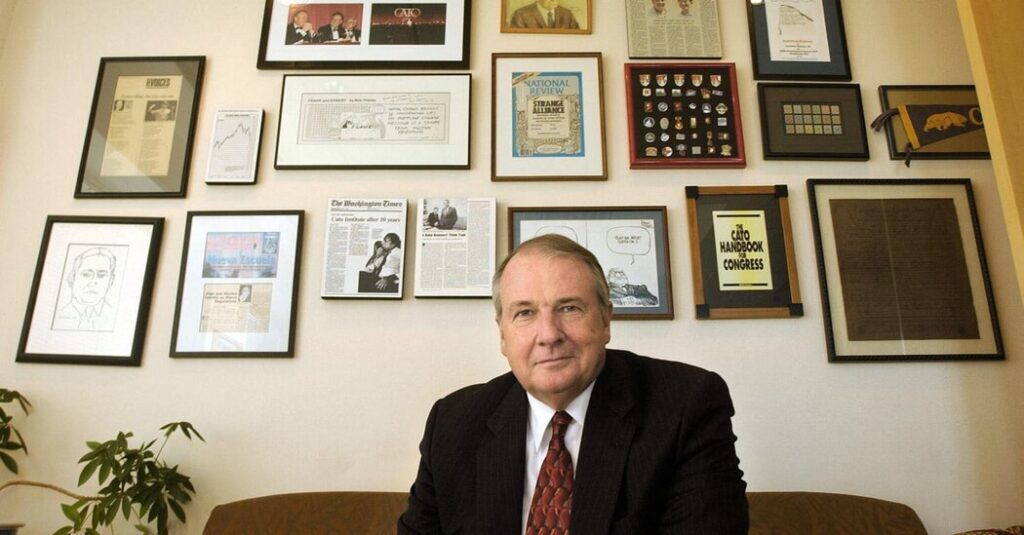
Edward H. Crane, who built the Cato Institute into the nation’s pre-eminent libertarian think tank before forfeiting his leadership in 2012 during a power struggle with the billionaire Koch brothers, two of Cato’s major funders, died on Feb. 10 at his home in Falls Church, Va. He was 81.
The cause was heart failure, his wife, Kristina Crane, said.
Mr. Crane, who was present at the founding of the national Libertarian Party in 1972, opened Cato as a policy research institution five years later in a San Francisco storefront with $500,000 in start-up money from Charles Koch, a conservative heir to a petroleum and chemicals fortune. A third founder, the economist Murray Rothbard, came up with the name Cato, the pen name of two British essayists of the 1700s who favored a republican form of government over a monarchy.
The organization soon moved to Washington, grew rapidly and, starting in 1993, occupied its own six-story building near the White House.
Mr. Crane was a true believer in libertarianism’s small-government, free-market political philosophy, and he could debate fine points of policy with the best of them. But his greatest talents were for building an institution: recruiting scholars, raising money and, during 35 years as the head of Cato, nurturing it as libertarianism evolved from a fringe movement of Ayn Rand-quoting undergraduates into mainstream respectability.
The Washington Post in 2002 called him “the lion king of button-down libertarianism.”
Under Mr. Crane, the Cato Institute, which is nonprofit and nonpartisan, embodied the heterodox politics of libertarianism, uniting social policies of the far left with economic policies of the far right.
Mr. Crane relished throwing others off-balance and seemed to have a quip for everything. He did not vote in elections, even for libertarians, and when people asked him about it, he would reply: “Don’t vote. It only encourages them.”
Cato scholars advocated privatizing Social Security, NASA and public transit. They argued for legalizing marijuana and opposed universal health care. For decades, Cato decried federal regulatory power. Some saw its influence in a sweeping Supreme Court decision last year that imperiled countless regulations by ending the requirement that courts must defer to executive-branch agencies when interpreting ambiguous statutes.
The institute also criticized the mainstream science of climate change and opposed government actions to slow carbon emissions, which aligned with the Kochs’ fossil fuel business interests.
On foreign policy, Cato has long been anti-interventionist, opposing the 1999 bombing of Yugoslavia led by President Bill Clinton and the 2003 invasion of Iraq led by President George W. Bush.
“While Charles Koch was his original partner and provided the seed money, it was Ed who ran the thing, and it was Ed’s impetus that built the institution into what it is today,” Robert A. Levy, a former chairman of Cato, said in an interview.
In 2018, six years after he left Cato, three female former employees accused Mr. Crane of sexual harassment, at the height of the #MeToo movement.
As reported by Politico, one woman who worked at Cato in the late 1990s said Mr. Crane had made dozens of sexual comments to her. Another said he had forwarded her an email about breast enlargement in 2003. A third said that during lunch at a restaurant, Mr. Crane suggested that she remove her bra.
Mr. Crane denied or said he didn’t recall the incidents. Politico also reported that he had settled a sexual harassment dispute in 2012 with a Cato employee over unwanted remarks.
“There were a number of reconciliations made, and everybody walked away from it satisfied,” Mr. Levy said.
Mr. Crane’s departure from Cato in 2012 came after a noisy dispute with Charles Koch and his brother David, who were increasingly aligning themselves with the Republican Party and wanted Cato’s support.
The Kochs expected Cato to supply intellectual ammunition for Koch-financed advocacy groups, principally Americans for Prosperity, which played a major role in the Republican takeover of the House in 2010 and in the 2012 elections.
Mr. Crane fought against aligning the think tank with a political party. “This is an effort by the Kochs to turn the Cato Institute into some sort of auxiliary for the G.O.P.,” he told The New York Times in March 2012.
In a statement at the time, Charles Koch said, “We are not acting in a partisan manner, we seek no ‘takeover,’ and this is not a hostile action.”
Nonetheless, the Kochs sued the Cato Institute, seeking to wrest control of its governing board from Mr. Crane and his allies. The brothers, who had donated some $30 million to Cato, mostly in its early years, had ended their financial support as the rift with Mr. Crane widened.
The fight ended in June 2012 with Mr. Crane agreeing to step down as president and chief executive and the Kochs dropping the lawsuit. The brothers won the right to name their own institute president and chose John Allison, a former chairman of a banking chain.
Charles Murray, the conservative author who has been affiliated with the American Enterprise Institute, a conservative think tank, described Mr. Crane in an email as an uncompromising idealist.
“I never once encountered any give in him when it came to ultimate goals,” he said.
Edward Harrison Crane was born on Aug. 15, 1944, in Los Angeles and raised in Palos Verdes, Calif., the middle of three children of Edward Crane, a physician, and Mary Barbara (Greene) Crane.
He earned a B.A. in business from the University of California, Berkeley, in the late 1960s. As with many of his like-minded peers, his introduction to libertarianism was Ayn Rand’s “Atlas Shrugged,” a paean to laissez-faire capitalism, though his reading broadened to encompass the anti-statist economists F.A. Hayek and Milton Friedman. He ran for student government president on a platform of eliminating the student government. He was not elected.
He went on to earn an M.B.A. from the University of Southern California and began a career as a financial analyst.
In attendance at the founding convention of the national Libertarian Party in Denver in 1972, Mr. Crane chaired the Southern California Libertarian Party that year and the national party in 1974.
In 1980, he managed the Libertarian presidential candidacy of Ed Clark and his running mate, David Koch, a campaign that Mr. Koch largely paid for.
Besides his wife, Kristina, Mr. Crane is survived by a son, Geoffrey; two daughters, Kathleen Jackson and Mary McMullan; four grandchildren; and a sister, Linda Bennett.
Mr. Crane met Kristina Knall at the 1979 Libertarian Party presidential nominating convention. Though they became a committed couple, Mr. Crane resisted getting married because, he said, he didn’t need government to legitimize the relationship. Ms. Knall disagreed. In that case, Mr. Crane said, they would get “a very strong government” to seal the marriage.
In 1988, the couple flew to China and were legally married in Shanghai at People’s Marriage Office No. 9.
Trip Gabriel is a Times reporter on the Obituaries desk.
The post Ed Crane, Who Built a Libertarian Stronghold, Dies at 81 appeared first on New York Times.