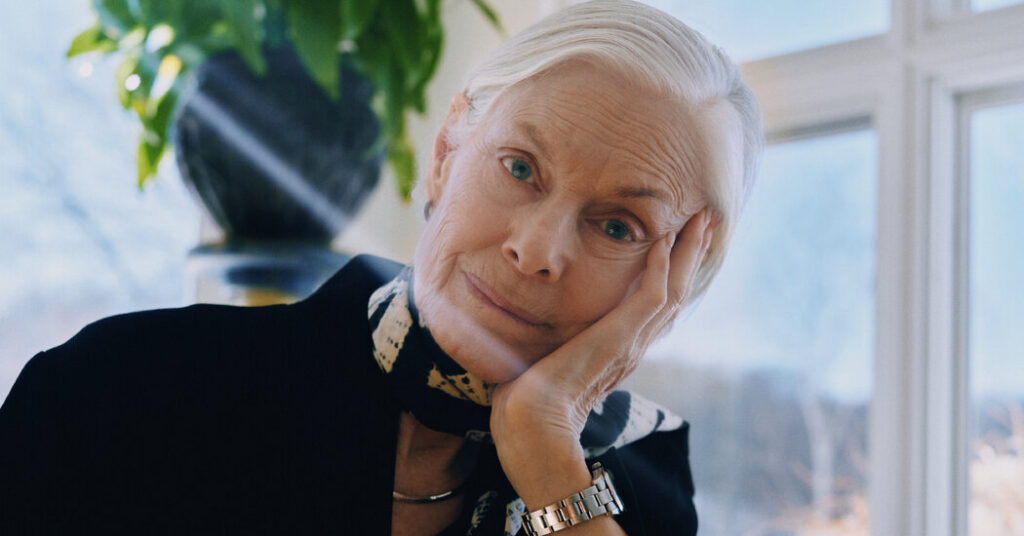
Dance isn’t just for the young, but it’s still startling — amazing, really — that an 85-year-old artist has been appointed the resident choreographer of a dance company. Lucinda Childs may be in the twilight of her career, but she is as artistically potent as ever.
“I’m not, um, young,” Childs said with a laugh in a recent phone interview from her home in upstate New York. “And I do have help. I don’t go in without somebody there who can help to translate and who understands my movement. But my favorite thing is to make things.”
This year, Childs begins a five-year partnership with Gibney Company, a contemporary dance group based in New York City, as its resident choreographer. In June, the Fisher Center at Bard will present the Lucinda Childs Dance Company as part of SummerScape 2026 in a collection of new and old works, including an adaptation of “Geranium ’64” to be performed by Childs.
And next month, Guggenheim New York, in conjunction with Dance Reflections by Van Cleef & Arpels Festival, will present a program of “Early Works,” a collection of mainly silent dances that Childs made starting in 1963.
Those early works, five in all, including “Radial Courses” and “Calico Mingling,” will be performed in the rotunda, which provides viewing from the museum ramps: the ideal bird’s-eye perspective. “People can be on the rotunda looking down on the dancers, which relates to my scores,” Childs said, referring to her movement drawings that are “an overhead view in two dimensions of what we do.”
A founding member of Judson Dance Theater, the experimental 1960s collective, Childs is known for pure dance works in which everyday movement becomes virtuosic inside of her meticulously plotted structures. Taken apart, the movement itself is pedestrian: walking, running, turning, skipping and jumping. All the same, it requires elite mind-body coordination, the kind that transforms dances from cold to hot before your eyes.
There is a stoic quality to Childs’s work: At first, what you see are the mechanics — a rigorous display of controlled, specific movement. But as the dances continue, you sense the individuals within the structure. A certain vulnerability shines through as the dancers fight to maintain the choreography’s architecture. “Radial Courses,” for instance, is about teamwork.
“Everybody’s tuned in to everybody else,” Childs said. “That’s of major importance. You’re feeling a pulse that’s established by the footwork and they establish that pulse at the outset, somebody taps it out and they just have to sustain it for the whole 10 minutes, which is pretty far out.”
The early works, mainly performed in silence, have that vibration. Within them is a score created by the sound of the dancing. Childs’s patterns, while mathematical, can also generate images of nature. In “Katema” (1978), originally a solo and now a quartet, turns and pivots have the sensation of flowing water; in “Radial Courses (1976), four dancers move along circular paths with walks interrupted by skips and hops that build to an exhilarating finish.
“Reclining Rondo” (1975), performed on the floor by three dancers, was inspired by images Childs saw in the visual art world of reclining nudes. “It’s just a little bit of a comment on that,” she said. “OK, we can do stuff on the floor, too. Our stage is not a bed, but the floor.”
Creating a limitation — like removing the possibility of verticality — opens doors, Childs said, “to things you would never think of or never realize. And that was the discipline that I found so amazing in that whole period. It carried over from Judson.”
Her interest in working with patterns, with geometry — her movement scores are two-dimensional renderings of three-dimensional choreographic worlds — relates directly to the discipline that was instilled in the Judson era. Though its practitioners seemed to embrace an ethos of anything goes, Judson was far from casual.
“When people would come to Judson and just think we were fooling around, I have news for you!” she said. “We spent hours on these things. Days. And this is a fascinating discipline that I inherited and that is still with me.”
Her early works paved the way for high-profile projects like “Einstein on the Beach,” Robert Wilson’s seminal opera spectacle with choreography by Childs and music by Philip Glass; and “Dance” (1979), a masterly collaboration with Glass and Sol LeWitt. Today, those early pieces remain a test of a dancer’s ability to maintain extraordinary focus.
“They force you to be present at all times,” Caitlin Scranton, a dancer who works closely with Childs, said. “Not only, of course, are you counting the rhythm of the piece, you are trying to check in with the dancers around you, who are dancing sometimes the same phrase with you, sometimes against you, sometimes a different phrase, and you’re all trying to keep the same rhythm and end up in the same place eventually, at the same time, if all goes according to plan.”
The second your mind starts to wander, trouble ensues. “It’s like a real-time puzzle of, OK, I have to keep moving, I have to keep counting,” Scranton said. “I know that I’m off. What are the choices I’m going to make to get myself back into this dance?”
There is nothing, she said, more satisfying than executing the dances properly or finding a way back in. Along with Matt Pardo, another experienced Childs dancer close to the choreographer, Scranton founded and runs the Blanket, a producing organization for dance that is overseeing “Early Works” at the Guggenheim.
Pardo said that dancing the silent pieces creates a beautiful tension between the individual experience and others, whose nonverbal cues you must pay attention to. “Sometimes it’s as little as hearing a foot scuffle behind you, and you’ll be like, they’re off, something’s wrong,” he said. “But I think that’s the joy: You feel a sense of community among us when we’re navigating these works.”
That’s one aspect that appealed to Gina Gibney when she decided to offer Childs the position of resident choreographer. Childs had worked with her company before, creating “Three Dances (for prepared piano) John Cage.” This spring, at the Joyce Theater, the company will perform “Canto Ostinato” (2015), set to music by the Dutch composer Simeon ten Holt.
“The process was incredibly seamless,” Gibney said of working with Childs. “She’s so prepared and so clear that the work just flowed. So she and I just stayed in dialogue and realized that she was at a time in her career where having a little bit more presence in New York would be a positive for her and definitely a positive to the community.”
It may seem ambitious to start a five-year artistic partnership with an 85-year-old, but Gibney said Childs shows no signs of slowing down. Next year, Childs will create a major evening-length work for the company. “I’m very aware of the passage of time,” Gibney said. “And to me, that adds urgency to it. We talked about the time frame. It could have been three years, it could have been 10, and she really landed on five. I have just every confidence that it’s going to be a very productive time for us. She’s a very, very unusual 85-year-old.”
Gibney had been thinking about naming a resident choreographer for some time. She quickly realized, she said, that Childs’s presence infused her company with an energy and integrity that would serve her dancers. There is the teamwork element, but within that connective physicality among dancers an individuality starts to emerge, even in unison movement. “It’s like the most raw version of yourself,” Pardo said. “I love that ‘there’s no pretending’ kind of element.”
In Childs’s work, pretending isn’t an option. The turmoil of the current political moment has led her to think a lot about what it means to be an American artist. Glass, her longtime collaborator and friend, recently pulled a composition from a Kennedy Center program in protest. “You feel like sitting ducks,” she said. “Every day is some other thing going on, and apart from staying tuned in, I feel a tremendous frustration, I wish I knew what to do. But I think Philip’s statement is an answer. That’s something you can do.”
And while Childs has had many chances to move to Europe, where her dances are in demand, she has remained in the United States.
“This is my home,” she said. “This is where family and friends and dancers and collaborators are — it’s all here and from here. I feel I belong here.”
Gia Kourlas is the dance critic for The Times. She writes reviews, essays and feature articles and works on a range of stories.
The post At 85, Lucinda Childs Still Has a Full Dance Card appeared first on New York Times.