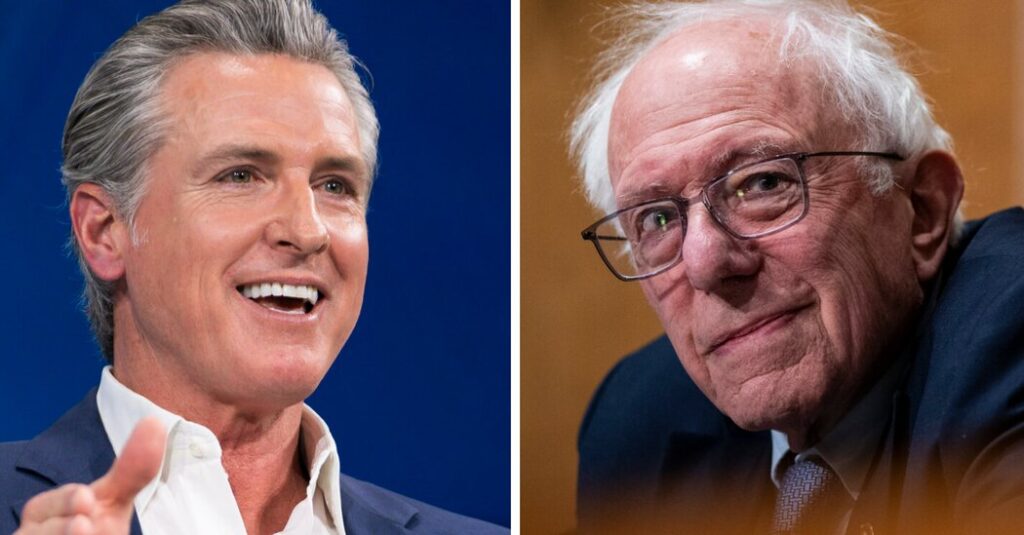
On one side, Senator Bernie Sanders is firing up California voters and encouraging them to tax billionaires as a matter of fairness.
On the other, Gov. Gavin Newsom, crypto executives and business leaders are ramping up efforts this week to stop the proposed wealth tax, warning that the measure would stifle innovation.
The fight is escalating in California this week as Mr. Sanders brings his populist message to a Los Angeles rally on Wednesday, while opponents are deploying ads, raising money and pursuing competing ballot measures to prevent the wealth tax from becoming law.
A health care workers’ union has only until April to collect nearly 900,000 valid signatures to place the tax measure on the November ballot. Union leaders believe the visit by Mr. Sanders will energize their campaign, which has already trained more than 1,000 volunteers and doubled the amount per signature that it is paying petition circulators.
Here is a look at how the battle lines are shaping up so far, and the emerging opposition strategy.
A populist, anti-Trump message
The wealth tax was initiated by Service Employees International Union-United Healthcare Workers West, which largely represents employees at private hospitals, including cooks and janitors. The organization has built a reputation in recent years for its aggressive use of ballot measures to pressure health care employers.
The union argues that a one-time, 5 percent tax on people with more than $1 billion would support critical health care programs that were slashed by President Trump. The measure would raise tens of billions of dollars over the next few years, though it could also result in lower revenues over the long term if billionaires flee the state, according to state fiscal analysts.
Backers are hoping that a California electorate frustrated by the state’s high living costs and the accumulation of Silicon Valley wealth will support the measure.
Mr. Sanders, a Vermont independent, is a major asset for the union. He won the 2020 Democratic presidential primary in California with more than a third of the vote and has a strong populist appeal in the state. His visit comes ahead of a California Democratic Party convention in San Francisco this weekend, where the union hopes to further build momentum for its measure.
“I think it’s time to say to the billionaire class, ‘Hey, you know what? You can’t have it all,’” Mr. Sanders said in a call with reporters last week.
Newsom allies lean on Democrats
Mr. Newsom, a Democrat, has a close relationship with Silicon Valley and has long raised concerns about scaring off tech leaders, given that California already has the nation’s highest taxes on high earners. He is also considering a presidential run in 2028, and a wealth tax could be a vulnerability as he tries to appeal to voters beyond California, especially in a general election.
A group tied to Mr. Newsom is kicking off its opposition drive this week by targeting social media ads at Democratic activists and other party insiders.
Some of the ads will feature Mr. Newsom, who has said the tax would harm innovation in the state and drive away wealthy residents whose income taxes pay for education and health care. The ads will also feature several candidates seeking to replace him as governor next year, Democrats and Republicans alike, along with Mayor Daniel Lurie of San Francisco, a moderate Democrat and a wealthy heir to the Levi Strauss fortune.
Brian Brokaw, a Democratic strategist and Newsom adviser working on the campaign, said that with Mr. Sanders coming to California this week to promote the wealth tax, it was important to explain that well-known California Democrats have “taken a look at this proposal and realized how dangerous it is.”
The opposition campaign has been funded so far by Ron Conway, a tech investor, and Daniel Tierney, an investor in A.I. and climate solutions, with more donations expected to be disclosed in the next several days.
The crypto-related opposition drive
An opposition campaign committee with ties to the crypto industry, called Golden State Promise, officially formed on Friday. It was expected to report this week a $10 million donation from Chris Larsen, a founder of the cryptocurrency company Ripple.
The group has been trying to raise money with a pitch deck that sheds light on some of its strategy.
“Messaging is everything,” the deck says. “Billionaires CANNOT be the focus or face of an opposition campaign.”
Instead, it says, the campaign must tailor messages for voters across different demographics, emphasizing that the wealth tax will hurt working people, will cause businesses to flee the state or is being pushed by special interests.
The sales pitch prominently features Fairshake, the crypto industry super PAC that spent more than $100 million in 2024 to help elect congressional candidates who backed cryptocurrency.
Golden State Promise also has Democratic ties. Its team includes pollster Ben Tulchin, who was a strategist on Mr. Sanders’s presidential campaign, and Roger Salazar, a longtime Democratic consultant.
Mr. Salazar said the group plans to run ads that will “make sure Californians know what’s truly at stake for the economy and for the work force.”
Suzanne Jimenez, chief of staff for the health care workers’ union, criticized such efforts.
“It’s unfortunate that instead of trying to figure out how to make sure that we don’t see a health care collapse in the state, wealthy individuals and their friends choose to go this route,” she said.
Competing measures
Another effort taking shape this week is less direct. It’s supporting three competing initiatives that could prevent the wealth tax from qualifying or nullify the tax if it reaches the ballot.
In the near term, the presence of three more petitions increases the costs for all initiative campaigns, potentially making it harder for other measures to get enough signatures.
Backers of two of the new initiatives are paying $12 per signature, more than almost every other campaign now circulating a petition, according to data compiled by the Bicker, Castillo, Fairbanks & Spitz Public Affairs firm, a longtime ballot measure consultant not involved in the new measures. The billionaire tax campaign is paying $10 per signature, double the amount it was paying earlier this month.
In California, campaigns that pay enough money can often qualify their initiatives because signature gatherers prioritize the highest-paying petition efforts. Rising rates could force the health care workers’ union to run out of money or prevent it from getting enough signatures on time.
The new measures are funded by Building a Better California, a PAC supported by Sergey Brin, a founder of Google, and several other tech billionaires, who have poured $35 million into it. Supporters of two of the measures began collecting signatures over the weekend, and backers of the third one are expected to hit the streets on Tuesday.
If the wealth tax qualifies for the November ballot and some or all of the new measures also get enough signatures, the battle is likely to move to the fall campaign season.
Under California law, if voters approve two ballot measures that contradict each other, only the one that receives more votes takes effect. Each of the new countermeasures contains provisions that conflict with aspects of the billionaire tax.
One of them would prohibit new taxes on personal property and financial assets like stocks, pensions and retirement accounts. The other two contain provisions that could invalidate the wealth tax; one is an auditing measure that would also prohibit the state from imposing taxes that are excluded from a longstanding state spending limit; the other says the state could not impose new taxes that do not follow California’s school-funding formula.
Abby Lunardini, a spokeswoman for Mr. Brin’s PAC, said the group was not motivated by political gamesmanship and was focused on supporting policies that improve affordability and quality of life in California.
“We believe in public investment, but we also think it’s critical there’s more transparency and oversight of how state funds are spent,” she said.
Outside a Safeway grocery store in Sacramento on Monday, shoppers stopped to sign petitions on a clipboard thick with 14 proposed ballot measures.
Some were eager to sign all of them. Others walked past the petitioner.
Matt Nielsen, 45, took time to review each petition in the stack. He decided he did not want to sign the new measure prohibiting new taxes on assets. He flipped through a few more until he got to the billionaire tax, and said he was happy to sign his name.
“They have the means to do it,” he said. “And the services that we all use need more funding. We need that to come from somewhere.”
Laurel Rosenhall is a Sacramento-based reporter covering California politics and government for The Times.
The post As Bernie Sanders Comes to California, Wealth Tax Opponents Intensify Efforts appeared first on New York Times.