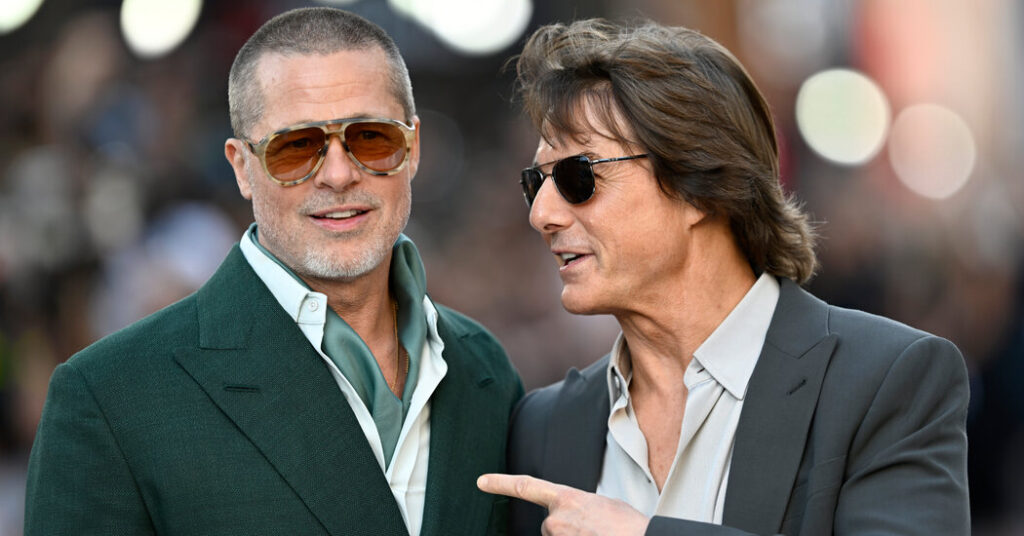
It took only a 15-second clip of Tom Cruise and Brad Pitt duking it out on a crumbling rooftop at twilight to draw swift outrage, and sizable fear, from Hollywood over the last few days.
The widely circulated video was created by the Irish director Ruairi Robinson using Seedance 2.0, a powerful artificial intelligence video generation tool owned by the Chinese technology company ByteDance. It had plenty of the bells and whistles of a big-budget Hollywood film: sweeping camera angles, stunt choreography, crisp sound effects and haunting music.
With a two-sentence prompt and the click of a button, Seedance had produced a stunningly realistic result that was a drastic improvement over previously generated artificial intelligence videos, often shoddy clips known as A.I. slop. This video was so convincing that it drew near immediate condemnation from some of Hollywood’s top organizations and companies.
Rhett Reese, a scriptwriter known for his “Deadpool” films, said in an interview that the Cruise-Pitt video had sent a “cold shiver” up his spine.
“For all of us who work in the industry and devoted our careers and lives to it, I just think it’s nothing short of terrifying,” he said. “I could just see it costing jobs all over the place.”
ByteDance released Seedance 2.0 last week, nearly two months after a previous version had failed to prompt much anger. A news release from the company praised the updated tool’s “physical accuracy, realism and controllability,” which it said was suitable for the needs of “professional-grade creative scenarios.”
“The creation process,” the release went on, “is more natural and efficient, allowing users to control their creations like a true ‘director.’”
Users promptly flocked to the platform to spin up their own content. An alternate ending to “Game of Thrones” went viral, as did a video of the notoriously beefing rappers Kendrick Lamar and Drake burying the hatchet on “The Tonight Show,” and one of Samara Morgan, the vengeful girl in “The Ring” horror films, emerging from an old television set to pet a cat.
Robinson himself posted additional videos, including of Pitt and Cruise battling a robot, and of Pitt sparring with a sword-wielding “zombie ninja.”
At the same time, Hollywood was swift to sit up straight. Charles Rivkin, the chairman and chief executive of the Motion Picture Association, called on ByteDance to “immediately cease its infringing activity,” saying in a statement that Seedance 2.0 had engaged in the unauthorized use of copyrighted works on a “massive scale.” Human Artistry Campaign, a global coalition that advocates using A.I. “with respect for the irreplaceable artists, performers and creatives,” said on social media that unauthorized works generated by Seedance 2.0 violated the “most basic aspects of personal autonomy.”
Disney, which in a watershed $1 billion deal last year agreed to allow OpenAI’s Sora users to generate video content with its characters, sent a cease-and-desist letter to ByteDance, accusing it of supplying Seedance with a “pirated library” of Disney’s characters — “as if Disney’s coveted intellectual property were free public-domain clip art.”
ByteDance, which also owns TikTok and has been valued at $480 billion in the private markets, said in a statement that it respected intellectual property rights and was aware of the concerns about Seedance.
“We are taking steps to strengthen current safeguards as we work to prevent the unauthorized use of intellectual property and likeness by users,” the statement said.
As last year’s deal between Disney and OpenAI suggests, Hollywood has for years wrestled with how to manage the rapid growth of generative artificial intelligence. The concerns outlined by Reese echoed the Writers Guild strike in 2023, when for months thousands of union members demanded that studios institute guardrails protecting them from having their jobs or their intellectual property stolen by A.I. In the end, the group won guarantees that A.I. would not encroach on writers’ credits and compensation.
Duncan Crabtree-Ireland, the national executive director and chief negotiator of SAG-AFTRA, which represents actors and media artists, said its contracts had specific and enforceable rules about digital replication. The kind of material represented by the Cruise-Pitt battle, he said, “could not be produced by any of the signatories to our contracts — the studios, the streamers — without the specific, informed consent of those individuals.”
According to Crabtree-Ireland, the real concern is that, even if videos generated by Seedance and other A.I. platforms “are not malicious in intent,” they could “really violate someone’s right to control how their image, their likeness and their voice is used.”
Not everyone is awed by Seedance’s latest technology. Heather Anne Campbell, an executive producer and a writer on the animated series “Rick and Morty,” said her social media accounts last week had been inundated with Seedance-generated clips of anime, sci-fi and unlikely superhero battles. But she is not yet worried, she said, about losing her job to the technology.
“Everybody is, I think, swept up by the circus that came to town and is showing off,” she said. “I haven’t seen anything good yet. Nothing that has taken my breath away, nothing that is poignant, nothing that is provocative even. It’s all just garbage.”
Campbell added that A.I. services like Seedance were at best “averaging machines,” and argued that the greatest art was never made quickly or impersonally.
Still, some people working in Hollywood find it difficult to imagine that studios will not come to see A.I. as a cost-saving shortcut. “It would be cheaper to have A.I. write a screenplay than it would be for me to write a screenplay,” Reese, the “Deadpool” writer, said. “I just know that in the back of my mind, that’s where the terror comes from.”
For Reese, a long-term answer to the unease that A.I. will reorder Hollywood could not come quickly enough.
“If I could wave my magic wand and make A.I. go away, at least in the creative field,” he said, “I would absolutely wave the wand.”
Derrick Bryson Taylor is a Times reporter covering breaking news in culture and the arts.
The post Why an A.I. Video of Tom Cruise Battling Brad Pitt Spooked Hollywood appeared first on New York Times.