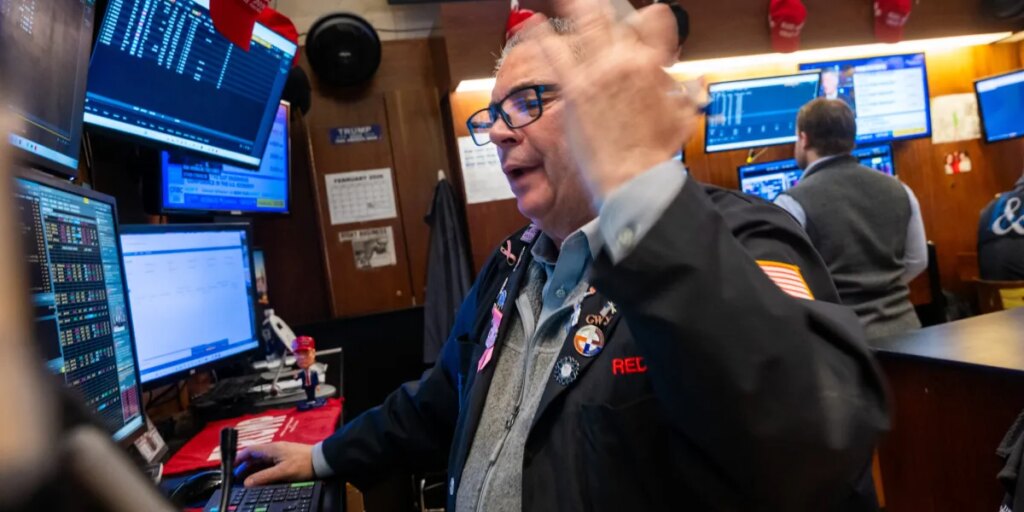
Investors wobbled last week as they worked through the disruption AI is likely to cause across global industries, with further hiccups potentially bubbling through this week. But the reckoning should have been expected, argued Deutsche Bank in a note to clients this morning, because it is a readjustment of perhaps overly optimistic expectations. Software stocks in particular suffered a wipeout amid mounting concerns that large language models may replace current service offerings. Companies in the legal, IT, consulting and logistics sectors were also impacted. JP Morgan wrote last week that some $2 trillion had been wiped off software market caps alone as a result, a reality that prior to a fortnight ago, Deutsche’s Jim Reid argued had been purely academic. A 13-figure sell-off is something Reid has speculated over for some time, telling clients: “For months, my published view has been that nobody truly knows who the long term winners and losers of this extraordinary technology will be. Yet as recently as October, markets were implicitly pricing in a world where almost every tech company would come out a winner.
“Over recent weeks we’ve seen a more realistic differentiation emerge within tech—but that repricing is now rippling into the broader economy with surprising speed.” Reid hasn’t been alone in his suspicion that investors had perhaps been painting over the entire stock market (and indeed wider economy) with the same, optimistic brush. Some speculators have made broad-stroke arguments that the efficiencies offered by AI will result in wins for the vast majority of companies, while others have argued that while AI is not in a bubble, there are pockets of overoptimism that may burst. JPMorgan’s CEO Jamie Dimon is of such an opinion, explaining at the Fortune Most Powerful Women Summit last year: “You should be using it,” (speaking to any business that was listening). But he added a caveat, saying that back in 1996, “the internet was real,” and “you could look at the whole thing like it was a bubble.” Then he broke down the real difference that he sees—between AI, on the one hand, and generative AI, on the other. It’s an important distinction, Dimon said, while adding that “some asset prices are high, in some form of bubble territory.” Indeed, Jeremy Siegel, Emeritus Professor of Finance at The Wharton School of the University of Pennsylvania, argued that such shifts demonstrate investors are “asking the right questions.” Writing for WisdomTreea week ago, where he serves as senior economist, Siegel said: “When companies talk about $200 billion in capital expenditures, markets should scrutinize payback periods, competitive dynamics, and whether durable moats can be built in an environment where technology is evolving at breakneck speed. That tension explains why leadership will continue to rotate even as the secular story remains intact.” That said, Reid suggested that the market may be repricing overzealously, arguing the disruption in “old economy” sectors feels overdone: “The real challenge is that even by the end of this year, we still won’t have enough evidence to identify the structural winners and losers with confidence. That leaves plenty of room for investors’ imaginations—both optimistic and pessimistic—to run wild. As such big sentiment swings will continue to be the order of the day.”
Thin ice
Disruptions provoked by investors’ caution around AI sits at odds to other market adjustments, argues Ed Yardeni, because it is a cycle which feeds itself.
Yardeni, the president of the well-regarded economic research shop after his own name, wrote over the weekend that AI is “speed skating on ice.” While it is typical for technological revolutions to be disruptive, the top economist argued, AI has the potential to unseat its own creators. He argued AI has the “ability to write software code, including AI code. So it can feed on itself, with the new code eating the old, making it obsolete very quickly. The pace of obsolescence seems to be moving at warp speed for both AI hardware and software, particularly the LLMs. That pace has recently spooked investors who’ve been selling the stocks of any company that might be negatively disrupted by AI.”
The post Trillion-dollar AI market wipeout happened because investors banked that ‘almost every tech company would come out a winner’ appeared first on Fortune.