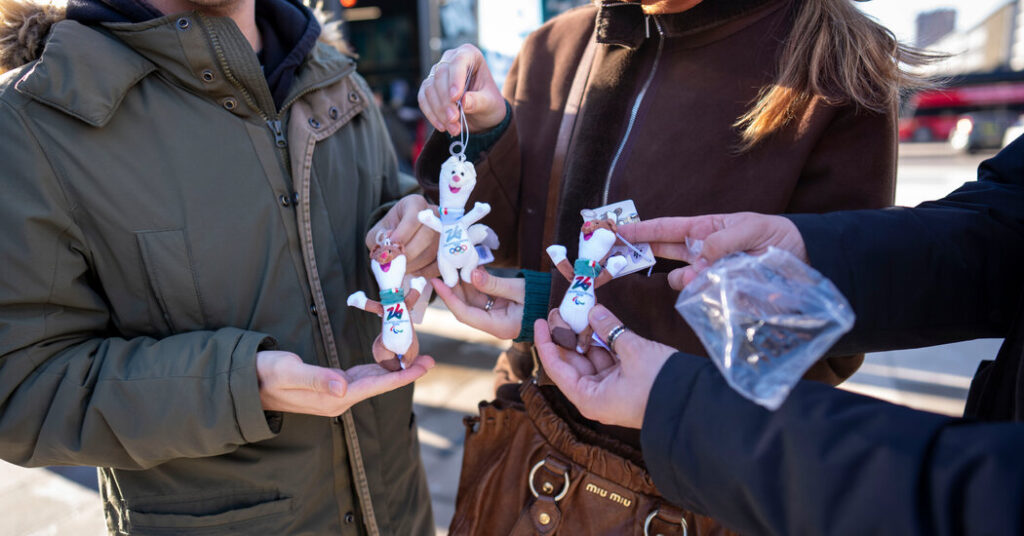
The clerk at the Olympic gift shop looked deadly serious as he leaned in for a whisper.
I’d just asked for help locating a stuffed toy — Tina, the mascot of the Winter Games — and he’d already informed me they were sold out everywhere. But now he was shooting furtive glances around the store and coming closer to me.
“Come back at 4 p.m.,” he said into my ear. “Bring cash.”
I asked whether this meant the dolls would be restocked then. He winced.
“Meet me outside,” he said, motioning to the rear of the building. He repeated: “Bring cash.”
There was reason for his illicit offer. Olympic spectators have fallen hard for the plush mascots — Tina, a white stoat, and Milo, her brown counterpart representing the Paralympics. But the effort to buy one, for most in Milan, has been fruitless. The stoats — available in four sizes, ranging in price from 18 to 58 euros ($21 to $69) — have been generally unavailable at official shops and competition venues. The online store has been entirely picked over, too.
“I can’t find them anywhere in Milan,” said Reed Alvarado, 33, who traveled from Los Angeles to watch the Games.
Emphasizing that he was “not obsessed” with the dolls — merely trying to get them for friends who were — he nevertheless tried to explain their appeal: “There’s a cuteness factor to them,” he said. “They almost have a Pokémon quality.”
And they have been hard to find from the start. On just the second day of competition, Mr. Alvarado and his fiancé, Kegan Gerard, 31, waited almost two hours to enter the “megastore” near Milan’s Duomo cathedral. Once inside, they found the plush toy shelves barren.
So far, officials have portrayed this undersupply as a good thing — “a great example of the great enthusiasm and excitement surrounding the Games,” according to Luca Casassa, a spokesman for the local organizing committee.
Dario Bertè, the chief executive of Trudi, the Italian toy company behind the mascots, promised that more would be available “in the coming months,” and mused that their success was “surely due to the fact that the two stoats have told a story so appreciated by the public.”
The holdup, he suggested, was a question of quality. He said each Tina and Milo toy was “an artisanal product” that was “sewn by hand, one by one, as you would a dress or a suit” and would therefore take time to restock. (They are manufactured in China.)
My personal quest began after I made my 6-year-old cry.
The day I left for Milan to cover the Games, he teared up before school, asking me not to go. Wracked with guilt, I resorted to a familiar tool of parental persuasion: bribery.
I opened the browser on my phone and searched for “Olympic mascot.” The stoats — longer, bouncier cousins of the weasel — appeared onscreen. I promised him I’d bring one home. He cheered up and went to brush his teeth.
But honoring my end of the bargain quickly proved difficult. The plush stoats were everywhere — handed to medalists on podiums, on advertisements around Milan — except Olympic store shelves.
One morning, I met Julien Beauvillain, 40, a Frenchman living in Milan, in line outside one of the official shops. He wanted to surprise his two children, ages 4 and 6, with the toys. He gently chided me for making such a concrete pledge to mine.
“With children, don’t promise something you can’t deliver,” he said. He surveyed the hectic scene and left.
Similar toy-buying frenzies happen now at every Olympics. Mascots first became a marketing juggernaut at the 1980 Summer Games in Moscow, where Misha, a brown bear, was plastered on all manner of merchandise.
Mascot fever seemed to peak at the 2022 Winter Games in Beijing, as plush versions of Bing Dwen Dwen, a rotund panda in a translucent snow suit, sold out across the country. Officials blamed the shortage on factory shutdowns for Lunar New Year, while instituting a nationwide one-Bing-Dwen-Dwen-per family rule.
With my own family relying on me, I kept striking out. There were whispers of inventory in the mountains — Mr. Alvarado had snagged a few Tinas in “random ski shops” while watching ski and snowboard races — but those were hours away from the city.
And my back-alley deal was a bust, too. After a brief internal debate, I slunk to the stated location at the appointed time, cash in my pocket. But the store clerk never showed.
Then came hope. Word got around that Olympic stores were restocking overnight, but only in extremely limited quantities and in the smallest sizes.
Greta Facchini, 25, rode the train early one morning from Busto Arsizio, a town outside Milan, to ensure she could claim a Milo doll for her girlfriend. She was outside the store entrance by 7 a.m., the first person in line. This proved prudent: Two hours later, an employee preparing to open the store announced that only three Milos would be available that day.
“I’m happy,” she said, stoat in hand, “because now I can go home and sleep.”
On another morning, I arrived at a store 20 minutes before opening. It was raining, which made the whole exercise feel especially undignified. Before long, a tiny Tina doll was smiling sweetly at me from the countertop. The moment was mostly anticlimactic. I felt only mild relief.
But my mission was complete. And I didn’t have to bribe anybody — besides my child.
Jason Horowitz contributed reporting.
Andrew Keh covers New York City and the surrounding region for The Times.
The post The Olympic Toys That Are Almost as Tough to Get as a Medal appeared first on New York Times.