A standing-room-only crowd jammed recently into the only courtroom in Comanche County, Kan. Residents came on their lunch breaks, trekked in from their ranches and even closed down a hardware store so they could watch.
They were there for the man at the defendant’s table, Joe Ceballos, who just weeks before had been re-elected mayor of Coldwater in a small-town landslide, with 101 votes to his opponent’s 20. There had been no time to celebrate. Hours before the votes were tallied, Mr. Ceballos, a legal permanent resident of the United States, was charged in state court with voting illegally as a noncitizen.
Now Mr. Ceballos, 55, sat in the high-ceilinged courtroom, glancing downward as a prosecutor from the Kansas attorney general’s office rattled off a list of felony charges that could lead to years in prison: three counts of election perjury, three counts of voting without being qualified.
When the charges were announced a few weeks before the hearing, the municipal politics of Coldwater suddenly became national news. Many conservatives from outside Comanche County framed the case as an example of rampant voter fraud. Before the first court hearing in December, the Trump administration drew attention to the case, pledging to seek Mr. Ceballos’s deportation if he were convicted.
“This alien committed a felony by voting in American elections,” Tricia McLaughlin, a spokeswoman for the Department of Homeland Security, said in a news release that included a photo of Mr. Ceballos and of his signature on a voter registration form.
Yet inside Coldwater — home to 700 people, zero stoplights and vanishingly few Democrats — the prosecution was widely seen as a personal attack on a pillar of the town. Most of them, Mr. Ceballos included, had voted for President Trump, and some said they supported his immigration policies. But they knew Joe, a fixture in Coldwater since he was a teenager. And they wanted the government to back off.
‘Just as American’
Decades before he appeared at the county courthouse as a defendant, Mr. Ceballos said he went to that same limestone-trimmed building on New York Avenue on a high-school field trip.
His teacher, Gail Boisseau, said she showed a group of seniors around, taking them to the spot where they would pay their taxes and introducing them to courthouse employees.
When they got to the county clerk’s office, she and Mr. Ceballos each recalled, the person working there asked if students who were at least 18 would like to register to vote. Mr. Ceballos said he filled out the form. Federal and state laws require that voters be United States citizens, and Kansans must check a box saying that they are citizens when they register to vote.
“Nobody ever told me that I couldn’t vote or register to vote,” Mr. Ceballos said during a recent interview inside the City Council chamber where he once presided over meetings. “And so, as a young man, yeah, I did it. I registered.”
The county clerk, Bri Uhl, said her office had no record of Mr. Ceballos’s registering to vote before 1999, when he would have been in his late 20s. Mr. Ceballos’s lawyer, Jess Hoeme, said in an email that “Joe is confident he was registered and had voted prior to the renewal or re-registration in 1999, but I’m having a hard time proving it.”
Mr. Ceballos was born in Mexico and came to the United States when he was 4 years old, he and his lawyer said. He moved around as a child before ending up in Coldwater, just north of the Oklahoma border in west-central Kansas, as a teenager in the 1980s. For all but a few months since then, Comanche County has been home.
Mr. Ceballos, who received a green card in 1990, said he had never been back to Mexico. And though he used to help local law enforcement as an informal Spanish interpreter, he said his knowledge of the language had faded.
Mr. Ceballos wears cowboy boots, drives a Ram truck and speaks with a slight Southern Plains accent. He cheers for the Dallas Cowboys, rides a Harley-Davidson and has a cavernous workshop next to his house that is stuffed with tools, car parts and an old Pepsi machine.
He said he did not follow national politics closely, but agreed with much of what the president had said about energy policy and illegal immigration. Mr. Ceballos said he voted for Mr. Trump in the last three presidential elections.
“I still strongly believe in Trump’s immigration laws about, ‘Let’s get the bad guys out of here.’ You know, they’re murderers, they killed people, they molested people, let’s get them out of here,” Mr. Ceballos said in an interview. “But I feel like I don’t fit that category. And I feel like that’s how they’re treating me.”
Over time, Mr. Ceballos became part of the fabric of Coldwater, a place where most people seem to have known most everybody else since childhood. He married twice, raised children and bought a pasture just outside city limits, where he tends to a herd of cattle. Each year, he hosts a mud run for large trucks, drawing spectators from across the region.
Court records show that Mr. Ceballos was arrested in 1994 and convicted of misdemeanor battery for his role in a fight involving several people. Someone was shot and wounded during that fight, according to those records, though Mr. Ceballos was not accused of shooting anyone. He and his lawyer described that case, as well as a 1995 case that led to a conviction for misdemeanor criminal damage to property, as related to the end of Mr. Ceballos’s first marriage. Kansas court records available online do not show any arrests of Mr. Ceballos in the last 30 years.
As he made a life in Coldwater, where 90 percent of the residents are white, Mr. Ceballos became a regular voter, always choosing Republicans. He worked for years in Coldwater’s public works department, then landed a job as a lineman with a utility company, where he is still employed.
His neighbors elected him as a City Council member, then as mayor, a position in which he focused on keeping up basic services while managing a tight budget. He said the job paid $500 a month. One of his signature issues, he said, was maintaining the pavement on Coldwater’s aging streets rather than converting them to dirt roads. He resigned as mayor soon after the charges were announced.
His work in city government earned good reviews. Britt Lenertz, who took over as mayor for a few weeks after Mr. Ceballos resigned, said that “whenever it came to anything that he could do to try to improve the community, he wanted to be a part of it.”
He was known for checking in with the city clerk almost every day to see if anything needed his attention. For Christmas, he arranged to cut down a cedar tree at a nearby lake and install it in the middle of Coldwater’s ultrawide Main Street. And when Rick Beeley posted a few years ago in the local newspaper that he was hoping to retire from his role decorating Main Street in U.S. flags for patriotic holidays, Mr. Ceballos was the only person who responded and volunteered to take on that job, he said.
“I’m a Vietnam vet — he’s just as American as I am,” Mr. Beeley said.
A day before his court appearance, an advertisement in The Western Star, Coldwater’s newspaper, urged readers to attend the hearing: “Please Find the Time to Show Support for Joe Ceballos!”
“Over many years, Joe chose this community to be his forever home” and “gave of his time and energy,” the advertisement added.
Even Mr. Ceballos’s opponent in November’s nonpartisan mayoral election, Greg Vanderree, had nothing particularly bad to say about him.
Mr. Vanderree, a Republican who said he broadly supported Mr. Trump’s policies on immigration, said he had no idea before the charges were announced that Mr. Ceballos was not a citizen. Mr. Vanderree said he had played no role in reporting his opponent to the authorities, and said he had been hurt that some of his neighbors seemed to think he had.
As far as what should happen to Mr. Ceballos now, he said, there were no easy answers.
“He’s not a bad guy,” Mr. Vanderree said. “He’s not doing anything to harm anybody, But he did — I mean, he flat broke the law. And the trouble is, due to other things, he’s been made an example of.”
‘A Real Problem’
To the Kansas attorney general, Kris W. Kobach, the case against Mr. Ceballos was proof of what he had insisted for years.
“Noncitizen voting is a real problem,” Mr. Kobach, a Republican, said at the news conference where he announced the case against the mayor. “It is not something that happens once in a decade. It is something that happens fairly frequently.”
He said that too little had been done over the years to identify ineligible voters and remove them from the rolls.
“Every time a noncitizen votes, it effectively cancels out the vote of a U.S. citizen,” Mr. Kobach said, adding, “if a person who is not a U.S. citizen actually ends up on the ballot for an office, then a U.S. citizen lost the opportunity to obtain that office.”
Concern about election fraud and voting by noncitizens is now a core issue for many Republicans, but Mr. Kobach was ahead of his time in identifying that topic’s political potency. When he was Kansas secretary of state in the 2010s, Mr. Kobach built a national profile by calling for stricter election laws and by prosecuting a small number of people accused of voting illegally.
In fact, voter fraud is rare, and an exceedingly low percentage of ballots are cast by noncitizens in the United States. Mr. Kobach declined through a spokeswoman to be interviewed.
Outside Coldwater, the push to prosecute Mr. Ceballos won the attorney general praise from fellow conservatives. But around Comanche County, where Mr. Kobach and Mr. Trump have overwhelmingly won elections, some questioned the decision.
“I think he needs to find out a little bit more what’s going on,” Dennis Byram said of Mr. Kobach, for whom he voted. Mr. Byram, who closed down his hardware store to attend Mr. Ceballos’s court appearance, said “the whole county backs” the former mayor.
Ryan Swayze, a high school classmate of Mr. Ceballos who now ranches just south of the state line in Oklahoma, said “I feel like this is an A.G. that’s drawing attention to himself.”
Still, the defining challenge for Mr. Ceballos and his supporters is that he openly acknowledges doing what he is accused of doing. Yes, Mr. Ceballos said, he voted repeatedly in United States elections without being a United States citizen. And that is illegal.
His defense, essentially, is that he did not understand that being a permanent resident should have precluded him from voting and holding office, and that no one ever told him he was not eligible. He said he engaged in politics not in some plot to subvert the system, but out of a desire to help the place he considers home.
After decades as a permanent resident, Mr. Ceballos said, he decided last year to pursue citizenship. He said he had passed the civics test and was sitting for an interview in Wichita with a federal official when he was asked whether he had ever voted.
Yes, the mayor responded. It was not the answer the government was looking for.
“His eyes got real big, and I was like, ‘Boy, did I do something wrong?’” Mr. Ceballos said.
According to Mr. Ceballos and his lawyer, that exchange derailed his citizenship application, alerted Kansas officials that he had voted as a noncitizen and set off the chain of events that led to his being charged.
A lingering question is what justice might look like in this case. Should Mr. Ceballos be convicted of felonies, as the attorney general is seeking? And if he is, should he be slated for deportation, as the Trump administration has pledged in his case? Or, as so many in Coldwater have suggested, might there be some way to give him a slap on the wrist and move on?
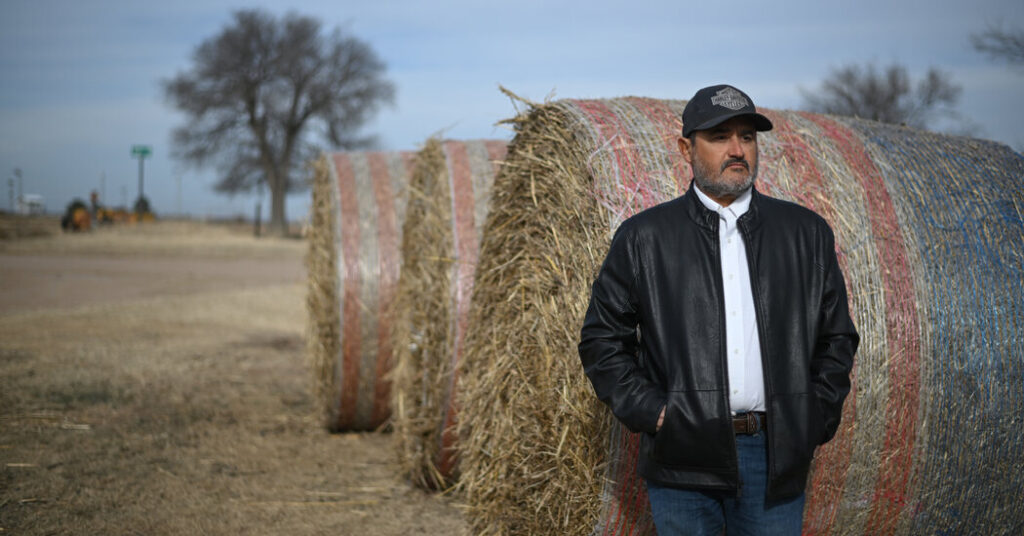
Mr. Ceballos, whose preliminary hearing is scheduled for March, said that perhaps he should be ordered to pay a fine, or even spend time on probation. But he feared a felony conviction would mean being sent back to a country he had not visited in half a century — away from his family and his cows and his tidy house on the edge of town with hay bales wrapped in red, white and blue.
Even now, before his case is decided, he said he worried that Immigration and Customs Enforcement agents might show up looking for him.
“You wake up, like, ‘Are they going to deport me now?’” he said. “It’s always in your thought.”
Mitch Smith is a Chicago-based national correspondent for The Times, covering the Midwest and Great Plains.
The post The Immigration Debate Came to Rural Kansas. Locals Stood by Their Mayor. appeared first on New York Times.