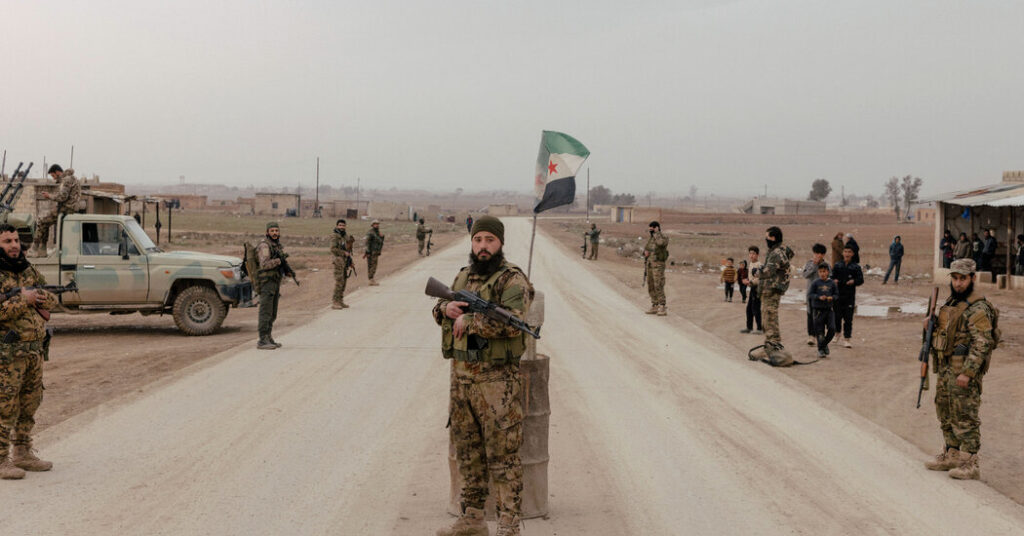
The mood was tense as government forces entered the city of Hasakah in northeastern Syria this month. U.S.-led coalition warplanes flew overhead, and a Syrian army unit monitored the column’s progress from drones, watching for ambush by Kurdish groups.
It was the first time the government was moving into Hasakah, a stronghold of the Kurds for more than a decade, and its presence was not welcomed by all. Kurdish soldiers, who are being made to abandon their ambition for an autonomous region, remained defiant, parading with Kurdish flags and weapons before a government base.
The display indicated the challenges ahead for President Ahmed al-Sharaa. Benefiting from a switch in American support away from the Kurds, he has used a mixture of muscle and negotiation in recent weeks to take over three provinces of eastern Syria.
The vast, resource-rich region had eluded his grasp since his rebel force toppled the dictatorship of Bashar al-Assad just over a year ago. His new government is now extending its authority, advancing toward its goal of unifying Syria for the first time in 15 years.
The task before him is daunting. Already stretched with stabilizing the war-battered country and lifting its people out of poverty, the government now has a huge new swath of territory to secure and rebuild.
During a two-week long journey across the newly opened territory, our reporting team encountered a land in desperate need and deeply divided after years of civil conflict.
The Kurds, a minority in Syria, are the dominant population in parts of northeast Syria, and they were by turns wary, resistant and resigned at the prospect of rule from Damascus.
Arab residents, who had chafed under the rule of the Kurdish-led force, the Syrian Democratic Forces, or S.D.F., were celebratory. Some had rushed back to reclaim their homes, even as army units were clearing mines and booby traps left by departing Kurdish forces.
“The entire village was displaced in 2013,” said Ahmed al-Ahmad, 40, who had returned from Lebanon and was repairing his house in the village of Al Belasha, in the newly controlled areas of Aleppo province. “Not even a bird could fly here.”
The infrastructure demands are immense. The area’s hydroelectric dams, oil fields and rich farming land are debilitated. Much of the countryside lies in darkness. Cities are strewed with trash. Power is so intermittent that neighborhoods roar with the sound of generators.
In the provincial capital of Raqqa, cars bumped through potholes filled with muddy rainwater. Others lined up to navigate a broken ramp onto the main bridge across the Euphrates River that had been blown up by retreating S.D.F. forces.
Security forces were still searching underground tunnels for explosives and S.D.F. stragglers, said Ahmed Adel, the acting head of the government’s Internal Security forces in Raqqa.
“Once we have security,” Mr. Adel said, “we can sort out everything else.”
Government officials said they have learned from the experience of taking over the rest of the country after the fall of the Assad regime in December 2024.
Security officers registered long lines of S.D.F. members in a reconciliation center during our visit. A panel of 11 judges from Damascus worked through a weekend to review case files of 1,600 detainees in Raqqa’s main prison.
Government delegations have been arriving from Damascus to assess the region’s needs, but residents are already complaining about rising gas prices. With the departure of the S.D.F., thousands who had built an economy linked to the force and its administration were now without jobs.
In northeastern Syria, the S.D.F. was more than a fighting force but a veritable government of its own. It had been the main ally working with U.S. forces in the area for more than a decade in combating the terrorist group Islamic State and guarding thousands of ISIS prisoners.
The Kurds had long wanted their own autonomous region there.
But in recent weeks, the Trump administration withdrew its support from the Kurds and threw it behind Mr. al-Sharaa in his aim to unite Syria under his rule. Some Kurds saw the shift as a betrayal.
Without American backing, the Kurdish force could not hold their neighborhoods in the city of Aleppo, and had little hope of controlling the mainly Arab populated provinces of Raqqa and Deir al Zour.
Some Kurdish fighters in Aleppo chose to make a last stand. After days of fighting, the bulk of the fighters and their political leaders withdrew to Hasakah, a largely Kurdish region. The government has now entered there, too.
People living in the mainly Arab populated provinces wrested from the S.D.F. complained that the Kurdish-led force had run a harsh police state.
“We were always in fear they would raid our shop. We knew anyone could charge us with being an ISIS fighter,” said Belal Bargash, 32, standing outside his cellphone shop in a part of Deir al Zour province that had been controlled by the Kurdish-led force.
“We feel extremely relieved,” he said, breaking into a beaming smile.
Some Kurds in the region said that they, too, had felt oppressed by the S.D.F.’s administration.
Ayman Lolak, 43, a Kurdish businessman in the Sheikh Maqsoud neighborhood of Aleppo, which the S.D.F. had lost, said he was pleased finally to be reconnected to the rest of the city and to the central government.
He said the Kurdish administration had confiscated his line of shops and other properties near the front line and allowed him only the use of one shop and one house.
“We were under a blockade for the last year,” he said. “Now it’s open and we can import and export goods.”
But there was apprehension, too. Kilstan Habash, a female Kurdish politician who chose to stay behind in Aleppo, said she feared for the safety of her teenage children, even though so far there had been no widespread reprisals by government forces.
“The worst that we expected has not happened,” she said, “but we don’t know if it will last.”
She said that for now she had refused to enter a government reconciliation program under which members of the S.D.F. were registering, handing in weapons and receiving papers that allowed them freedom of movement.
“Trust needs time,” she said.
A female Kurdish fighter patrolling the city of Hasakah said she would fight again, reluctantly, if called to. Now 29, she had been fighting for 12 years, she said.
“We feel a lot of pain, we lost a lot of friends, our family members, so we don’t want war,” said the fighter, who gave only her code name, Rosa, in accordance with military rules. “But if we need resistance, we need to fight.”
Government officials insisted that Syria should be united under one rule and that the government have a monopoly on force.
“Different armed groups were controlling areas during the war, trying to build their own projects, and now we are trying to solve things by creating a united national project,” Abdurahman Salamah, the newly appointed governor of Raqqa province said in an interview.
“The country cannot survive while a single part of Syria remains out of control,” he said.
Mr. Salamah said that he had led a campaign to rein in the various rebel groups opposed to the Assad regime. That campaign was in some cases ruthless, but helped forge a united force that was able to topple the dictatorship.
Mr. Salamah indicated that the S.D.F. would be treated in the same manner. A former S.D.F. official has been appointed governor of Hasakah to keep the Kurds happy, he said, but if he did not perform as expected, he could be removed, he said.
The Kurds have been promised citizenship, long denied for many, cultural and educational rights and some local control. But their armed forces will be integrated into the Syrian defense and interior ministry forces, according to the American-brokered agreement.
Sheikh Hwaidi Hwaidi, a local leader with a wide following in eastern Syria, said that popular discontent against S.D.F. control had already reached a tipping point, but that leaders of the community had not acted for fear of repercussions from the American military in the region.
“I expect a wonderful future,” he said with satisfaction. “We are in Syria and our capital is Damascus.”
Carlotta Gall is a senior correspondent, covering the war in Ukraine.
The post Syria Crosses a Threshold appeared first on New York Times.