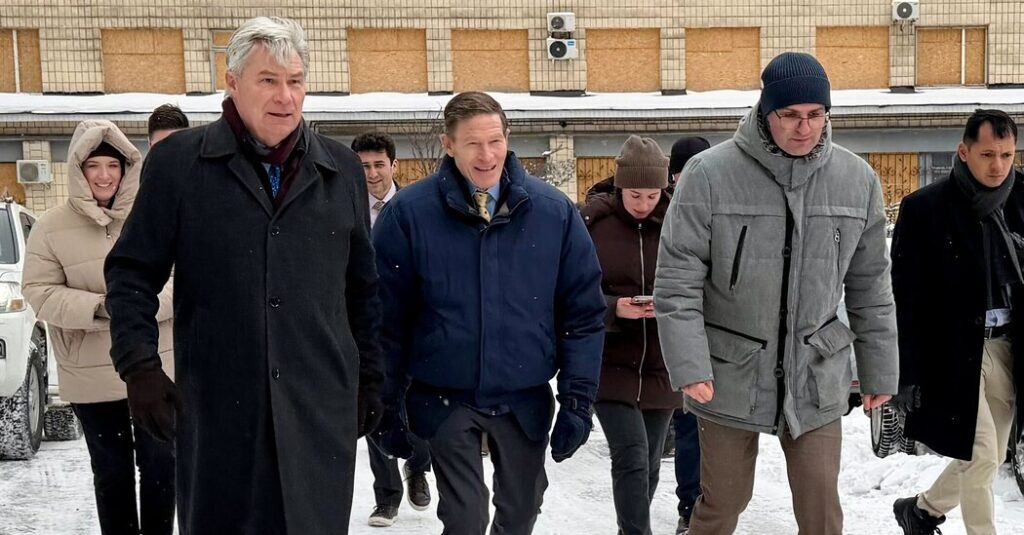
Two senior Democratic senators traveled to Kyiv on Monday to meet with the war-torn nation’s president and make the case for a long-stalled sanctions bill that could cripple Russia’s main economic engine as its war against Ukraine drags into a fifth year.
Senators Richard Blumenthal of Connecticut and Sheldon Whitehouse of Rhode Island expressed fresh confidence during their visit that the legislation, which has languished on Capitol Hill as President Trump has resisted congressional action on the matter, could finally move forward. Yet it was still not clear whether Mr. Trump would embrace the legislation, allowing it to advance in Congress.
After meeting President Volodymyr Zelensky and touring a children’s hospital and a power plant damaged under the Russian onslaught, Mr. Blumenthal said what he saw only underscored the need for harsh new economic penalties on Russia.
“There is something very tactile and immediate about the suffering and hardship of going without heat, without light, without electricity — which means without water and food,” he said in an interview. “The suffering here is palpable.”
The meetings took place as officials departed for Geneva, where trilateral talks among the United States, Ukraine and Russia to resolve the conflict are set to take place this week.
While lawmakers in Kyiv continued to press for sustained American support for Ukraine, the White House has instead concentrated its pressure on Kyiv, demanding land concessions, particularly on the eastern region known as the Donbas, and urging new elections take place quickly as the administration pushes to bring an end to the war.
Mr. Blumenthal said he was hopeful that stalled legislation he introduced nearly a year ago with Senator Lindsey Graham, Republican of South Carolina, to impose sanctions on countries that buy Russian oil, gas and uranium, would soon move ahead.
Their measure quickly drew support from 85 senators, more than enough to both pass and override a presidential veto. But it has languished because of resistance from Mr. Trump, who has signaled he wants to maintain the power to impose or cancel sanctions himself, not leave it up to Congress.
Mr. Graham has said in recent days that Senator John Thune, Republican of South Dakota and the majority leader, promised him a floor vote on the measure “as soon as we have the votes.”
Mr. Blumenthal said Mr. Thune had made the commitment to him and Mr. Graham on the Senate floor last Thursday, “which means he has a green light from President Trump.” He called Mr. Thune’s commitment “highly significant.”
Mr. Graham, who along with a larger bipartisan group of lawmakers met with Mr. Zelensky on Saturday in Munich, said in a statement that the legislation “will be a game changer. President Trump has embraced it. It is time to vote.”
The White House did not immediately respond to a request for comment on its position on the bill.
First introduced last April, the legislation would impose penalties of up to 500 percent on nations buying Russian energy products.
Since the last time Mr. Blumenthal traveled to Ukraine, Mr. Trump imposed his first round of sanctions of his second term on Russia, which was seen at the time as a signal of his heightened frustration with President Vladimir V. Putin.
The administration announced in October that they would apply to Russia’s two largest oil companies, Rosneft and Lukoil.
But as fall gave way to one of the coldest winters Kyiv has endured since the war began, Mr. Putin has continued to order strikes on energy infrastructure and residential areas. Mr. Blumenthal argued that showed that executive action alone fell short of what could be done through his legislation.
“We want to bring a sledgehammer down on purchasers of Russian energy products and make them pay,” he said.
After enduring rolling blackouts and fearing an intense offensive in the spring, the delays have not gone unnoticed in Ukraine. During a panel discussion in Munich, Svitlana Zalishchuk, Ukraine’s ambassador to Sweden, publicly pressed Mr. Graham.
“Your bill, which I am grateful for your leadership, is not voted,” Ms. Zalishchuk said, noting that he “was talking about this bill last year” during the same conference.
Mr. Graham acknowledged the impatience. “I’m sorry it’s not fast enough,” he replied, citing divisions among Republicans in Washington.
Republican support for backing Ukraine in the war has flagged in recent years. Many G.O.P. lawmakers have argued that prolonged U.S. engagement there and the tens of billions of dollars the United States has already committed conflict with Mr. Trump’s campaign pledges of “America First.”
But Mr. Blumenthal and Mr. Whitehouse, who visited Ohmatdyt Children’s Hospital and toured the Darnytsia power plant, said they hoped the stories they brought back to Washington would sustain the will to intervene in a way that could support Ukrainians without leveraging taxpayer dollars.
During the stop at the hospital, the pair met with three young men who were among the thousands of Ukrainian children forcibly separated from their families by the Russians in what Ukraine and human rights advocates have condemned as war crimes. The senators listened as the men, who were returned to Ukraine by SAVE Ukraine, an organization that returns children taken by Russians, recounted stories of separation, indoctrination and escape.
“You should be proud of your country, you should be proud to be Ukrainian, because you are fighting for freedom,” Mr. Blumenthal told them, holding back tears. “You are heroes.”
For Mr. Whitehouse, who has made multiple visits to Ukraine before and after the invasion, the scenes reinforced the stakes of a conflict that has increasingly settled into a grinding war of attrition.
“Some of the kidnapped children who have been brought back to freedom here and are a live testament to that particular brutality,” he said after the meeting. He said the same brutality was on display in the wreckage of the strikes at the Darnytsia power plant. “We owe the Ukrainians what they need to win,” he said.
Luke Broadwater contributed reporting from West Palm Beach, Fla.
Robert Jimison covers Congress for The Times, with a focus on defense issues and foreign policy.
The post Senators Meet Zelensky With Hopeful Message on Sanctions appeared first on New York Times.