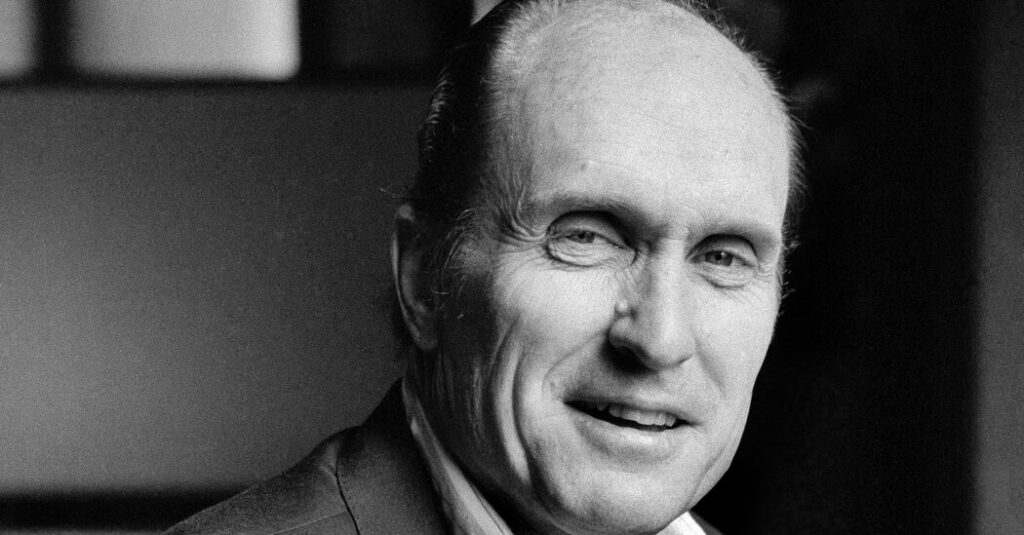
Robert Duvall, who drew from a seemingly bottomless reservoir of acting craftsmanship to transform himself into a business-focused Mafia lawyer, a faded country singer, a cynical police detective, a bullying Marine pilot, a surfing-obsessed Vietnam commander, a mysterious Southern recluse and scores of other film, stage and television characters, died on Sunday. He was 95.
His death was announced in a statement by his wife, Luciana Duvall, who said he had died at home. She gave no other details. Various news outlets have reported that he lived in Fauquier County, Va., in horse country west of Washington.
Mr. Duvall’s singular trait was to immerse himself in roles so deeply that he seemed to almost disappear into them — an ability that was “uncanny, even creepy the first time” it was witnessed, said Bruce Beresford, the Australian who directed him in the 1983 film “Tender Mercies.”
In that film, Mr. Duvall played Mac Sledge, a boozy, washed-up country star who comes to terms with life through marriage to a widow with a young son. The performance earned him an Academy Award for best actor, his sole Oscar in a career that brought him six other nominations in both leading and supporting roles.
“He is the character,” Mr. Beresford said of Sledge. “He’s not Duvall at all.”
Mr. Duvall, though, wasn’t buying it. “What do you mean?” he said in an interview with The New York Times in 1989. “I don’t become the character! It’s still me — doing myself, altered.”
Audiences and reviewers remained unconvinced. For them, Mr. Duvall, with a voice far from silky and features falling more than a few degrees short of movie-star handsome, effectively became someone entirely new, time and again.
Across a film career that took flight in the early 1960s, he stood out for an intense studiousness that shaped his every role. Even as a boy, in a Navy family that moved around the country, he had an ear for people’s speech patterns and an eye for their mannerisms. “I hang around a guy’s memories,” he once said. Insights that he gleaned were routinely tucked away in his head for potential future use.
To prepare for the role of Mac Sledge, he sang with a country band and drove around East Texas with a friend, who finally had to ask what they were up to. “We’re looking for accents,” Mr. Duvall said.
On similar hunts, he hung out with assorted, and sordid, types. He befriended hoodlums in East Harlem while preparing for a role that would help make him a star: that of Tom Hagen, the sensible consigliere to the Corleone crime family in Francis Ford Coppola’s first two “Godfather” movies in the early 1970s.
He palled with police detectives before playing a hard-bitten investigator in “True Confessions” (1981). To prepare for one of his signature stage roles — as the hustler Teach in the original 1977 Broadway production of David Mamet’s “American Buffalo” — he spent time with an ex-convict, taking from him the idea of carrying his gun over his genitals.
He did similar immersions for other notable roles, whether as Lt. Col. Bull Meechum, the frustrated warrior without a war (except within his own family) in “The Great Santini” (1979); or Frank Hackett, the aptly named hatchet-man executive in “Network” (1976), Paddy Chayefsky’s scalding take on television news; or Lt. Col. Bill Kilgore, who loved “the smell of napalm in the morning” in Mr. Coppola’s “Apocalypse Now” (1979). For years, Mr. Duvall told interviewers, people would routinely come up to him and recite that line, as if it were some little secret known only to him and them.
‘The American Olivier’
His chameleonlike skill invited comparisons to the incomparable Laurence Olivier; indeed, in 1980, Vincent Canby of The Times flat-out called him “the American Olivier.” A similar sentiment was expressed earlier by Herbert Ross, who directed “The Seven-Per-Cent Solution” (1976), in which Mr. Duvall, barely recognizable yet again, played Dr. John Watson to Nicol Williamson’s Sherlock Holmes. (Olivier himself played Holmes’s archnemesis Prof. James Moriarty in the movie.)
Only Mr. Duvall and George C. Scott, Mr. Ross said at the time, “have the range and variety of Laurence Olivier.”
That Mr. Duvall could become practically whomever he chose was foreshadowed in his first film, “To Kill a Mockingbird,” a 1962 classic based on Harper Lee’s novel about racial prejudice in a Southern town. He played Boo Radley, the reclusive, hollow-eyed neighbor who fascinates and ultimately rescues the two small children of the defense lawyer Atticus Finch (Gregory Peck).
As Mr. Duvall’s career flourished in the 1970s and ’80s, it surprised many of his fans, on looking back, to discover him in that film. One person apparently not surprised was Harper Lee. When Mr. Duvall landed the part, she sent him a congratulatory telegram. “Hey, Boo,” she wrote. It was, he said later, his only contact with her.
Mr. Duvall had his own favorite role, and it was none of his major big-screen characters. He repeatedly told interviewers that his heart was fully with Augustus McCrae, an old Texas Ranger on a cattle drive in “Lonesome Dove,” a 1989 CBS television mini-series based on a Larry McMurtry novel.
“Let the English play Hamlet and King Lear,” Mr. Duvall said, “and I will play Augustus McCrae, a great character in literature.”
He was nominated for an Emmy Award for that performance. But he waited nearly two decades for an Emmy win, for a role with echoes of Gus McCrae: the worn-out cowboy Prentice Ritter in “Broken Trail” (2006), a two-part AMC movie. (As an executive producer on the show, he also won an Emmy for outstanding mini-series.)
Mr. Duvall tried his hand at film directing a few times, usually putting up the money for projects that intrigued him. There was “We’re Not the Jet Set” (1977), a documentary about a Nebraska rodeo family. A chance encounter with a boy on the street led to “Angelo My Love” (1983), a film about Gypsy life in New York City.
No project under his direction contained more of his soul than “The Apostle” (1997), which he also wrote, financed and starred in. He played Sonny Dewey, a wayward Pentecostal preacher in search of redemption, and received another Oscar nomination.
Mr. Duvall was generally wary of directors, and some of them found him difficult to work with. He fought bitterly on the set with Henry Hathaway, who directed him, alongside John Wayne, in the original “True Grit” (1969).
“I don’t try to be a hard guy to work with,” Mr. Duvall said in a 1981 interview with American Film magazine. “But I decide what I’m going to do with a character. I will take direction, but only if it kind of supplements what I want to do. If I have instincts that I feel are right, I don’t want anybody to tamper with them. I don’t like tamperers, and I don’t like hoverers.”
Not all directors irritated him. He liked working with Ulu Grosbard, who guided him in “True Confessions,” as well as onstage in an early Duvall triumph, as the tormented longshoreman Eddie Carbone in a 1965 Off Broadway production of Arthur Miller’s “A View From the Bridge,” and later in Mr. Mamet’s “American Buffalo.” (Once his film career kicked into high gear, Mr. Duvall did not return often to the theater, but he described his occasional stage work as “an investment in the long run — it makes you a better actor.”)
And then there was Mr. Coppola, who as much as anyone put Mr. Duvall on the Hollywood map. “Coppola made them so beautifully,” the actor said of the first two “Godfather” films. His admiration did not stretch far enough, however, to impel him to recreate the role of Tom Hagen for “The Godfather: Part III” (1990) — a pale sequel, most reviewers agreed.
“It boiled down to money,” he told Esquire magazine in 2010. “If you’re gonna pay Pacino twice what you pay me, fine. But five times? Come on, guys.”
Early TV Roles
Robert Selden Duvall was born on Jan. 5, 1931, in San Diego, the second of three sons of William Duvall, a rear admiral, and Mildred (Hart) Duvall, an amateur actress said to have been a relative of Robert E. Lee, the Confederate general.
The father’s naval career meant that the family moved around a lot. Robert found his way into acting while at Principia College, a small liberal arts school in southwestern Illinois — a career choice shaped in large measure, he once said, by a realization that he was “terrible” at everything else.
After two years in the Army, serving principally at what is now Fort Gordon in Georgia, he went to New York in 1955, where he studied under Sanford Meisner at the Neighborhood Playhouse. Two of his closest friends, Dustin Hoffman and Gene Hackman, were fellow acting students. To support himself, Mr. Duvall worked for a while in a post office branch. But soon enough, television roles fell his way, on shows like “Playhouse 90,” “Naked City” and “Alfred Hitchcock Presents.” Then came the invitation to play Boo Radley.
Throughout his career, Mr. Duvall tried to keep Hollywood at arm’s length. He preferred living elsewhere — for many years on a ranch in Northern Virginia with his fourth wife, the former Luciana Pedraza, an Argentine woman 41 years his junior. They met in the 1990s in Buenos Aires, which he visited often after developing a passion for the tango.
Complete information about his survivors was not immediately available.
He was a Hollywood outlier on another front: politics. He was an ardent conservative, strongly supporting Republican presidential candidates, in a film world dominated by political liberals. In 2005, President George W. Bush awarded him a National Medal of Arts. Mr. Duvall, however, was not conspicuously a supporter of President Trump.
As the years passed, major roles fell Mr. Duvall’s way less frequently. Or perhaps he sought them less. All the same, he still commanded meaty parts, which he imbued with characteristic intelligence, whether as an engagingly irascible editor in “The Paper” (1994), or a sensitive small-town doctor in “Phenomenon” (1996), or a retired astronaut brought back to duty to rescue a world threatened by a giant comet in “Deep Impact” (1998), or a diligent lawyer in “A Civil Action” (1998), or an understanding bartender ministering to a boozing country singer in “Crazy Heart” (2009). One of his last major roles, in 2014, was in “The Judge,” in which he played an aging jurist in a small town who is accused of murder.
From early on, Mr. Duvall enjoyed the life of a supporting actor. “Somebody once said that the best life in the world is the life of a second leading man,” Mr. Duvall told The Times. “You travel, you get a per diem, and you’ve probably got a better part anyway. And you don’t have the weight of the entire movie on your shoulders.”
The post Robert Duvall, Chameleonlike Actor of Film, Stage and TV, Dies at 95 appeared first on New York Times.