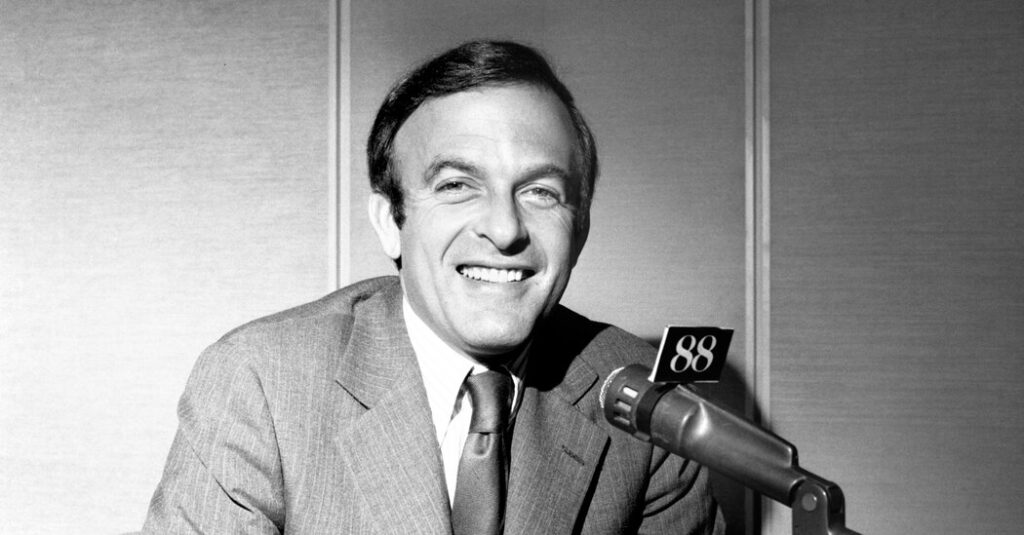
Richard L. Ottinger, a New York Democrat who represented largely Republican Westchester County districts in Congress for 16 years and who championed the environment by fighting to clean up the Hudson River, keep gas guzzlers off the roads and stop nuclear plants from being built, died on Monday at his home in Mamaroneck, N.Y. He was 97.
His son Larry confirmed the death.
Descended from a wealthy Republican family — one of his uncles narrowly lost to Franklin D. Roosevelt in the 1928 New York governor’s race — Mr. Ottinger switched to the Democratic Party while a young lawyer in the 1950s. He served six years in the House of Representatives beginning in 1965 and 10 more years starting in 1975. During the four-year hiatus between those stints, he ran unsuccessfully for the U.S. Senate.
Besides sponsoring legislation to reduce pollutants in the Hudson and development along its shoreline, Mr. Ottinger joined environmental groups in bringing lawsuits on those matters. One suit, in 1983, forced the Reagan administration to unlock funds to begin removing cancer-causing polychlorinated biphenyls (PCBs) from the river.
Mr. Ottinger also opposed plans for a 10-mile expressway that would have run north from Tarrytown along the eastern bank of the Hudson, and for a Consolidated Edison hydroelectric power plant that would have been embedded in Storm King Mountain on the western side.
The long fight to halt the Storm King plant through legislation and the courts is seen as a template for modern American environmentalism.
Mr. Ottinger was a frequent critic of the federal Nuclear Regulatory Commission, questioning its ability to ensure the safety of nuclear energy plants and opposing further construction of them. During his second House stretch, he chaired a subcommittee that played a key role in nuclear energy legislation.
But he also called the nation’s heavy reliance on imported oil a “course to catastrophe” and introduced or backed legislation aimed at reducing such imports. He favored lowering gasoline use through rationing, and he urged a subsidy for the motorist “who buys an American-made car that gets 10 miles per gallon more than the gas guzzler he turns in.” He was also a leading congressional advocate of developing solar energy.
Mr. Ottinger fit snugly into the liberal wing of the Democratic Party, in an era when both parties included officeholders across the ideological spectrum. Former President Gerald R. Ford in 1982 called him a “big spender and irresponsible” fiscally. The League of Conservation Voters, on the other hand, named him one of seven House members in 1977 with a perfect voting record.
Early in his freshman term, Mr. Ottinger voted against funding the House Un-American Activities Committee, a vestige of the McCarthy era. And he assailed Democratic and Republican administrations over their support for the Vietnam War. In his first speech on the House floor, in 1965, he called it “the wrong war in the wrong place for the wrong cause.”
Mr. Ottinger liked to recall a time that President Lyndon B. Johnson tugged him up by his shirt collar in the Oval Office and told him to stick to conservation and leave the war to the president.
Mr. Ottinger, who was elected in 1964 on Mr. Johnson’s coattails, dialed down his criticism and voted with the administration on most war measures. However, by the late 1960s, when Johnson was out of office and opposition to the war had grown even in Republican-dominated Westchester, Mr. Ottinger renewed his outspoken opposition. In 1969, he introduced the Vietnam Disengagement Act.
Vietnam was a major issue in the 1970 Senate race, in which Mr. Ottinger ran against James L. Buckley, of the Conservative Party, and the Republican incumbent, Charles E. Goodell, who had been appointed to the seat by Gov. Nelson A. Rockefeller after the assassination of Robert F. Kennedy in 1968.
Mr. Buckley lumped together Mr. Ottinger and Mr. Goodell, who also opposed the Vietnam War, as “white flag” candidates. With Mr. Ottinger and Mr. Goodell splitting liberal voters, Mr. Buckley was narrowly elected with 39 percent of the ballots.
Richard Lawrence Ottinger was born in Manhattan on Jan. 27, 1929, the younger of two children of Louise (Loewenstein) and Lawrence Ottinger. His father, the son of a German immigrant, founded the United States Plywood Corporation and vigorously opposed Roosevelt’s New Deal. His uncle Albert Ottinger gave Roosevelt his close gubernatorial race, and the family long blamed chicanery by the Democratic machine in New York City for the loss.
Mr. Ottinger took exception, at least in part. “Roosevelt was unquestionably one of our great presidents,” he once said. “If the election had been counted fairly, it would have changed the course of history, and probably not for the better, my good uncle notwithstanding.”
He was laconic and seemingly uncomfortable in interviews. “When Ottinger does speak,” The New York Times noted in a profile in 1970, “his words are halting and produced reluctantly, in a low-keyed monotone, often around the stem of his pipe or the tip of a cigarette, forcing the questioner to lean forward and plead for more volume.”
Raised in Scarsdale, N.Y., Dick, as he was known, attended the Loomis School in Windsor, Conn., then Cornell, earning a bachelor’s degree in 1950. He graduated from Harvard Law School in 1953, and during the next decade served in the Air Force, practiced law and worked for the newly established Peace Corps as program director for several South American countries.
He met his first wife, Betty Ann Schneider, when his family was vacationing at the Sun Valley Lodge in Idaho and she was waiting tables and performing in the water ballet.
The couple bought a colonial house on 28 acres in Mount Pleasant, N.Y., in Westchester County, where in 1957 and 1959, Mr. Ottinger ran unsuccessfully as a Democrat for town supervisor. He had become a Democrat in part because of his disillusionment with the Eisenhower administration.
In his first run for Congress, in 1964, he made pollution of the Hudson, which bordered the district, his major issue, well before the environment was a demonstrated vote-getter. He defeated a three-term Republican incumbent, Robert Barry, in a race in which the wealthy Ottinger family’s spending weighed heavily. He created 25 campaign committees that each took in $3,000 donations from his mother and his sister, Patricia L. Heath, exploiting a loophole in campaign finance law.
Over the years, opponents contended that prolific spending on his campaigns was a major reason for his victories. His supporters held that his high profile and devotion to quality-of-life issues that resonated with many Republican constituents better explained his success in overcoming political demographics.
After the 1970 Senate loss, he was re-elected to the House in 1974, and then won re-election four times. He cemented his environmental leadership by cofounding the bipartisan Environmental Study Conference in Congress, which in 1977 toughened the country’s chief air and water pollution laws.
By 1984, Mr. Ottinger was seen as virtually unbeatable in his district, but at 55, he chose not to seek re-election. He said he was disgusted with his own party’s weak opposition to Reagan policies, especially tax cuts, calling it feckless.
“The institution is quite reactionary, the leadership is very timid and cautious,” he told The Times, explaining his retirement from the House. He also cited his inability to win a leadership role in the party.
On leaving Congress in 1985, Mr. Ottinger joined the faculty of Pace University’s law school, in White Plains, N.Y., as an environmental law professor. He founded the Pace Energy and Climate Center, which advocates for renewable power. He served as law school dean from 1994 to 1999.
Mr. Ottinger’s first marriages — to Ms. Schneider, for 25 years, and Sharon Frink — ended in divorce. In 1987, he married June Godfrey, who survives him. In addition to her and his son Larry, he is survived by three other children from his first marriage, Ronald, Randall and Jenny Louise Ottinger; 10 grandchildren; three great-grandchildren; and a niece, Karen Heath.
In 2007, Mr. Ottinger, who remained active in environmental causes after retirement, put his money where his mouth was by becoming one of the first homeowners in Mamaroneck to install geothermal heating and cooling, at a cost of $30,000.
“It started to pay for itself immediately by cutting my utility bill in half,” he said.
Trip Gabriel is a Times reporter on the Obituaries desk.
The post Richard Ottinger, 97, Dies; Fought for the Environment in Congress appeared first on New York Times.