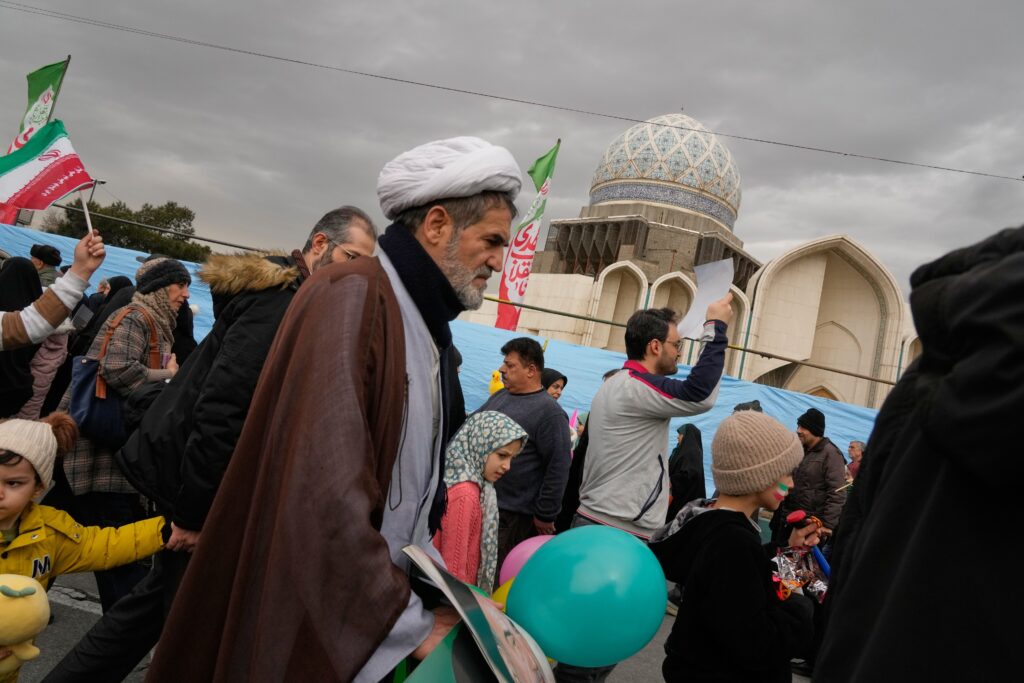
As Iran heads into a second round of nuclear talks with the United States in Geneva on Tuesday, under the threat of U.S. forces building up in the region, Tehran is attempting to project strength and unity. But seething popular anger has not abated in the weeks following a government crackdown that killed thousands of protesters, according to accounts from inside the country.
Following the partial rollback of a government-imposed communications blackout that closed off Iran during the protests and crackdown last month, more information has begun to circulate. Iranians described to The Washington Post a society deeply traumatized, with many people saying they only recently learned the full extent of the violence, as security forces continue to carry out waves of arrests.
But some analysts say Iran’s unprecedented weakness at home could diminish the flexibility of its country’s leadership to make the kinds of compromises necessary for a deal.
Iran remains a nation in shock. The government crackdown left more than 7,000 people dead, more than 6,500 of them protesters, according to the Human Rights Activists News Agency, a U.S.-based advocacy organization for rights in Iran. The figure is expected to climb. Thousands are missing and families are still in mourning. A campaign of arrests continues, some businesses have reopened and schools are back in session, but many parents report keeping their children at home.
“Some of us don’t work because we are still grieving, but some of us cannot work because there are no reliable prices,” said a Tehran shopkeeper, 40. Inflation has skyrocketed since the crackdown, and with the added threat of U.S. strikes, no one wants to spend any money, he said. He has been increasing the prices of goods in his shop almost daily. Like others in Iran interviewed for this article, he spoke on the condition of anonymity for fear of retaliation.
Iranian authorities have arrested tens of thousands of people since last month, according to activists and human rights groups. The campaign has expanded to include prominent political leaders: Azar Mansouri, head of the Reform Front of Iran, was arrested last week and released on bail days later. In some areas, security forces screen people on streets and in businesses for evidence they supported the protests.
A 45-year old woman from Rasht, near Iran’s Caspian Sea coast, said security forces showed up at her niece’s school and strip-searched students for wounds sustained at protests from the less-lethal pellet ammunition fired into crowds.
“Two girls fainted from the stress,” she said. Her niece hasn’t been back to the private school since, which the principal has allowed. But at some public schools, the woman from Rasht said, absences aren’t tolerated and students found with pellet wounds are expelled or arrested.
In other parts of the country, popular anger is bubbling to the surface.
Chants of “Death to Khamenei,” Iran’s supreme leader, can be heard at some funerals for those killed during the protests, according to recent videos shared with The Post. Similar calls rang out in Tehran, “Murderous Khamenei, see it in your dreams,” people yelled from their apartment windows last week, using a dismissive Farsi expression now associated with the January protests.
While the crackdown occurred weeks ago, many Iranians say they are only now coming to terms with its scale. A woman from Bandar Abbas, on the Persian Gulf, who says she participated in the protests, said she saw security forces open fire into the crowds.
“The bullets wouldn’t pause for a second,” she said. As she was running away, someone running beside her was shot and fell to the ground. But even after what she saw, she wasn’t prepared for what she learned of the scale of the killings once internet connectivity was partially restored.
“Seeing the mass killing all over the country felt like waking up from a deep sleep with a slap on my face. I am so ashamed to be alive,” she said. “I am also full of rage.”
Before January she would not have understood why someone would want their own country to be attacked, she said, as the threat of U.S. strikes loomed. “But this time it is different,” she said, espousing a view long unpopular in Iran: “The real enemy is the Islamic Republic and any country or army that can weaken or attack them is going to liberate us.”
When Iranian officials do address the January protests, they blame the violence on “terrorist” groups linked to outside countries. Iran’s President Masoud Pezeshkian spoke last week to families of people killed.
“We are embarrassed because of what has happened in the country,” he said in an even tone to men and women dressed in black sitting in sterile meeting room. Pezeshkian pledged to help those who lost loved ones. “As someone who has a responsibility to this country, sometimes I cannot even sleep thinking about” what happened, he said.
Iran used overwhelming force against the protesters to clear people out of the streets, but to also buy the government time by preventing any future waves of unrest, said Alex Vatanka, a senior fellow at the Middle East Institute, a Washington think tank.
“They didn’t mind the optics. In fact, they wanted to show how ruthless they were,” he said. “Right now they want society to be scared. They don’t care about the reputational cost. It’s about survival.”
That could complicate negotiations with the U.S. over Iran’s nuclear program.
Public comments by Iranian and U.S. officials in recent days have ranged from optimism that a deal could be reached to threats of military action. Late last week, President Donald Trump said he was sending a second aircraft carrier group to the Middle East and said that regime change was “the best thing that could happen” in Iran. If Tehran wanted to avoid an attack, it should “give us a deal that they should have given us the first time,” he said, referring to talks last summer that ended when the U.S. and Israel launched air attacks on Iran’s nuclear sites.
But Secretary of State Marco Rubio told reporters during a visit Sunday to Slovakia: “The president’s made clear he prefers diplomacy and an outcome of a negotiated settlement.” He said U.S. negotiators Steve Witkoff and Jared Kushner were headed for “important meetings and we’ll see how that turns out.”
Iran’s deputy foreign minister, Majid Takht Ravanchi, told the BBC in a Sunday interview that the ball was “in America’s court to prove that they want to do a deal,” adding that “if they are sincere, I’m sure we will be on the road to an agreement.”
Takht Ravanchi said an Iranian offer to dilute its highly enriched uranium was proof of its willingness to compromise, and he did not rule out an agreement to ship its stockpile out of the country, saying it was “too early to say what will happen in the course of negotiations.”
Robert Malley, a former U.S. official who negotiated with Iran on the nuclear issue under President Joe Biden, said the talks are less likely to succeed if the Trump administration asks for concessions like curbs to Iran’s ballistic missile program or the end of support for armed groups in the region — a widening of scope Tehran has long rejected.
Those are “concessions Tehran’s weakened regime will not make — especially because it is weakened and thus can’t afford to give up the few remaining tools at its disposal,” he said. While Iran’s proxy network is significantly diminished after the war in Gaza, Israel’s blows against Hezbollah in Lebanon and the end of Bashar al-Assad’s rule in Syria, Iran’s missile program remains its only form of deterrence, he said.
Karen DeYoung contributed to this report.
The post Popular anger burns in Iran after crackdown, as Trump turns up pressure appeared first on Washington Post.