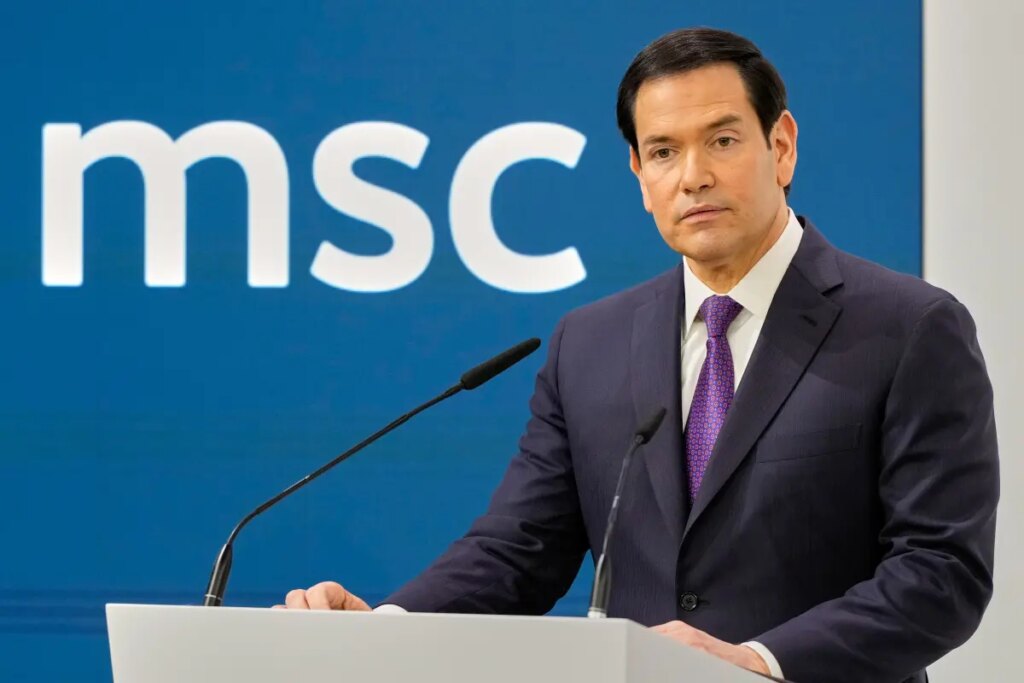

Secretary of State Marco Rubiogave a truly terrific Valentine’s Day address at the Munich Security Conference, laying out the deep ties entwining the United States with Europe — while firmly laying down America’s worries about how the Old World is abandoning our shared heritage.
Above all, he aimed to rally our allies to return to their senses.
He won huge applause with this reassurance: “In a time of headlines heralding the end of the trans-Atlantic era, let it be known and clear to all that this is neither our goal nor our wish — because for us Americans, our home may be in the Western Hemisphere, but we will always be a child of Europe.”
Crucially, he traced the divisions within the alliance to the “dangerous delusion” that with the fall of Soviet Communism “every nation would now be a liberal democracy; that the ties formed by trade and by commerce alone would now replace nationhood,” that some “global order” could “replace the national interest” in “a world without borders where everyone became a citizen of the world.”
Those fantasies have now produced a West challenged to even defend itself, let alone preserve “the cohesion of our societies, the continuity of our culture, and the future of our people.”
The United States remains loyal to our common heritage; under President Donald Trump, “America will once again take on the task of renewal and restoration, driven by a vision of a future as proud, as sovereign, and as vital as our civilization’s past.”
America will, “if necessary, to do this alone,” but hopes “to do this together with you, our friends here in Europe.”
He challenged the allies to wake up and join in defending “a great civilization that has every reason to be proud of its history, confident of its future, and aims to always be the master of its own economic and political destiny.”
Emphasizing our connections “not just economically, not just militarily,” but “spiritually” and “culturally,” he insisted: “We want Europe to be strong.”
Then he listed off all the ways the West has instead chosen decline, from deindustrialization — a “voluntary transformation of our economy that left us dependent on others for our needs and dangerously vulnerable to crisis” — to allowing mass migrations that are “transforming and destabilizing societies all across the West.”
Our allies can still choose otherwise: “What has ailed our societies is not just a set of bad policies but a malaise of hopelessness and complacency.”
Let us choose to be an alliance “that boldly races into the future,” knowing “the only fear we have is the fear of the shame of not leaving our nations prouder, stronger, and wealthier for our children.”
We can build a grand future, “advancing our mutual interests and new frontiers, unshackling our ingenuity, our creativity, and the dynamic spirit to build a new Western century.”
In a speech that celebrated the glories of Western civilization and the tremendous victories of the trans-Atlantic alliance, he finished by looking forward: “We should be proud of what we achieved together in the last century, but now we must confront and embrace the opportunities of a new one — because yesterday is over, the future is inevitable, and our destiny together awaits.”
He didn’t drop the mic, but he should’ve: Rubio took every gripe our allies have with Team Trump — and indeed with the US role in world affairs for the last half-century — and flipped the script to show how what Western elites imagine to be progress is actually a suicidal rejection of our civilization’s great strengths.
No single speech can heal divisions that grew up over decades, but Rubio delivered a devastating rebuttal to the complacent European conceit that America is the one rejecting the fundamentals of our alliance.
His remarks visibly scored with an audience that had earlier applauded Gov. Gavin Newsom and Rep. Alexandria Ocasio-Cortez for using the Munich stage to criticize the United States.
Rubio’s vision, that is, is not just principled, but persuasive; we pray it proves persuasive enough.
The post Marco Rubio reminds Europe — and the world — what the Western Alliance is all about appeared first on New York Post.