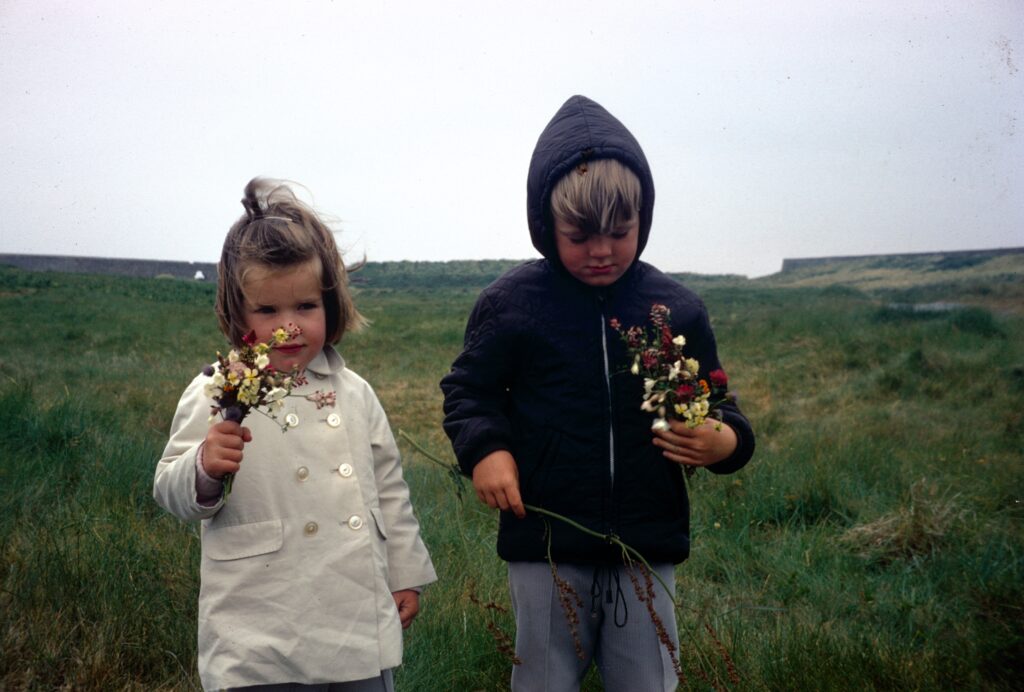
Mark Haddon, the best-selling author of “The Curious Incident of the Dog in the Night-Time,” was an anxious and depressed child. He was afraid of sharks and airplanes, getting sucked into escalators and pinned down in swimming pools. Once, on a boat ride with his parents, he writes, “I spent the entire journey crying with a towel over my head.”
His anxieties, he claims in “Leaving Home: A Memoir in Full Colour,” were unremarkable. “I knew many people who could say the same.”
But the deeper the reader gets into this unusual and gripping book, the more remarkable Haddon — anxieties, insights and all — seems. In 87 sections that move back and forth through time, he writes of a cold, loveless and possibly abusive childhood he was eventually able to leave behind. Despite it all, though, it’s clear through his writing, teaching and work with people with disabilities that Haddon never lost his compassion and humanity.
The sensitive and imaginative child grew up to be a sensitive and imaginative man, one who suffered two nervous breakdowns, deliberately cut himself (at least once so severely he required stitches) and found release in long-distance running — particularly through trees. “I don’t think I’ve ever been sad running through woods,” he writes. “It’s something bone-deep and the fact that I can’t explain it is an essential part of the experience.”
“Leaving Home” is a mosaic of memories, stories and observations, written out of chronological order, because, he says, that’s the way memory works — or, at least, it’s the way his memory works, “as if I were leafing through a damaged photo album, individual snapshots separated by gaps where many other pictures have fallen out.”
Understatement is key; many times, Haddon makes a brief, sideways mention of some kind of trauma, including sexual abuse, but seldom fills in the blanks. (At one point, he and his sister, Fiona, play “Sex Abuser Bingo,” trying to determine how many of their parents’ friends belong on the list.)
But in this book, chronology and detail aren’t necessary. It’s written sometimes in past tense, sometimes in present tense; characters appear with no introduction, and events are dropped in with little explanation, yet the reader is never confused. We follow the jumbled order of his mind, and it all makes perfect sense.
“We are narrative-making creatures,” Haddon writes. “As writers we don’t need to make those connections. We can simply lay one thing beside another and let readers do the rest.”
The deeper into the book the reader gets, the deeper into Haddon’s mind the book goes, moving from anecdotes to contemplation about books, films, history, his own writing, philosophy, happiness and the powerful concept of “home.”
Despite the darkness underpinning the book — his pregnant wife’s near-fatal bicycle accident, Haddon’s own breakdowns, his battle with long covid, his father’s Alzheimer’s, his mother’s cold cruelty, his sister’s recurring nightmares — he rescues the reader from bleakness time and again with his wry, subtle humor. It might feel odd to laugh out loud at such a melancholy book but laugh we must — and Haddon is very funny.
Whenever he and Fiona visited his grandmother, for instance, she gave them each a bottle of Babycham, an alcoholic drink definitely not intended for babies, “and I’m still unsure whether this was ignorance or sedation.”
His mother, he notes, “couldn’t abide men with beards, or the Welsh,” and while those were not the worst of her inclinations, the humor and specificity might make them her most memorable.
When Haddon came home from college with a pierced ear, she treated him coldly until he asked why. “That thing in your ear,” she said. “Only inadequate men have earrings.”
She was particularly cruel to Fiona, and her dying words to her only daughter were, “I’ve never believed a word you’ve said.”
In addition to “Curious Incident,” which won multiple awards and was longlisted for the Booker Prize, Haddon is the author of several novels and story collections for adults, a collection of poetry and a play. He is also a prolific writer and illustrator of books for children, and in this memoir his “full colour” illustrations are on almost every page — photographs, drawings, old maps and prints and artifacts. They depict not only the people he writes about, but his state of mind.
Early in “Leaving Home,” he shares advice he gives his writing students. “Sometimes I think a writer’s job is simply to create the gaps that readers are hungry to fill,” he says.
This memoir satisfies that hunger.
Laurie Hertzel is the author of “Ghosts of Fourth Street,” a memoir to be published in March by the University of Minnesota Press. She teaches at the University of Georgia in Athens and lives in Minnesota.
Leaving Home
A Memoir in Full Colour
By Mark Haddon
Doubleday. 320 pp. $35
The post ‘Leaving Home’ turns a troubled childhood into a gripping memoir appeared first on Washington Post.