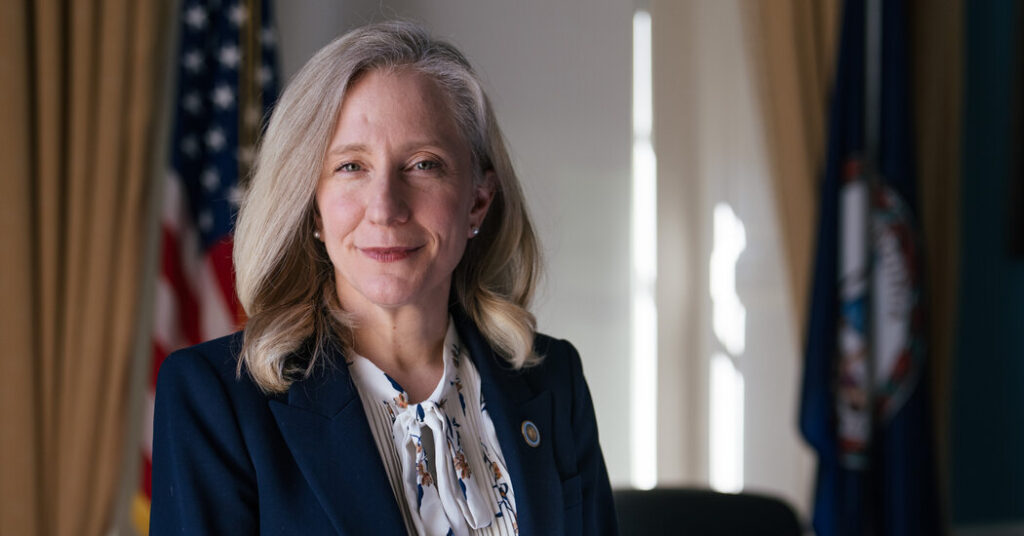
Abigail Spanberger ran for governor of Virginia on her record as one of the most bipartisan members of the House and as a mother of three who worked undercover for the C.I.A. It was the disciplined campaign of a centrist Democrat in a purple state. Even her supporters called it boring.
Things have picked up.
In her first weeks as governor, Ms. Spanberger ended all cooperation agreements between Virginia’s state law enforcement agencies and U.S. Immigration and Customs Enforcement. She signed a bill for an April vote on whether to redraw Virginia’s political map ahead of the fall midterms, potentially giving Democrats an edge in 10 of the state’s 11 congressional districts compared with their 6-to-5 margin now.
Before taking office, Ms. Spanberger demanded and got the resignations of five University of Virginia board members, who all participated in a Trump White House push that removed James E. Ryan as the university’s president, largely because of his diversity efforts.
The right wing is on fire. Suddenly, to partisan critics eager to take down a Democrat whose political future is already discussed in terms of national office, she is a witch, a “Bond villain” and dangerous.
Ms. Spanberger is “moving at high speed to permanently radicalize and change the state,” the Fox News right-wing firebrand, Mark R. Levin, said on X. “She campaigned as a moderate and lied through her teeth.”
The Lepanto Institute, a conservative Catholic organization, posted on X a doctored photo of Ms. Spanberger as the White Witch from the “Chronicles of Narnia” — transforming the white outfit she had worn to honor the suffrage movement at her swearing-in — and said, “A long winter without Christmas has come to Virginia.”
“White liberal women are the most dangerous people in our society,” the far-right activist Laura Loomer posted on X, along with a video clip of Ms. Spanberger signing an executive order on ICE. Harmeet K. Dhillon, the assistant attorney general overseeing the Justice Department’s Civil Rights Division, commented on the same video, calling Ms. Spanberger a “Bond villain.”
In Ms. Spanberger’s view, the furor is a sign of the threat she poses to Republicans after winning the governorship in a rout. “It’s a good narrative,” she said of the attacks. She spoke in an interview in her office in the State Capitol, where portraits of some of the state’s previous 74 governors, all men, hang outside her top floor suite. “There’s probably plenty of reasons that one might be inclined to be critical of a Democrat who swung a state 17 points.”
Ms. Spanberger, whom friends describe as blunt and tough in private, was composed, coolheaded and approachable in the interview, a demeanor that former C.I.A. colleagues say served her well in her years as a case officer recruiting and handling foreign agents who spied for the United States. The experience gave her the national security credentials that helped her rise in politics and the training, she said, to help connect with people different from herself.
“I’ve always been a person who wants to talk to anybody and everybody,” Ms. Spanberger said in an earlier interview. “At C.I.A., that was something that I further practiced, or got comfortable with.” In her political life, she said, “I have had the experience of, ‘All right, I’m going to walk into this room and I’m going to talk to somebody who doesn’t want to talk to me.’”
Ms. Spanberger’s big victory in November by 15 percentage points — Glenn Youngkin, the former Republican governor, won four years earlier by two points — was the largest margin for a Democratic candidate for governor in Virginia in more than six decades. She campaigned on lowering housing and utility and health care costs, and against President Trump’s cuts to the federal work force, which affected Virginians disproportionately.
She ran up big numbers in the blue swath of Northern Virginia, but also picked up support in the state’s rural red pockets. In a national party debating whether the future belongs to moderates or progressives like Mayor Zohran Mamdani of New York, moderates say Ms. Spanberger is the blueprint of how to run in 2026 and beyond.
“What wins in New York City wins in about three other places,” said Jim Kessler, the executive vice president for policy at Third Way, a centrist Democratic think tank. Ms. Spanberger, he said, will now have to prove herself on the yardsticks that matter in Virginia, growth in the state’s economy and jobs, and on a bigger stage.
“She’s now moved from being a regional politician to a national politician,” he said. “People will be paying attention to her.”
They already are in Richmond. “She’s the same thing as Mamdani in New York, except that Mamdani at least admits that he’s a socialist,” said Bryce E. Reeves, a Republican state senator, who said he would give Ms. Spanberger “an F for working across the aisle right now” because “none of my colleagues have seen her.”
Told of Mr. Reeves’s remarks, Ms. Spanberger reached across her desk for her cellphone and began scrolling through past messages from him. “That tone and tenor seems to differ very significantly,” she said calmly, “from his direct outreach to me at the beginning of January, and the lengthy conversation we then had.”
The state’s Republicans also denounced Ms. Spanberger’s decision to break with ICE. “Reckless,” said Delegate Terry Kilgore, the leader of the Republican minority in the Virginia House. Ms. Spanberger made clear that the chaos in Minneapolis and the shooting deaths of two U.S. citizens had influenced her.
“Sadly, the bad tactics, the bad training, the bad vetting that we have seen or witnessed or perceived in places like Minnesota, that is degrading trust in law enforcement,” she said in a recent news conference. “I want to draw a very clear line in the sand.”
Nancy Drew
No one in Ms. Spanberger’s family is surprised that she is now in the governor’s office or, for that matter, that she served in the C.I.A. From grade school, Ms. Spanberger dreamed of being a spy, in part inspired, she and her mother said, by the teenage sleuth Nancy Drew, who cracked codes and solved mysteries in the book series of the same name.
When one of her two younger sisters, Hilary Scribner, stole Ms. Spanberger’s childhood diary and asked a neighbor to tell her what it said because she couldn’t yet read, Ms. Spanberger responded by writing subsequent entries in her own secret code. She had an early ear for languages — by high school in Henrico County, Va., near Richmond, she was studying French, German, Spanish and Italian — while she served as president of the school’s chapter of the National Honor Society and co-captain of the debate team, and appeared in school plays.
“Definitely Type A,” Ms. Scribner said. “You know, big personality. Big bossy sister.”
Ms. Spanberger’s mother, Eileen Davis, a nurse and a prominent advocate in Virginia for the state’s passage of the Equal Rights Amendment, set an example. “I knew her mother before I knew her,” Don Scott, the speaker of Virginia’s House of Delegates, said. “The fruit does not fall far from the tree.”
Ms. Davis did not disagree. “When she said she was going to do something, it’s a given,” she said. “And to that point, she was not an easy kid to raise. Because she had a lot of opinions at a very young age. She understood her own agency very young. She’s a very old soul.”
Ms. Spanberger graduated from the University of Virginia in 2001, and months later the Sept. 11 attacks convinced her to seek a job at the C.I.A. She was hired in 2002, but because of a flood of post-9/11 applications, she waited years for a background check. In the interim she worked as a postal inspector, as her father had, investigating potential anthrax attacks and other crimes committed by mail.
She started at the C.I.A. in 2006, the same year she married Adam Spanberger, a computer engineer she had known since high school. The two settled in Brussels, where Ms. Spanberger worked under her real name while posing as an official at another U.S. government agency. She would not say which one, although she referred in passing to “the embassy” while describing a typical first meeting with a person who had potential information for the C.I.A.
“I would say, ‘Oh, I’m so-and-so at the embassy working on this portfolio. It’s so interesting that you previously served here.’” In reality, Ms. Spanberger said, she would have learned all about the person’s previous service and their connections to another person the agency was interested in. Her goal was to put them at ease.
“You want to convey you’re trustworthy,” she said, without irony. “You want to know who they might know.”
Did they ever wonder why she wanted to know? “Depends,” she said. “People like to talk about themselves.”
Other times, she used one of five fake passports to pose as someone else, usually in a meeting with a foreign agent who had already been recruited. “Those meetings would always be clandestine, and they knew you were C.I.A.,” she said.
To get to those meetings, she would go on what the agency calls “surveillance detection routes” — elaborate journeys that required hopping cities and switching cars and trains and taxis to make sure she wasn’t followed.
She liked the adventure, she said, but “I definitely did different things where I’m like, ‘I don’t really want my kids to grow up and pursue this line of work.’” Or, “Glad my mom doesn’t know about this.”
Marc Polymeropoulos, a former senior C.I.A. operations officer who served there at the same time as Ms. Spanberger but first got to know her as a supporter after she ran for Congress, described the job as high-wire tradecraft.
“Case officers are kind of the fighter pilots of the C.I.A.,” he said. “You operate on your own, and you learn all about how to deal with ambiguity and high-stress situations and decision making when you have a lack of situational awareness. I think all those things certainly helped her when she was in Congress.”
Ms. Spanberger, who eked out an upset victory in 2018 against the Republican incumbent Dave Brat, a Tea Party member, formed a tight bond with the group of women with national security backgrounds elected to the House that same year. Among them were Mikie Sherrill, now the governor of New Jersey, and Elissa Slotkin, now a U.S. senator from Michigan.
Capitol Hill Roommates
Ms. Spanberger and Ms. Sherrill were roommates in a house on Capitol Hill, but all the women got together regularly in Washington for drinks and dinners. “We had a very active — still do, actually — group text on Signal,” said Ms. Slotkin, a former C.I.A. analyst who served multiple tours in Iraq. “Many, many things have been discussed over the past eight years.”
Ms. Spanberger spent a lot of her time trying to push her Democratic colleagues toward the middle, and rarely successfully. After the party lost more than a dozen House seats in 2020, she let loose in an infamous conference call with her party, leaked to The Washington Post, saying that “we need to not ever use the word ‘socialist’ or ‘socialism’ ever again.”
Ms. Spanberger has long declared herself proud of her work in the House, but “it was frustrating from the day I got there,” she said. By 2024, she had announced she was running for governor. Ms. Sherrill, a former Navy helicopter pilot, followed her a year later.
“We both came to feel that in order to truly stand up for people, it was going to take the executive power found in the governor’s office,” said Ms. Sherrill, who still texts with Ms. Spanberger almost daily as both get used to working with state legislatures, picking cabinet members and handling snowstorms.
Ms. Spanberger said that one positive aspect of her new job was the authority to change things with a stroke of a pen, as she did with ICE.
“It does suit my personality,” she said.
Elisabeth Bumiller writes about the people, politics and culture of the nation’s capital, and how decisions made there affect lives across the country and the world.
The post In First Months as Governor, Abigail Spanberger Kicks Up Heat From the Right appeared first on New York Times.