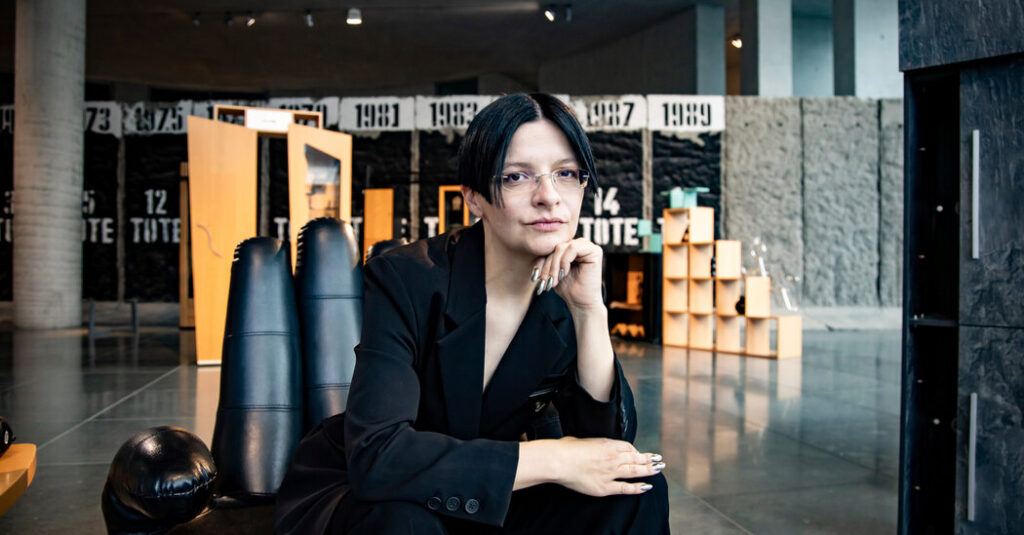
Henrike Naumann, a German artist who was set to grab the global spotlight in May when she represented Germany at this year’s Venice Biennale, died on Saturday in Berlin — less than three months before the prestigious art event is scheduled to open. She was 41.
Clemens Villinger, Naumann’s partner, said in a statement on Monday that the artist had died “after a cancer diagnosis that came far too late.” Naumann was working “until the very end” on a “heartfelt project” for Venice, Villinger added.
The Venice Biennale, which held its first edition in 1895, is widely considered the art world’s most important event. Naumann’s death is the second tragedy to hit this year’s edition, which will run from May 9 through Nov. 22.
Last May, Koyo Kouoh, who was slated to become the first African woman to curate the Biennale’s main exhibition, also died suddenly of cancer. After her death, the biennale announced that Kouoh’s assistants would finish her exhibition, called “In Minor Keys.” The biennale is scheduled to unveil a full list of artists featured in that show on Feb. 25.
The event’s organizers did not immediately respond to a request for comment.
The Biennale includes a major central exhibition featuring hundreds of artists, curated by a single figure, as well as individual shows presented by participating nations. Little was publicly known about Naumann’s plans for her presentation in the German pavilion, which she was sharing with Sung Tieu, a Vietnamese German artist.
Naumann was born in East Germany in 1984, a few years before the fall of the Berlin Wall. Her art often reflected on the rapid changes in German society that followed reunification, and she is best known for installations featuring furniture and household items from the era.
In 2022, she staged “Re-Education” at SculptureCenter in New York, an exhibition that included a room filled with fur rugs and a bone telephone — the sort of kitsch furniture that East Germans bought after the collapse of Communism. Naumann told The New York Times’s T Magazine in 2023 that as a child she hadn’t understood there was political change underlying the change in interior styles, “but I saw there was this aesthetic shift.”
Naumann’s other exhibitions included the 2012 “Triangular Stories,” in which she imagined the childhood bedrooms of real neo-Nazi terrorists. In the 2019 “Ostalgie” — borrowing a popular term that combines the German words for East and nostalgia — she installed furniture and carpets on the walls of a gallery, with pictures and wallpaper stuck to the floor, as if the room were rotated 90 degrees. Naumann told T Magazine that the show “was a spatial reflection of what it feels like when the system changes, or when a state ends.”
On Monday, German newspapers stressed Naumann’s importance to the country’s art scene. Peter Richter, writing in Süddeutsche Zeitung, said that Naumann had “gone down in recent German art history as the artist who took furniture most seriously as a medium of ideology, social history and politics.” Tobias Timm, writing in Die Zeit, said that Naumann had influenced the German art world “more than almost anyone else of her generation.”
A spokeswoman for Naumann said in an email that the Venice Biennale show would go ahead as planned. The artist is survived by Villinger and the couple’s 1-year-old daughter, Nina.
Alex Marshall is a Times reporter covering European culture. He is based in London.
The post Henrike Naumann, Artist Set to Represent Germany at Venice Biennale, Dies at 41 appeared first on New York Times.