My cat shreds the furniture with her claws and has ruined an expensive couch. I’m thinking of relinquishing her to a shelter, but I don’t want her to be put to sleep. Should I get her declawed? My last cat was declawed when she was neutered, and this was never a problem.
You’re not alone. More than 50 percent of cat owners report undesirable scratching. At the risk of negative judgment, I admit that I had my own cat, Freckles, declawed as a kitten 10 years ago. My previous cat, Jaffa, wreaked havoc on my furniture, including an expensive sofa set that I had to throw away. I tried all the alternatives, but nothing seemed to help. Since then, we’ve learned more about the degree of pain that declawing causes and the unintended consequences of declawing, and we have better alternatives. As a result, declawing is now illegal in many countries and U.S. states. Here’s why I won’t be declawing my next cat.
Why do cats scratch?
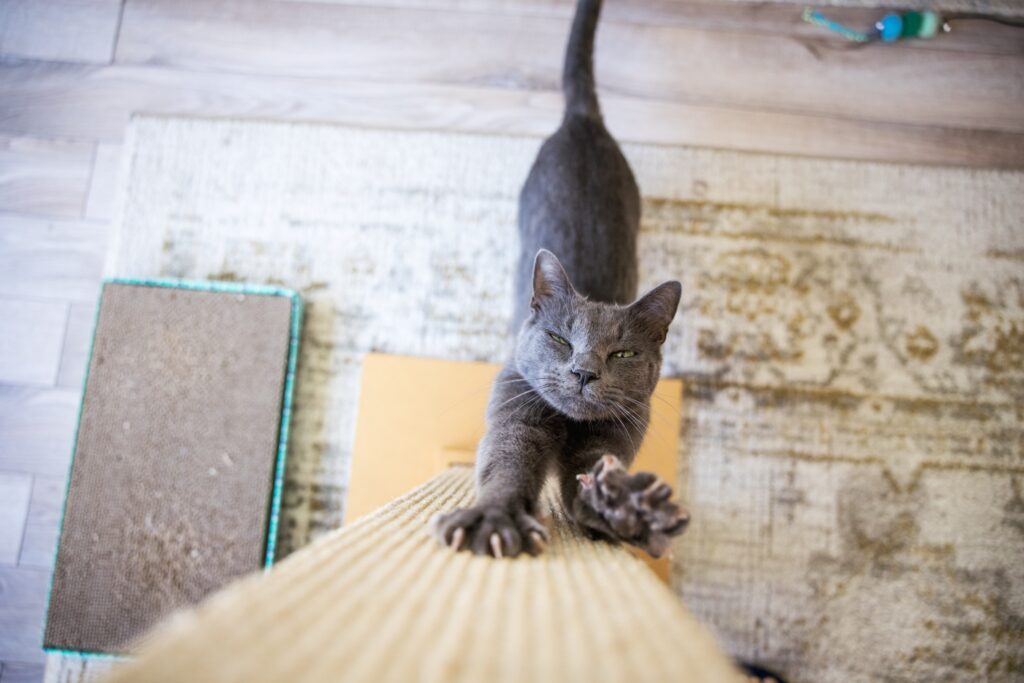
Repetitive scratching allows cats to sharpen and condition their claws, which they need for effective predation. It’s also a stretching exercise. And cats deposit scents known as pheromones, which come from glands between their toes, onto surfaces when they scratch. Pheromones are used for communication with other cats and to mark territory. In some cases, social tensions with other cats (or animals) in the household can trigger repetitive scratching. If your cat is also displaying other aggressive or anxious behaviors (like urine spraying), social tensions could be a factor.
What are the arguments for declawing?
Scratching ranks as one of the top behavioral problems in cats, with the main concerns being damage to furniture and wounds to people. Scratch wounds can become infected, which is especially dangerous in babies, the elderly, diabetics, and people on cancer chemotherapy or immunosuppressive drugs.
Proponents say that declawing makes it less likely that owners will relinquish their cats to shelters or euthanasia. They also say it fosters cat ownership and the human-animal bond, reduces the chance of cat scratch wounds and infections, and, provided it is done properly and with a multipronged approach to pain control, is more humane for cats than a lifetime of being yelled at and sprayed with squirt guns. And while most vets prefer not to perform the surgery for animal welfare reasons, some routinely offer declawing of kittens to prevent destructive scratching behavior.
How is declawing done?
Declawing, or onychectomy, is most often performed under general anesthesia by amputating the claw and the bone that attaches to it (called phalanx 3, or P3). Removal of P3 is like amputating the very last segment of a human finger. The fastest and simplest way to do this is with clippers, which often leaves a small piece of P3 behind. Using a scalpel or laser instead removes P3 completely at the joint. Another procedure, called tendonectomy, involves cutting tendons on the underside of the foot. When this is done, cats keep their claws but are unable to extend them when they scratch or clench a surface. In these cases, you still need to trim claws regularly to prevent scratch wounds to humans. (Ironically, the act of claw trimming itself can increase the risk of scratch wounds.)
Is declawing painful?
There’s indisputable evidence that cats feel pain for days to weeks during recovery from onychectomy, based on studies that measure the amount of force cats place on the ground when they walk. Many cats also develop chronic pain that lasts for years. This is because tendons that normally curl the toes downward (such as when cats knead your lap) pull on the amputation stumps so that the stumps rub on the ground, and no mechanism remains to oppose that action.
Other studies have shown that affected cats can have “phantom limb” pain (like that experienced by human amputees). Peter Delisser, a board-certified small-animal surgeon at the University of California at Davis, says that “while there are several medications we can use to reduce the immediate pain, and careful surgical technique can reduce the chance of infections and persistent lameness, more than half of cats still have complications.” Deaths have occurred when owners decide to declaw their cats themselves. (Yes, this sounds insane, but it happens — and led to a jail sentence in one Florida case.)
Tendonectomy is less painful than onychectomy; a study from Cornell University found that 67 percent of cats resumed normal behavior three days after tendonectomy, compared with just 44 percent for onychectomy. In some cases, tendonectomy is used to treat chronic post-onychectomy pain because it relieves the tension on the amputation stumps. Whether cats develop chronic pain after tendonectomy is less well-studied.
Here’s something you might not know: Onychectomy has been linked to other behavioral and medical problems that can lead owners to euthanize their cats or relinquish them to shelters, or that can put immunocompromised people at risk of infection. These issues include urinating or defecating outside the litter box, “barbering” (also known as excessive grooming or self-induced alopecia), aggression and biting (with associated infectious-disease risks), and chronic back pain.
What are the alternatives?
Alternatives to declawing include regular home claw trimming (every one to two weeks), and application of soft claw caps. These can be purchased online and are attached using special glue. Claw caps come in many colors. (Buy transparent caps if you want to go au naturel.) Typically, caps need to be replaced every one to two months.
You can also provide scratching posts to encourage your cat to scratch on surfaces other than furniture. It’s important to try different surface types if one doesn’t help. To make the post more appealing to your cat, rub catnip on it or apply a cat pheromone product. In the United States, there are two types of pheromone products available: One is sprayed on scratching posts to encourage cats to scratch there; the other is a calming pheromone sprayed on furniture to discourage scratching behavior. Don’t confuse the two, as it could worsen the problem. You should also clean surfaces that previously have been scratched to remove scent that your cat left behind. (Use an odor-neutralizing enzymatic cleaner.)
Positive reinforcement (praise or a treat when your cat scratches in the right place) can help. Don’t yell at your cat or punish it, as this can lead to aggression and other behavioral problems. And make sure you identify and address any potential underlying causes (such as social tensions among cats); consider seeing a board-certified veterinary behavior specialist.
What’s being done to prevent declawing?
Over the last 20 to 30 years, animal welfare organizations worldwide have called for government bans on declawing. Most European countries, Britain, Australia, New Zealand, Brazil, Israel and many provinces in Canada have banned declawing unless it’s medically necessary (as determined by a vet). In the United States, bans began in cities in California in 2003, starting with West Hollywood. By 2009, Los Angeles, San Francisco and several other California cities issued bans. Denver joined in 2017.
The first state to ban declawing was New York, when then-Gov. Andrew M. Cuomo signed a bill against it in 2019. Between 2023 and 2025, other states (as well as Washington, D.C.) joined: Maryland, Virginia, Massachusetts, Rhode Island and California. Penalties vary from one state to another but include fines, as well as suspension of licensure. Several more cities in the United States have also now banned declawing, and corporate veterinary practice groups do not allow their vets to perform declawing, regardless of location.
So even if you do want declaw your cat, it’s becoming increasingly difficult to find someone who will do it.
Have questions about your pet’s behavior, health or other issues? Use this form to submit them to Dr. Sykes.
The post Ask a Vet: Is it wrong to declaw my cat? appeared first on Washington Post.