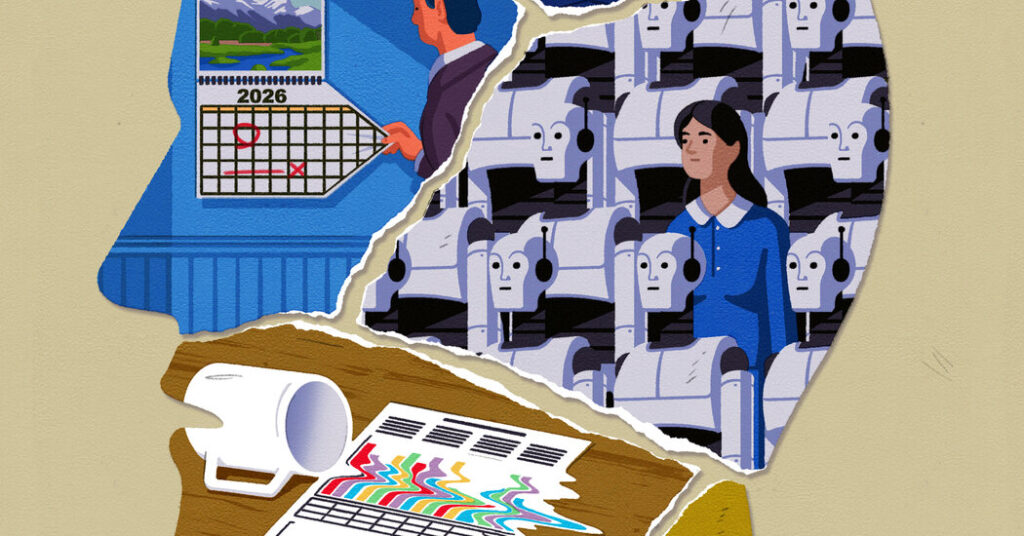
Chief executives have a lot on their minds in the best of times. This year, the list of worries is particularly daunting.
In the second year of President Trump’s second term, corporate leaders have to keep up with tariffs and trade restrictions that continue to shift unpredictably. They also must weigh when, or whether, to speak up about the administration’s policies — on trade, deportations and more — that affect their employees, customers and investors.
Artificial intelligence is another hot topic in boardrooms, with executives considering its risks against its opportunities. While announcing major investments in A.I., leaders must reassure employees that the technology isn’t coming for all their jobs while also being clear that it’s coming for some of their jobs. All the while, executives are trying to expand revenue and profits, as the economy sends distinctly mixed signals.
In recent interviews on the sidelines of the annual gathering of the global elite at the World Economic Forum in Davos, Switzerland, several chief executives reflected on their priorities as leaders during this moment. They shared what they expected to occupy most of their days — and what threatens to keep them awake at night.
These interview excerpts have been edited and condensed.
Where Will Growth Come From?
Growth is hard work. The economy’s OK. On a global base, the economy is at around 3 percent growth. That’s fine, but almost no company is satisfied with being at 3 percent. They all want to be meaningfully north of that. So how do you find growth right now, particularly in places where consumers are more challenged? — Rich Lesser, global chair of the Boston Consulting Group, a professional services firm
I need to be thinking about things that are going to happen in three or four or five years, and I need to be thinking about what’s happening tomorrow. Management teams tend to be more focused on the immediate. Part of my job is helping them and helping the company take permission to take on some things that have a longer burn.— Jeremy Allaire, chief executive of Circle, a major issuer of crypto stablecoins
When there’s a lot of uncertainty, we need to focus on economic growth, which you do by growing your company in a responsible manner. Almost every problem right now really comes down to growth. — Julie Sweet, chief executive of Accenture, a global consulting firm
Our job as C.E.O.s is to look at nation-state geopolitics, business, A.I. implications and risks, job displacement, job training, and we have to harmonize all of it to create a coherent strategy that lets our businesses continue to grow. That’s what we get paid for. — Bipul Sinha, chief executive of Rubrik, a cybersecurity company
Navigating Politics and Rebuilding Trust
You know what is one of the biggest mistakes that a C.E.O. makes? That the role takes over the persona. We have to be authentic, we have to genuine, and by doing that you create a culture where authenticity is a living reality. Then people will trust companies because they will trust employees. — Juvencio Maeztu, chief executive of Ingka Group, the main operator of IKEA stores around the world
This administration, in particular, is attuned to engaging directly with business leaders. The president enjoys interacting with our C.E.O.s, so they have to play a strong role in Washington in managing these political relationships and engaging in the political process, much more so than they have historically. — Stephen J. Ubl, chief executive of the PhRMA, a trade association
When you have an inflection point of disruptions like A.I., the government needs help. Their job is to regulate and to incentivize in the right way, but they don’t have the understanding of this technology. So we need to educate not just the decision maker but one or two levels down so that they can be better informed and better prepared as they develop policies or incentive programs. A lot of my job is making sure I spend time with government officials. — Antonio Neri, chief executive of Hewlett Packard Enterprise, a business software and services company
The Promises and Perils of A.I.
I’ve heard some suggest that we will know whether businesses will generally earn a positive return on investment on A.I. I don’t think that question gets answered in 2026. But I think by the end of the year, we should be closer to that answer. Our priorities are how to better deploy these tools, build adoption in our work force and then find ways to grow from A.I.-driven tools. — John Q. Doyle, chief executive of Marsh, an insurance broker and risk advisory firm
Everyone’s just trying to figure out how A.I. is going to positively impact their business. Same can be said for us. I think it’s definitely going to make a huge incremental benefit and difference, but we’re first and foremost in the people business. What I think about most is retaining and growing the culture of our team. So I’m more focused on people than I am on a specific technology. — Zak Brown, chief executive of McLaren Racing, a Formula 1 team
What we tell founders is: “Look, you’re going to use A.I., and you’re going to create productivity. It’s going to come at the expense of work force reductions.” We help the companies take the work force they already have and get more out of them. But as A.I. scales more, it will lead to, “Hey, you don’t need as many people.” If that’s going to happen, don’t leave that problem to society. Be part of the solution as well. — Hemant Taneja, chief executive of General Catalyst, a venture capital firm
Jordyn Holman is a Times business reporter covering management and writing the Corner Office column.
The post What C.E.O.s Are Worried About appeared first on New York Times.