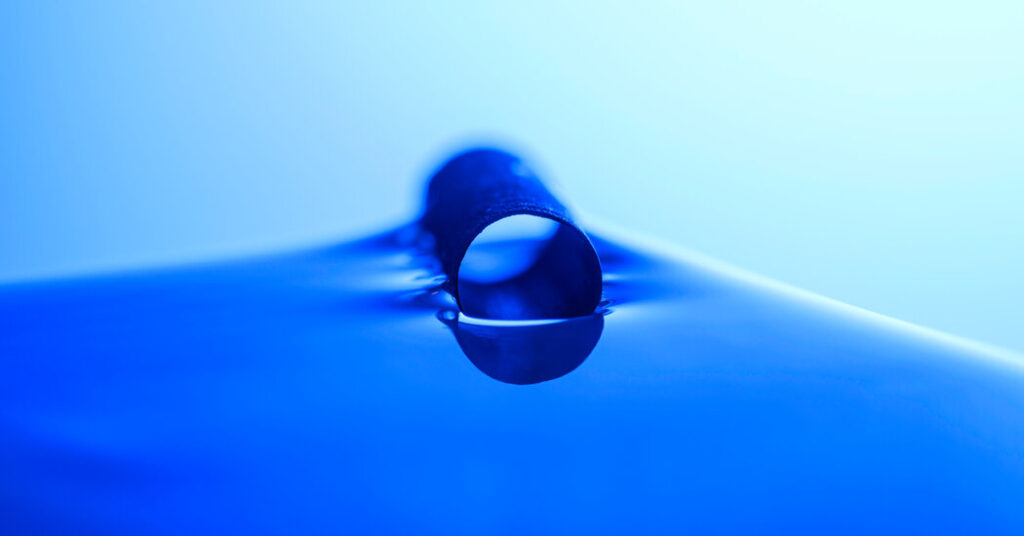
Researchers say they have come up with a clever way to make aluminum tubes unsinkable by securely trapping air bubbles inside.
The tubes are narrow, about one-fifth of an inch in diameter. But stacked together, they could be assembled into larger structures used for floating platforms or devices to harvest energy from the undulations of ocean waves.
“I think the ocean is still a vast untapped resource,” said Chunlei Guo, a professor of optics and of physics at the University of Rochester who led the work, published last month in the journal Advanced Functional Materials.
Or perhaps the technique will get you a nice floating chair for your swimming pool.
Even when tossed around or badly damaged with holes, the tubes remain buoyant.
“It will still stay floating,” Dr. Guo said. “We have done quite extensive, really harsh environmental testing.”
Andreas Ostendorf, a professor of applied laser technology at Ruhr-University Bochum in Germany who was not involved in the research, called the development “really interesting.”
“As researchers, especially in engineering, we are always looking for disruptive ideas,” he said. “This can be a road map toward really penetrating this technology in many applications.”
Aluminum is among the lightest of metals, but it is still 2.7 times as dense as water. Drop a lump of that into the ocean, and it will sink.
Of course, metal objects like ships and empty soda cans float because the air within is lighter than water. But if the outer shell is punctured, water rushes in, and the formerly floating objects sink into the abyss.
To make aluminum tubes that are unsinkable, the Rochester scientists chemically etched microscopic pits on the structures’ surfaces. Because of the surface tension of water, droplets cannot flow into the pits. Instead they roll off almost instantly, and the surface remains dry.
This property is known as superhydrophobicity — extreme fear of water — and some creatures in nature take advantage of it. Similar to the tiny pits in the aluminum tubes, hairs on diving bell spiders and fire ants also repel water. The spiders use superhydrophobicity to trap air, allowing them to breathe underwater. Fire ants survive floods by linking together into waterproof rafts.
Superhydrophobic surfaces have been known for decades but have so far found limited practical use. Some medical implants have a water-repellent coating to prevent corrosion and bacterial infections.
Dr. Guo said he wanted to come up with applications for superhydrophobic surfaces that were “less straightforward.”
A few years ago, his research group published a paper describing a floating structure consisting of two parallel superhydrophobic aluminum disks connected by a plastic post. The superhydrophobic surfaces prevented water from flowing into the narrow gap, preserving a layer of air between the disks.
It worked, but when the disks were tilted and shoved downward, the air could be pushed out. So the scientists started thinking about other geometries, and tubes turned out to be a more robust shape than the disks, especially with a dividing wall inside the tube. That would block water from flowing in from one end and out the other and pushing out the air bubble.
The superhydrophobic surfaces inside the tube again prevented water from entering and kept the air from escaping.
“This is very, very stable,” Dr. Guo said.
They tested the resiliency of the tubes by weighing them down in both salty water and water with algae growing in it. Because the water was repelled, the insides of the tubes did not corrode and algae could not grow there. Even drilling holes into the tubes did not destroy their ability to float.
Dr. Guo said they performed numerical analysis that showed stacking a few layers of tubes produced a structure that could survive the harshest of ocean conditions.
Dr. Ostendorf said more work was needed to demonstrate that the tubes would work in real-world situations. “There are some open questions, but the principle is very nice and very simple, and maybe can be scaled up,” he said.
Dr. Guo and his colleagues have spent decades altering the properties of a material by placing microscopic patterns on the surface.
In 2008, Dr. Guo and Anatoliy Y. Vorobyev, another University of Rochester researcher, used lasers to pockmark metal surfaces in a way that still felt smooth but altered how the light was absorbed and reflected.
The result was aluminum that looked like gold and titanium that was navy blue.
Later, the scientists carved tiny channels in silicon to create surfaces that attract rather than repel water. They suggested that such surfaces, known as superhydrophilic — extreme attraction to water — could be used to cool computer chips.
Dr. Guo has also explored combining colorful metals and water-attracting surfaces. For example, he has used a black metal to create a device known as a thermoelectric generator, absorbing heat from sunlight and other sources to generate electricity.
“You can harness any waste heat,” Dr. Guo said. “Maybe next to the muffler underneath the car.”
Kenneth Chang, a science reporter at The Times, covers NASA and the solar system, and research closer to Earth.
The post These Unsinkable Tubes Could Help Harvest Energy From the Ocean appeared first on New York Times.