The Winter Olympics are a two-week ratings spectacle of patriotic hockey battles and figure skating kiss-and-cries, but in between, it’s nice that less glamorous, less sponsor-luring sports — whether biathlon or bobsled, skeleton or luge — finally have their moment too. Many of the competitors in these events train just as hard as Mikaela Shiffrin and Chloe Kim, but with only a fraction of the glory. Believe it or not, people curl even when the world is not paying attention, which is nearly always.
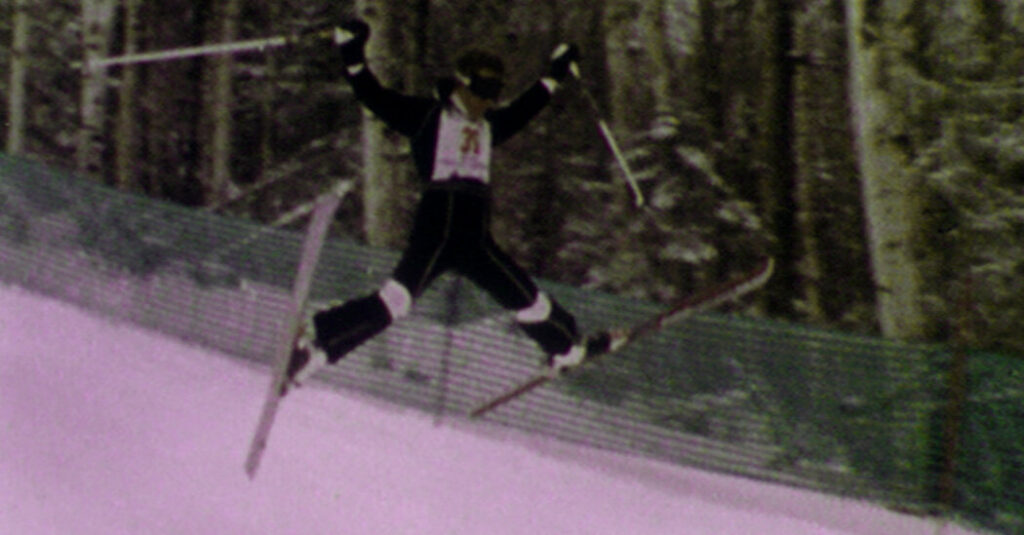
Curling has become a handy punchline, the poster child for Olympic wallflowers. But among the less celebrated disciplines anointed by the Games, arguably the greatest — by which I mean the most inadvertently amusing — was ski ballet, also known as acroski. The sport dressed up ski tricks such as flips, jumps and spins with showy dance moves (more jazz hands and fly girl hip thrusts than ballet per se) while music was piped onto the slopes. Even in figure skating and gymnastics, the marriage of athleticism and choreography can sometimes feel forced. Add skis, poles and snow suits and the effect is more the hippos in tutus from “Fantasia” than it is Simone Biles or Michelle Kwan.
Ski ballet was part of a constellation of “demonstration” freestyle skiing events held in Calgary, Alberta, in 1988 and Albertville, France, in 1992. But unlike the other two freestyle disciplines, aerials and moguls, ski ballet didn’t graduate to full Olympic medal status. There’s a reason old clips of the sport regularly go viral: It’s hard to believe it ever existed.
And yet, where would the sports world be without risk and experimentation, the drive to innovate and excel? Yesteryear’s stoners hotdogging their way down a mountain are today’s halfpipe snowboard medalists. Flopping backward over a high jump bar, now standard practice, looked goofy to many track and field fans when gold medalist Dick Fosbury pioneered it at the 1968 Summer Olympics. Millenniums earlier, cave men might well have laughed the first time a group of kids started kicking around a sheep’s head or mastodon’s bladder or whatever the first ball was. Hit one with a bat? Why?
“Why not?” retort the dreamers, visionaries and time wasters compelled to find ever new random things that someone can be better at than everyone else.
This year’s Games have been full of thrilling athletic moments, but alas, so far, they have lacked much of a nutty quotient — like that “Wait, break dancing is a sport now?” moment we had in Paris in 2024. One signal aspect of the Olympics is the continuity of competition, the ability to compare achievements across eras, but still, you want at least one weird entree on the menu, even if only for the pleasure of not ordering it.
Demonstration sports used to fill that void reliably, serving as a kind of Olympics lab. They were contests added to the quadrennial lineups on a trial basis, to see whether anyone cared enough to warrant official status going forward. The practice has been discontinued, though host countries now get to add a locally favored sport, which is how we got break dancing for that one Olympics. (This year’s games in Milan and Cortina include ski mountaineering, in which competitors race up a slope and then back down, changing equipment at the top. A challenge, but nothing that would confuse Dorothy Hamill.)
Curling, short-track speedskating and ice capades — excuse me, ice dancing — all began their current Olympic runs as demonstration sports. Others flamed out. Skijoring, which came and went in 1928, featured races in which skiers were pulled by horses. (You can still attend skijoring competitions in the American West if you so desire.)
If you watch videos of old ski ballet competitions, it’s not hard to see why it joined skijoring as an Olympic has-been. The performers ski in switchback patterns down what appear to be relatively gentle slopes, never building up too much speed. That tended to elongate the transitions between tricks and dancing, isolating each as if they were two entirely different disciplines welded together in one performance. Which they sort of were. Campy musical choices — such as segues between pompous classical fanfares and medleys of MTV-era pop hits — didn’t help.
The poles, though providing essential leverage for tricks, were a special problem: What otherwise to do with them? You often see a ballet skier trying to wield them like a vaudevillian’s cane or a majorette’s baton, rarely to good effect. Sometimes they are waved in what looks like sheer desperation, as if the athlete were a lost backcountry skier trying to catch the attention of a rescue helicopter, which is at least poignant.
The sport itself was signaling for help by the time it reached the Olympics after a brief “golden age” in the 1970s and 1980s, when it was occasionally shown on ABC’s “Wide World of Sports,” and Suzy Chaffee, the alpine skier turned ballet skier, became famous for her “Suzy Chapstick” commercials. But attention had moved on by 1988. During the lead-up to Calgary, the American ski ballet champion Jan Bucher told Sports Illustrated, “Everybody’s going to see what it is freestylers do, and each person can then decide whether he hates the sport or likes it.”
Or merely shrugs? Bucher placed second at Calgary, though you wouldn’t have known it from, say, reading The New York Times. (I could find only one brief wire service article, from 1992, covering results from either Olympic ski ballet competition in those pages.) Failing to make the Olympic cut further dimmed the sport’s popularity, and it was finally eclipsed by the rise of freestyle snowboarding. By the turn of the century, ski ballet barely existed as an organized sport. Today, a popular YouTube video asks, “HOW was this an Olympic sport?”
I want to be clear: I am critiquing ski ballet purely as an aesthetic spectacle. The sport obviously required skill, strength, dedication, discipline and nerve, all of which rank higher on the scale of Olympic values than taste. It may have proved to be an evolutionary dead end, but you can see its vestigial traces in competitions like freeski slopestyle, which provided one of the most electrifying showdowns of Milan Cortina’s first week: the duel between the silver medalist Eileen Gu, skiing for China, and the winner, Mathilde Gremaud of Switzerland.
I’m pretty sure no one ever called ski ballet electrifying. But just as some walk so that others may run, some danced on skis without falling (or clubbing nearby spectators with their poles) so that others may today land not only double cork 1260s, but also modeling gigs and huge endorsement deals. Gu, for one, is reported to have earned more than $20 million last year alone. I hope she, Gremaud and their rivals have at least heard of Suzy Chapstick.
Bruce Handy is the author, most recently, of “Hollywood High,” a history of teen movies, and “Balloon,” a picture book illustrated by Julie Kwon.
Archival footage courtesy of the Colorado Snowsports Museum.
The Times is committed to publishing a diversity of letters to the editor. We’d like to hear what you think about this or any of our articles. Here are some tips. And here’s our email: [email protected].
Follow the New York Times Opinion section on Facebook, Instagram, TikTok, Bluesky, WhatsApp and Threads.
The post The Olympics Are Not Weird Enough appeared first on New York Times.