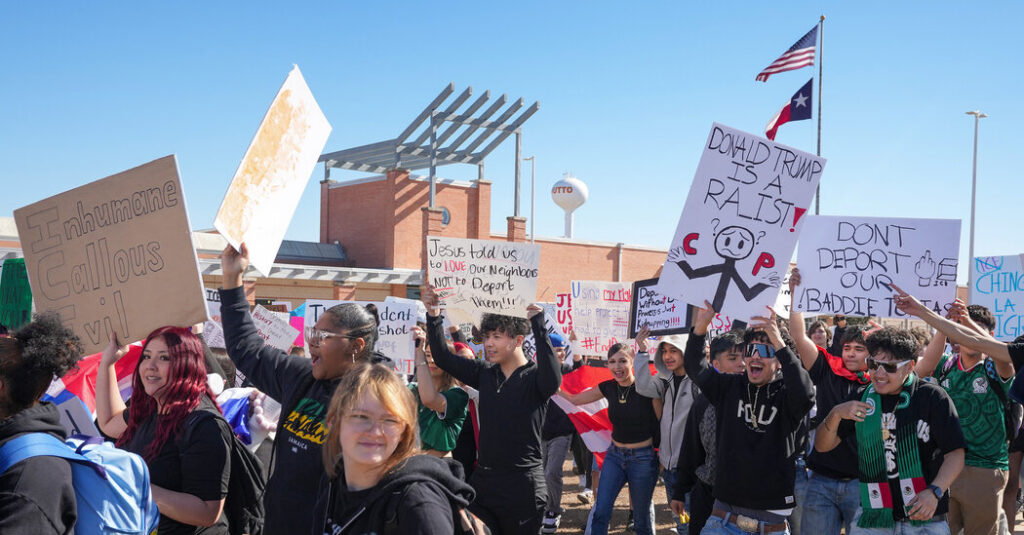
Students in more than three dozen states have walked out of class to protest the Trump administration’s deportation tactics in recent weeks, a wave of defiant demonstrations that continues as some officials have vowed to crack down.
Teenagers in Utah carried backpacks and bullhorns as they walked out of eight schools in Salt Lake County. In Maine, students in mittens convened on a bridge over the Kennebec River. Scores of students were seen stopping highway traffic in Maryland. Classmates at a high school in Sunnyside, Wash., lined a parking lot carrying hand-drawn posters. “We are skipping our lesson to teach you one,” read one.
But in Texas, where more than half of all public school students are Hispanic, Republican leaders have tried teaching a very different lesson of their own, threatening students, teachers and school districts with severe consequences for taking part in demonstrations.
Gov. Greg Abbott of Texas has suggested that state funding could be stripped from school districts and that students who are disorderly during protests should be arrested. The Texas Education Agency has warned that districts found to have facilitated walkouts could be taken over by the state.
“Schools and staff who allow this behavior should be treated as co-conspirators,” Mr. Abbott said in a social media post last week, which focused on one walkout in Kyle, Texas, outside of Austin.
Yet despite the threats from state officials — and the pleas to students from many school administrators — the protests over immigration enforcement did not stop.
On Feb. 10, there were at least 10 walkouts at schools in the Dallas area, with hundreds of students participating. Protest organizers said they were aware of the potential consequences but remained determined to speak out against the tactics of federal agents and the killings of two people in Minnesota.
“It is important especially right now that students understand that they have the right and the privilege to speak up for what they believe in,” said Cat Krankota, a 16-year-old student who helped organize a walkout at Booker T. Washington High School for the Performing and Visual Arts in Dallas.
For Paola Ramirez, 16, the protest was personal. Her cousin was deported this year after a check-in at an Immigration and Customs Enforcement office in Dallas, leaving his wife and 5-year-old son to move in with Paola’s family.
“I see injustices happening everywhere,” Ms. Ramirez said.
Thomas Baughman, 17, said that a lot of students joined the walkout at his school at the Yvonne A. Ewell Townview Magnet Center in Dallas to express their political feelings at a time when they still cannot vote.
He and several classmates spent more than a week planning the protest, posting on Instagram and handing out pamphlets at school. They also reviewed their legal rights, Mr. Baughman said, including a 1969 Supreme Court decision, Tinker v. Des Moines Independent Community School District, that protected the free speech rights of students at school.
But Mr. Abbott, a lawyer and former state supreme court justice, has said that the students do not understand that there are limits to free speech under the Constitution.
“You don’t have freedom of speech to say and act any way you want to, anywhere you want to, anytime you want to,” the governor said at a news conference Feb. 4, adding that the “free speech of students does not include leaving the school to go protest.”
Other Republican state leaders have also bristled at the student demonstrations. In Oklahoma, 10 Republican lawmakers expressed concern that the protests “appear to target law enforcement officers and federal agents who are carrying out lawful duties.” And Florida’s education commissioner warned school superintendents that protests could lead to discipline.
Leaders in Texas appear to have gone the furthest in trying to tamp them down. Civil rights advocates said it might be too much.
“What the state is threatening, including school takeovers, goes beyond routine punishment,” the legal director at the ACLU of Texas, Adriana Piñon, said in a statement. “The state is threatening drastic and severe consequences for peaceful speech that could amount to retaliation, which is unconstitutional.”
The Texas Education Agency did not respond to a request for how many students and teachers had been disciplined in relation to the walkouts, or whether any school districts were identified as facilitating protests and thus targeted for funding cuts.
Walkouts have long been a common form of student protest, including in Texas. In recent years, students have walked out to protest school district policies or the actions of the federal government. There were similar walkouts over immigration enforcement last year.
Mr. Baughman, in Dallas, said his fellow students expected their walkout Tuesday to be handled as others had been, with organizers informing school officials and getting permission for their plans. Instead, because of the threats from state leaders, he said the protest took place without the endorsement of school officials.
In the Houston area, students at several schools walked out last week after school leaders warned them of potential consequences, including suspension or being barred from extracurricular activities.
“On the day of the protest and the day before, our principal got on the speaker with the same message about the potential for disciplinary action,” said Mallika Mohan, a 17-year-old junior at Bellaire High School, who covered the protest at her school as a student journalist. “He also sent this out in an email, twice.”
In a letter to the governor on Monday, more than three dozen Democratic members of the Texas House asked Mr. Abbott for guidance on how schools should respond to and manage the walkouts.
“We can all agree that students possess constitutional free speech rights — a principle that the governor and the Texas Education Agency have repeatedly affirmed,” the Texas Democrats wrote, pointing to Mr. Abbott’s support for the free speech rights of student clubs. Mr. Abbott has pushed schools to allow students to create chapters of Club America, a conservative political club for high school students started by Charlie Kirk.
The threats have worried many parents and students, including some of who opted not to join walkouts at their schools over fear of what disciplinary action could do to their academic record.
“My kids have worked very hard as students and all openly expressed their concerns for safety and consequences of the walkout,” said Jessica Zelaya, who has three children in high school in Mesquite, Texas, south of Dallas.
Opinions are divided among parents on Facebook forums over whether the school could be expected to force students to stay inside.
“You can’t stop a student from walking out of the classroom,” said Monette DeBaun Stransom, whose daughter joined the walkout on Tuesday at Booker T. Washington. “If they want to cut class and go play video games or do whatever, you can’t stop them.”
Ms. Stransom said she felt comfortable encouraging her daughter to participate because she and several other parents were walking near the route the students took as they protested outside of the school.
“I talked with her about her First Amendment rights. I reminded her to walk only on the sidewalk and to not obstruct traffic,” Ms. Stransom said. “I said, ‘If a policeman asks you a question, you have the right to remain silent. But you have a First Amendment right to peacefully protest.’”
J. David Goodman is the Texas bureau chief for The Times, based in Houston.
The post Students Across the U.S. Are Protesting ICE. Texas Wants to Punish Their Schools. appeared first on New York Times.