The state of South Carolina is facing daunting challenges far beyond its growing population. As artificial intelligence advances, data centers are proliferating to support it, and the governor is pushing small nuclear reactors and the revival of a half-built nuclear plant to power those data centers.
Electricity costs could rise, environments could be stressed.
But in the state capital of Columbia, Republicans who dominate the South Carolina legislature are pressing to restrict the agencies that would regulate such changes, arguing for a different imperative — economic growth.
“We do not want to have unelected bureaucrats making rules and laws that are forced upon people,” State Representative G. Murrell Smith Jr., the Republican speaker of the State House, said in an interview.
South Carolina’s Small Business Regulatory Freedom Act is in the vanguard of a broad push by conservative state lawmakers to pass laws this year that would remove state-level controls on business, work places and the environment.
Legislation in South Carolina and at least 16 other statehouses would shift power away from state agencies by subjecting to legislative scrutiny any regulation that would cost at least $1 million to implement. Regulations that do survive would automatically expire after a fixed term unless specifically reauthorized.
A federal deregulation bill that would do the same has failed repeatedly to clear the Senate. So the states are taking up the call.
“Taxes are one of the big costs of government, but the regulatory burden is sometimes even more difficult because you don’t see it,” Grover Norquist, a veteran anti-tax activist in Washington, said at a recent news conference in Columbia to push for South Carolina’s version.
As of now, nine states have such far-reaching laws in place. But after the Supreme Court’s landmark decision in 2024 to limit the power of regulatory agencies, states like Wisconsin and Florida at the forefront of the movement could soon be followed by a flood of others seeking to shackle their own state regulators, said Jaimie Cavanagh, senior state policy counsel for the Pacific Legal Foundation, a libertarian public interest law firm that has worked on some of the bills.
The American Legislative Executive Council, a conservative organization that focuses on state legislatures, has crafted model legislation to go after “administrative agencies with insufficient democratic controls.”
South Carolina’s version passed unanimously in the State House last year, and Mr. Smith said he was cautiously optimistic that the State Senate would follow suit as early as next month. Supporters say it would reduce the number of state regulations by 25 percent.
At stake in the national drive are protections placed by agencies even in conservative states on labor, water and air quality, and the consumer — especially at a time when the Trump administration is pressing to roll back similar regulations imposed by federal agencies. Meantime, A.I. and crypto currencies are advancing with minimal oversight, while the president seeks to boost coal burning, scrap automobile fuel efficiency standards and eliminate all controls on climate change.
Proponents of deregulation ignore “what regulation is really about: protecting people, saving lives, making markets more fair,” said Rachel Weintraub, executive director of Coalition for Sensible Safeguards, a national alliance that defends consumer and environmental regulations.
South Carolina’s version would require, among other demands, that agencies eliminate two regulations for every one that they create. And it would empower courts to independently interpret laws and regulations without giving agencies’ arguments extra weight. Kansas this year approved a similar law empowering courts to set aside their traditional deference to regulatory agencies.
Opponents say paring regulations by numerical mandates is hardly thoughtful policy, especially given the dizzying changes that South Carolina is facing.
It also may be trying to solve a problem that doesn’t exist. The Mercatus Center, a libertarian-leaning research organization at George Mason University, says the state, the 23rd-most populous, is the 36th least regulated.
“I’m unaware of a huge gaping example of a regulation that has been so onerous that it hasn’t come to our attention and we haven’t addressed it,” said State Senator Brad Hutto, a Democrat and the minority leader, adding that the legislature already reviews regulations, as does a longstanding small business regulatory review committee led by business owners.
Instead, he believes the goal is to weaken the executive branch by saddling agencies with more paperwork, and inhibiting their day-to-day work.
“It takes more than a legislature to run a government,” Mr. Hutto said in his Statehouse office, where he displays a signed copy of the 2001 State of the State address delivered by former Gov. Jim Hodges, the last Democrat to hold that office.
“We’ve got to have state agencies, totally functioning state agencies, to carry out and execute the laws,” he continued. “Part of the execution of those laws is to build them out in the technical areas that we just don’t have any expertise in.”
The South Carolina bill might save businesses money, but it will cost the government at least $4.5 million annually to implement, according to the legislature’s fiscal impact analysis. The biggest share, $1.6 million, would be shouldered by the Department of Environmental Services. That agency now reviews regulations every five years for possible streamlining, the analysis noted. If the bill passes, such reviews would have to be continuous.
During a walk along the Congaree River in West Columbia, Meagan Diedolf, president of the Conservation Voters of South Carolina, and Bill Stangler, the Congaree Riverkeeper, said environmental regulations and reforms had helped the community clean up a polluted waterway that is now used for recreation and community events.
“So many people are making regulation a dirty word,” Mr. Stangler said. “But we depend on those regs for environmental protection. These are the rules that are meant to protect people, and it’s everything from dam safety to day care. It’s gas pumps. It’s restaurant food safety, public swimming pools, everything that touches everyday life.”
On the other side are people like the owner of a popular barbecue restaurant in Florence and the owner of a clothing boutique in Chester who have been working with the South Carolina chapter of Americans for Prosperity, a conservative advocacy group. They say regulations have cost them time and money and hampered their expansion plans.
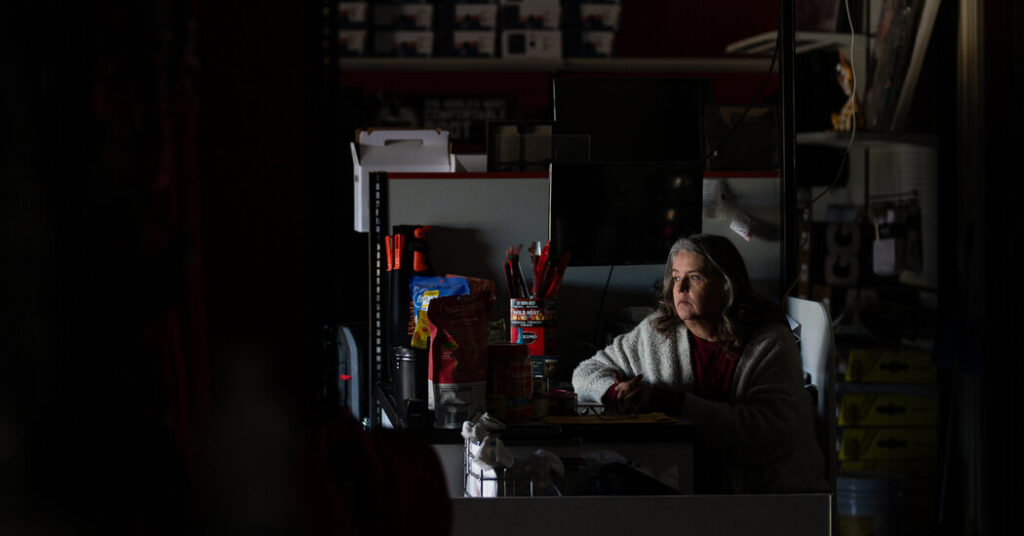
Gail Nicholls, who owns Red Bug Barn, a pet and livestock supply store in Richburg, S.C., said it was important to protect water, air and food. But, she added, she needs one permit to grow, ship and sell plants, and another to sell eggs and chicks. To deal with the paperwork, she closes her store two or three hours a day, a couple of times a week.
“All these folders,” she said, pointing to a teetering stack in her tiny office, “represent something different I have to do.”
David W. Chen is a Times reporter focused on state legislatures, state level policymaking and the political forces behind them.
The post Republican State Legislators Rush to Limit Their Own Regulators appeared first on New York Times.