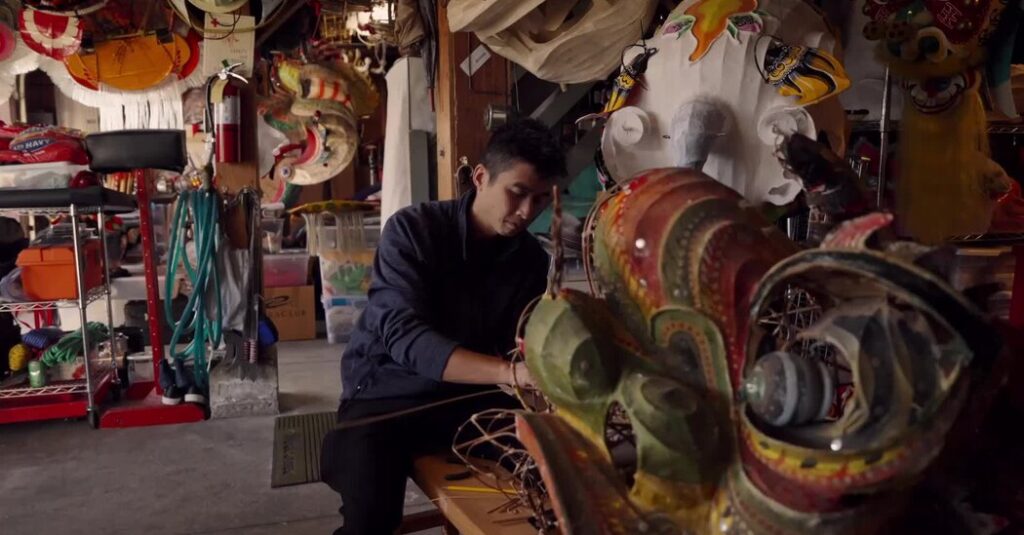
Corey Chan’s San Francisco home looks like any other in the elevated neighborhood of Anza Vista: simple, two-storied, with large windows to let in sweeping views of the skyline and glimmering bay below.
But when Chan, 63, opens his two-car garage, it’s like a portal to another world.
Chinese lion heads of seemingly every color, size and style hang from the walls and ceiling. A five-foot tall dragon head, its fanged mouth agape, sits where one would expect a car. Brilliant pompoms, fake peaches and real spears, swords and axes rest near drying laundry.
Chan grew up watching Chinese lion dances during Lunar New Year, and committed himself to learn each part of the craft, from the construction and repair of lions to the accurate performance of each move. (The dances are also common during weddings, business openings and funerals for esteemed elders and martial arts teachers.)
“I was hungry to learn,” Chan said of the tradition, steeped in roughly a millennium of history and mythology. “It’s a never-ending learning journey.”
Amiable and unassuming, Chan presents himself as a humble scholar, but he is also a deeply respected and knowledgeable teacher. He is the heritage director at Cameron House, a longstanding nonprofit in San Francisco’s Chinatown that serves the low-income and immigrant Asian American community. He is also the director of Kei Lun Martial Arts, which he joined at 18. Through his practice, he met the men who would come to make up his crew: Jeff Lee, Travis Lum and Thomas Chun.
“What do you call it if you have a photographic memory but with your body?,” said Lee, 61. “The master shows it one or two times and then, boom, Corey’s got it.”
Because information about lion dancing in English is scarce, Chan led a group of Kei Lun Martial Arts members on a research trip to China in 2000. They studied with skilled craftspeople in Shanghai, Guangzhou and Hong Kong.
“It’s a labor of love, but also an appreciation of their family art, their tradition,” Lee said.
There, they learned the five-part process of making lion heads: building a bamboo skeleton, pasting on papier-mâché skin, painting, adding symbolic accouterments and, finally, bringing the lion to life through ceremony.
In order to construct a lion frame, Chan and his crew cut bamboo into long, thin strips, which they heat with a candle or hot air gun to make pliable. They then bind the bent strips with about a thousand knots of paper tape. Building the bamboo skeleton is often the most difficult step.
Although it is customary to burn unused lions, symbolically returning them to heaven, Chan and his friends have never done so. They half-jokingly refer to themselves as the Lion Rescue Squad. “We’ve never had to burn a lion because we know how to fix them,” Chan said.
Through their side business, Of Course Lion Source, which Chan likens to “a hobby that kind of went out of control,” people from across the country send them Chinese lions and dragons to repair. They’ve also salvaged a severely dilapidated lion they found abandoned in a park in Oakland. (Both lions and dragons are meant to bring good fortune and ward off evil spirits; dragons are longer and require more performers.)
“Anybody that makes these things, prepares these things, they’re putting not just their time, they’re putting in their soul,” Chan said. “A little bit of me goes into this.”
In 2014, the New York Historical Society and the Marysville Chinese Community in California commissioned the squad to restore Moo Lung, a massive, nearly 150-year-old dragon that is believed to be the oldest in the United States.
Crafted at a time when Chinese were being massacred across the American West and discriminated against through laws like the 1882 Chinese Exclusion Act, Moo Lung demonstrated and celebrated China’s rich, ancient civilization. It traveled from the Bok Kai Temple in Marysville, Calif., to the 1893 Chicago World’s Fair and the 1911 New York City Fourth of July parade.
Today, the art form is tricky to make profitable. When asked about their business, the group laughed. With their commissions, which can range from $300 to $2,000, depending on a piece’s condition and customer specifications, they mostly break even in terms of labor and supply costs. Often, the squad invests its own time and funds into the craft. “You don’t do this kind of thing to make a lot of money real fast,” Chan said. “It’s art.”
Real lions, which are not native to China, are believed to have been introduced to the Chinese Imperial Court via the Silk Road during the Han dynasty. In the centuries that followed, they took on mythological importance as protectors and harbingers of peace.
Three common colors correspond to characters in the classic Chinese historical novel, “Romance of the Three Kingdoms”: yellow (Liu Bei), red (Guan Gong) and black (Zhang Fei).
“So the Liu Bei lion often has a white beard because he’s older, more knowledgeable, civil, and he’s danced with a more regal type of nature,” Lee explained. “Whereas the Guan Gong lion is a General. He’s strong, he is in his prime, he has a black beard.”
It’s rare to encounter a black Zhang Fei lion, the youngest and supposedly most pugnacious. “Traditionally, you don’t even bring out a black lion unless you’re going to fight,” Chan said.
Lee and Chan said that when they were younger, fights would often break out between different martial arts and lion dance troupes. “That’s why a lot of parents wouldn’t let their kids join,” Chan said. (Lee’s parents, for example, didn’t let him participate.) “The guys who did lion dance at the time had to be really good at martial arts.”
Before a Chinese lion can perform its first dance, it must be brought to life, or consecrated, through an eye-dotting ritual. The Rescue Squad uses a calligraphy brush dipped in muddy red cinnabar to awaken the lion’s sense organs.
They dot the nose for smell, the tongue for taste, the ears for hearing, and place one on the horn and seven along the length of the lion’s body, representing the seven stars of the Big Dipper.
The lion is then nearly ready to perform its public duty: scaring away evil spirits and jumping and retrieving red envelopes tied to heads of lettuce, bringing prosperity (in the form of a good harvest or financial success).
It is also almost ready to solve the many physical and mental puzzles, known as Cheng, that knowledgeable business owners arrange outside their shops — a dying art that Chan is working to document and collect in a book.
The lion awakens once it receives a final blessing.
“The last line in the liturgy, or how we say it,” Lee said, “is, ‘Now we bring this lion to life, now may he raise his martial valor and bring peace to the world.’”
This story is part of a series on how Asian Americans are shaping American popular culture. The series is funded through a grant from The Asian American Foundation. Funders have no control over the selection and focus of stories or the editing process and do not review stories before publication. The Times retains full editorial control of this series.
Miya Lee is the editor of Modern Love projects.
The post Meet the Crew That Makes Dancing Lions for the Lunar New Year appeared first on New York Times.