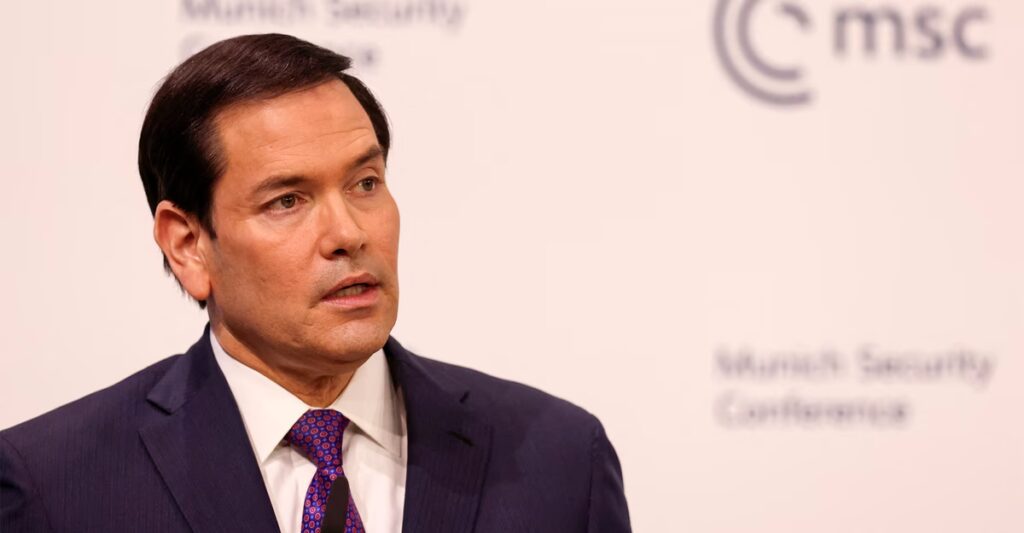
Marco Rubio offered a more supportive message to Europe at the Munich Security Conference yesterday than J.D. Vance did a year ago. Wolfgang Ischinger, the chair of the conference, thanked him for the message of reassurance, adding: “I’m not sure you heard the sigh of relief in this hall.” This despite the fact that Rubio, like Vance, clearly misunderstands Europe and is in denial about the threats facing the United States and the transatlantic alliance.
In 2025, Vance said that the threat he worried the most about for Europe is not Russia, China, or any other external actor. It was the “threat from within,” particularly perceived restrictions on free speech. Vance’s attack landed like a bombshell in Europe. In the weeks that followed, Vance’s role in the Oval Office showdown with Ukrainian President Volodymyr Zelensky and the Signalgate leak (in which he wrote “I just hate bailing Europe out again”) reinforced his reputation as Europe’s strongest critic in the Trump administration.
Serving as the administration’s more diplomatic good cop, Rubio used his time at Munich to emphasize ties between Europe and the United States. He told the audience: “We want allies who are proud of their culture and of their heritage, who understand that we are heirs to the same great and noble civilization, and who, together with us, are willing and able to defend it.” Further emphasizing unity and shared purpose, he added, “We will always be a child of Europe.”
[Robert Kagan: America vs. the World]
Rubio also tried to contextualize President Trump’s “direct” approach as part of the noble “task of renewal and restoration,” essential for both the alliance and for Europeans themselves. “We in America have no interest in being polite and orderly caretakers of the West’s managed decline,” Rubio declared. Europe, he explained, had too much faith in open borders and international institutions when the only true defense of the world order is hard power—and the military investment that demands.
This story about Trump rescuing Europe from its short-sighted pacifism and general malaise is one you hear regularly, including from Europeans such as NATO Secretary General Mark Rutte, but it’s not true. Consider the following.
On defense, Europe has been rearming rapidly over the past decade. Non U.S. NATO members increased their defense spending by $70 billion a year during the first Trump administration, then by $190 billion in the Biden administration. The steep rise was largely in response to the growing threat from Russia, but it indicates that Europeans were seriously investing in their own defense well before Trump’s reelection.
It would be similarly wrong to claim that Europeans have outsourced Ukraine’s defense to the United States, given that Europe has been the biggest provider of aid to the country, allocating over 132 billion euros between January 2022 and December 2024, compared to 114 billion euros from the U.S., according to the Kiel Institute for the World Economy. Europe’s contribution has grown since Trump took office again, while U.S. aid flatlined.
Even before Trump returned to power, the EU’s asylum policy had shifted toward tighter border controls, faster processing, and a growing effort to assess asylum claims before allowing migrants in. The EU had also begun “de-risking” the economies of member nations by limiting Chinese investment, backing American export controls on advanced chipmaking equipment to China, and reducing dependence on Chinese supply chains.
But the real problem was not what Rubio got wrong about Europe. It was what he chose not to say at all.
[Read: Why Europe Is Talking About Nukes]
The big geopolitical story of this moment, other than Trump, is the increasing alignment and cooperation between Russia, China, and North Korea. Beijing and Pyongyang are now actively involved in a major war in Europe. China is helping Russia reconstitute its military and North Korea has sent weapons and troops. Russia has returned the favor by offering valuable military technology and know-how to both countries. Senior U.S. military and political officials have told me that they are particularly worried about North Korea’s cooperation with Russia and what it means for peace on the Korean peninsula.
This authoritarian alignment is the most profound threat that the United States and its allies, in Europe and the Indo-Pacific, face. Yet there was no mention of Russia or China in Rubio’s speech. He touched on both in the questions and answers but did not characterize them as strategic competitors or a threat to the alliance. This seems to be part of a pattern for the administration. In January, Undersecretary of Defense for Policy Elbridge Colby gave a major speech in South Korea without ever mentioning North Korea. It’s like something out of Harry Potter—the threat cannot be named.
More perniciously, the Trump administration wants to readmit Russia to the G7 and has asked Russia and China to join Trump’s Board of Peace (Russian leader Vladimir Putin said yes, China said no). Meanwhile, Trump officials have seemed keen to alienate the EU and dismiss the “rules-based order” as nothing more than “cloud castle abstractions,” despite the fact that these are the very allies and ideals that the U.S. needs to compete with China and contain Russia.
Before arriving in Munich, Rubio told the press that “the old world is gone” and that “we live in a new era in geopolitics.” He is right, but he misunderstands why. The old order is fraying not because Europe is weak or complacent or guilelessly reliant on diplomatic institutions, but because authoritarian powers are increasingly willing to work together to forcefully reshape the world order. In this landscape, cohesive alliances, military deterrence, and economic resilience are essential.
By devoting his speech to the perceived shortcomings of America’s friends instead of the threats posed by the country’s adversaries, Rubio revealed not only the Trump administration’s flawed diagnosis of this geopolitical moment, but its dangerously naïve strategy for managing what is becoming—thanks largely to Trump—a treacherously multipolar world.
The post Marco Rubio Doesn’t Get It appeared first on The Atlantic.