“I think she likes our company,” the woman said.
“I hope she goes to bed early,” said another.
“We still have 30 minutes before bedtime,” a third said.
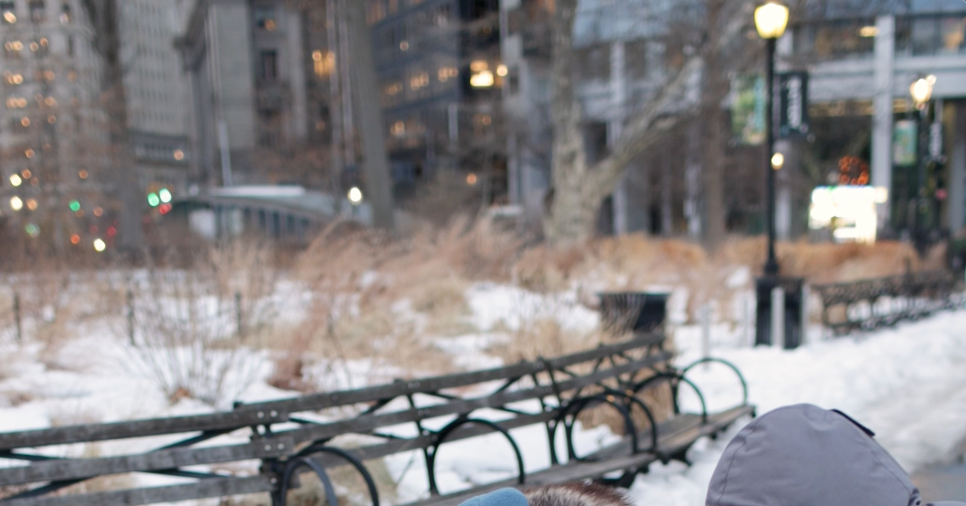
It was a frigid dusk in the Battery, a park at the southernmost tip of Manhattan, and the sleepy companion in question was a wild turkey named Astoria.
Last spring, Astoria arrived in Manhattan and caused a sensation by roosting briefly in ritzy Sutton Place, then landing on Park Avenue before finding her way down to the West Village.
She has since settled in the area near the SeaGlass Carousel, just north of the Staten Island Ferry terminal. There, three middle-aged human women, Astoria’s self-appointed caretakers, visit her daily.
New York City regularly falls in love with celebrity wildlife — unusual ducks, lovebird coyotes and the heroic owl who cut a majestic figure against the steel and glass metropolis.
But few would describe Astoria as majestic. And generally, in New York, the word “turkey” is followed by the word “sandwich.”
“She’s the only known turkey in Manhattan,” said Sunny Corrao, the deputy director of the city parks department’s wildlife unit, “but this is not unusual.” A turkey was known to hang out in Inwood Hill Park in Upper Manhattan in the past, Ms. Corrao said, and there are large flocks in the Bronx and on Staten Island. Smaller groups come and go in Queens and Brooklyn.
(Astoria got her name because she was first spotted in Astoria, Queens, before making her way to Roosevelt Island and, finally, Manhattan.)
“New York City is actually great habitat for a wild turkey,” Jessica Wilson, the executive director of NYC Bird Alliance, said. She noted that the birds are native to the area, have plenty to eat here and don’t necessarily need turkey friends. She added: “They often join flocks, but they also are fine on their own — and in general, we try not to interfere with their social life.”
On a recent afternoon, as a cold wind whipped in from the harbor, Stella Hamilton, Anke Frohlich and Keiko Komiya walked slowly behind Astoria at a distance, single file, as she strolled along a footpath banked by snow. It was, briefly, a turkey parade.
The women coordinate their schedules in group chats and text messages, sharing photos and updates on Astoria’s location and condition. Their relationship is very close — adjacent to friendship but perhaps better described as a joint custody agreement.
Ms. Komiya visits the turkey in the morning, and Ms. Hamilton and Ms. Frohlich are generally there in the afternoon, and for bedtime.
Astoria’s days are spent strutting around on the ground. Every evening, about 20 minutes after sunset, she flies up into a tree, where she spends the night.
Ms. Hamilton, a retired nurse who lives on the Upper East Side, is a birder who was previously a big fan of Flaco, the Eurasian eagle owl set free from the Central Park Zoo. She first encountered Astoria last April when the bird landed on an apartment building in the East 50s.
“I saw her on that balcony and I was enamored,” Ms. Hamilton said. “I made myself a promise — I said I’m going to see this turkey every single day.”
Ms. Komiya, an English student, is also an avid birder; her first New York City celebrity bird obsession was the mandarin duck, which she photographed daily in 2018. She then followed Barry the barred owl and Flaco. In 2024 she spotted Astoria on Roosevelt Island and has been following her ever since.
In fact, Ms. Komiya, who is originally from Chiba, Japan, said she had witnessed Astoria’s flight across the East River to Manhattan. “I was so surprised,” Ms. Komiya said. The trip, she said, took “only one or two seconds: psshew!”
Ms. Frohlich started photographing birds during the Covid-19 pandemic. On a visit to Central Park, she saw birders and was reminded of her childhood in Germany. “My father introduced me to birding at a very young age,” she said.
She runs an alternative healing practice in Greenwich Village, but her schedule is flexible. “I always give the birds priority,” she said.
Ms. Frohlich first saw Astoria tiptoeing through the tulips in the middle of Park Avenue last April. Ms. Hamilton was there that day, too. Cars zipped by, honking, and both women worried the turkey was in danger.
“We were busy from that very first day protecting her,” Ms. Frohlich said. “It was stressful, but it was also incredible.”
Eventually, Astoria wound up in the West Village, where Ms. Frohlich lives, and slept in a tree outside her apartment building. That’s when Ms. Frohlich realized the turkey was special: “She stole my heart.”
The truth is, it’s not Astoria the women worry about — it’s everything and everyone else.
“Young kids, when they get excited, run after her, screaming,” Ms. Frohlich said, “and that scares her.” There’s a similar anxiety around dogs, not to mention people who stick phones in her face, angling for selfies.
And sometimes Astoria crosses State Street to bask in the warmth emanating from the Starbucks on the corner. It is a high-traffic area, and Astoria’s friends are concerned she will be hit by a vehicle.
Their fears are not unfounded.
In 2003, a different wild turkey took up residence in The Battery. Her fans named her Zelda, and she survived a decade of touristy summers, frosty winters and even Hurricane Sandy but died after being hit by a car in 2014.
And so, Astoria’s fairy godmothers watch over her every waking hour. They feed her unsalted almonds and “superworms” from the pet store. They offer her water in a plastic container, which she accepts, sipping daintily.
(Animal experts do not condone this behavior. Ms. Corrao of the parks department urged New Yorkers not to feed wildlife. “We don’t want them to associate people with food because then they’ll get close, and they may approach a person that’s not comfortable with them,” she said. “Also, their diet is very specific to each animal.”)
Observed at a distance, with her entourage trailing behind her, Astoria, appeared unhurried as she explored the park.
She stepped over curbs and slipped between railings with confidence. She marched over snow drifts and through puddles. She stopped and tilted her head to the right, then to the left. She blinked her huge, dark eyes. The wind ruffled her feathers and she performed a little shake, rays of sun finding the iridescent greens and golds hidden in her brownish plumage.
The daylight faded, and her minders waited patiently for her to fly up into her tree for the night.
Andy Eller, 28, happened to be walking by as Astoria plotted her route. He had never seen her before. What did he think?
“She’s gorgeous,” Mr. Eller said. “She’s very polite, just kind of minding her own business.”
A moment later, another passerby noticed Astoria, and, startled, muttered to no one in particular, “Look at that thing. What in the world?”
Astoria raised one foot, then the other, and made a little warbling sound. She took a running start, stretched out her enormous wings and swept up and onto a branch in a London plane tree just behind the carousel.
Having filmed her flight, the three women put their cameras away and headed for the subway. The turkey was safely tucked in for the night.
Dodai Stewart is a Times reporter who writes about living in New York City, with a focus on how, and where, we gather.
The post Manhattan’s Only Wild Turkey Has Her Own Entourage appeared first on New York Times.