In 1832, Joseph Brewster built a fashionable rowhouse mansion in one of New York City’s wealthiest neighborhoods. The three-story home in the East Village was built to entertain other wealthy, white peers, many of whom were profiting from the slave trade.
What Mr. Brewster’s guests did not know was that just on the other side of the parlor wall was a passageway meant to ensure freedom via the Underground Railroad. In fact, almost no one knew of the narrow chute’s connection to the freedom network until now.
Researchers at the Merchant’s House Museum, which preserves the historic rowhouse, believe that Mr. Brewster, a hatter and merchant who owned the house until 1835, intentionally built a passage to help enslaved people on their way north to as far as Canada.
“This passage is completely unlike any other house in this neighborhood, any other house that we have seen, that architectural historians that we have worked with have seen,” Emily Hill-Wright, the museum’s director of operations, said in an interview. “It’s really quite a remarkable find.”
The passageway is now at the center of a debate over a proposed development next door, a new residential building that would share a wall with the secret passage. The museum has warned that the passageway would not survive construction.
The Merchant’s House Museum, one of the first landmark buildings in Manhattan, has been a pristine example of 19th century architecture since it opened to the public in 1936. Its features, down to the window dressings, have been maintained in their original condition or are careful replicas.
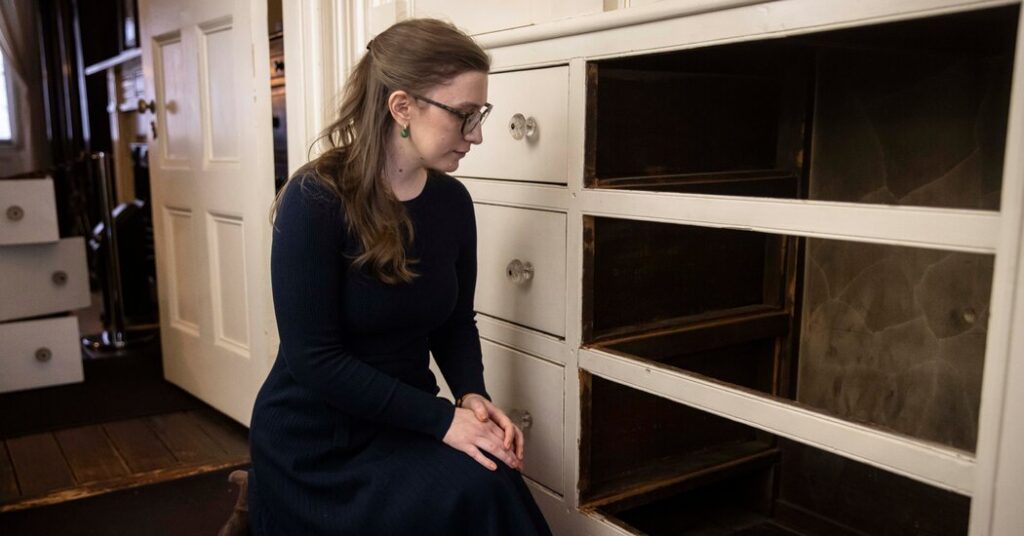
That includes built-in drawers in a dressing area on the second floor that connects two primary bedrooms.
On a recent visit, the gentle rattle of a wooden drawer being pulled out from the dresser led to something surprising: below the drawer, a hatch that led to a two-foot by two-foot opening. There, wooden rungs of a built-in ladder extended down to what would have been the basement pantry.
Mr. Brewster sold the house to the Tredwell family in 1835, who lived there until 1933. Because Mr. Brewster lived there for such a short time, museum staff members have focused on the Tredwell family and preserving their archives.
For a long time, the passageway was somewhat of a mystery. Theories included that it may have been a laundry chute or a secret passage for younger members of the family.
But two years ago, Ann Haddad, the museum’s historian, started looking into Mr. Brewster, and discovered there was more to him than selling hats on Broadway.
She found that Mr. Brewster was a fervent abolitionist and leader in social reform circles, spurred on by his commitment to a reform wing of the Presbyterian Church.
Mr. Brewster had signed at least two antislavery petitions and played a prominent role in founding and leading three antislavery churches, including one just a few blocks away, on Rivington Street, where documents showed he had instructed builders to include a false floor.
“In my mind, that indicates a dedicated and ardent abolitionist,” Ms. Haddad said. “You’re going to put your signature onto something that could blow you right out of the water in terms of your business, your safety, your security.”
Helping enslaved people would have been dangerous and costly in the early 19th century, when New York was a proslavery city, with heavy investment in the banking, insurance and merchant industries that relied on slave labor from the South, and where slave catchers ran rampant and often operated with impunity.
But the city was also a hub for the abolitionist movement, creating “community networks in which people were cultivating supplies, operating in secrecy and having churches or homes that were posts on the Underground Railroad,” said Kellie Carter Jackson, chairwoman of Africana Studies at Wellesley College.
The movement was predominantly led by free Black men and women, but white abolitionists were also part of it, and by the 1830s the movement became more formalized.
The drawer space was likely used by people in short-term hiding — to lay low while a slave catcher made a sweep or while company was over — before they made their way to a bigger space like a church and then moved north.
Ms. Jackson said she had seen attics, cellars and false floors as hideaways, but never a drawer. The discovery was reported by Spectrum News NY1.
“This is kind of exceptional,” said Ms. Jackson, who was not involved in the discovery. “What makes it so exciting is the creativity and ingenuity of people to hide someone in plain sight. You might suspect someone in a closet, you might suspect somebody under a bed, but you’re not going to think of someone in a dresser drawer.”
Ms. Jackson said she would not be surprised if Black laborers were part of the construction process, too.
Mr. Brewster would likely have developed trust and built relationships with people in Black communities “because no one was going to willingly trust a white person,” she said, and then, through word of mouth, shared news of the hideaway. “But none of that would have been written down or discussed publicly,” she said.
There are no records of who used the passageway or how. There is also no indication that the Tredwell family knew about the passageway or participated in the secret operation.
Not only is there a secret passage, but museum researchers noticed that the sliding pocket doors that separate the parlor from the dining room were unusually thick compared with other buildings of the same time, which could have been to accommodate the passageway hidden in the wall.
A museum report found the design to be “completely atypical” compared to other houses of the same time period.
“Pocket doors were intended to save space, and so our pocket doors don’t save space,” Ms. Hill-Wright said. “They have all this big fat wall that the pocket door slides into to accommodate the passage.”
The Merchant’s House was already a historically significant landmark, said Patrick Ciccone, a historic preservationist and author who specializes in New York City brownstones.
“This discovery adds orders of magnitude,” he said at a news conference at the museum.
Of more than 37,000 city properties with landmark protection, 17 sitesare related to abolitionism or the Underground Railroad, according to the city’s Landmarks Preservation Commission.
Mr. Ciccone said the location of the passageway may also have been situated to hide freedom seekers from other people in the house, including servants, who would have likely been Irish and lived on the top floor, he said.
The museum is working on a formal exhibit built around the passageway, but for now visitors can walk up the creaking staircase, past the rich mahogany furniture and red drapes and see the secret drawer passageway as part of a museum tour.
The small museum team is still studying many threads, including how Mr. Brewster included the passageway into his design, with whom he may have collaborated, and who might have passed through.
But because of the clandestine nature of the network, it’s likely many of those questions will remain unanswered.
“When looking for examples of intact spaces, everyone references the Merchant’s House, we’re the reference,” Ms. Hill-Wright. “When we’re trying to look for something else, that becomes a lot trickier.”
Remy Tumin is a reporter for The Times covering breaking news and other topics.
The post In the East Village, Hiding in Plain Sight: A Secret Passage to the Underground Railroad appeared first on New York Times.