The New York Times has covered the Winter Olympics for over a century, since the event was first held in 1924 in Chamonix, France. Over the years, The Times has also commemorated the deaths of some of the Games’ greatest champions, including a swaggering Finnish ski jumper, the youngest-ever Winter Olympian and the coach of the “Miracle on Ice” American hockey team that won a surprising gold medal in 1980.
Here are some of their stories.
Cecilia Colledge
British figure skater (1920-2008)
The youngest athlete ever to compete in the Winter Olympics — she was 11 when she appeared at the 1932 Games in Lake Placid, N.Y. — Colledge was also the first woman to execute a double-rotation jump in competition, at the 1936 European championships in Berlin. Read her obituary.
Herb Brooks
American hockey coach (1937-2003)
A coach for the University of Minnesota at the time of the 1980 Games, Brooks “molded an unheralded collection of United States hockey players, most of them collegians,” as The Times put it, into the “Miracle on Ice” team that stunned the Soviet Union, then hockey’s global powerhouse, 4-3. The U.S. team went on to defeat Finland for the gold medal. Read about his death.
Bob Suter
American hockey player (1957-2014)
Like many of the players Brooks recruited, Suter, a defenseman, had not played beyond the college level when he joined the U.S. team for the 1980 Games. About three months before the Games, he sustained a broken ankle in a preliminary matchup against the Canadian Olympic team. But he was able to play in Lake Placid, and was on the ice during the Americans’ upset win over the Soviet Union. Read his obituary.
Matti Nykanen
Finnish ski jumper (1963-2019)
Nykanen, whose nickname was the Flying Finn, won four Olympic gold medals, including three in 1988 at the Calgary Games. “He was kind of a savant,” Larry Stone, a former coach for the United States Skiing Association, told an interviewer in 2011. “He couldn’t tell you what he was doing, but he was absolutely the best in the world.” After his athletic career was over, Nykanen had a troubled life, with a record of alcohol abuse and episodes of violence, but he remained a national hero in Finland, where ski jumping is as popular as ice hockey or Formula 1 racing. Read his obituary.
Steven Holcomb
American bobsledder (1980-2017)
A degenerative eye disease threatened Holcomb’s vision and pushed him to attempt suicide in 2007. But he found a workable therapy, and at the Vancouver Games in 2010 he piloted a four-man bobsled team to the United States’ first gold medal in the event in 62 years. Read his obituary.
Dick Button
American figure skater and commentator (1929-2025)
Before he became an Emmy-winning TV commentator who was, essentially, figure skating’s global spokesman for decades, Button was a two-time Olympic gold medalist himself. He was the first American to win figure skating gold, and at the 1952 Games in Oslo, he executed the first triple jump in competition. Read his obituary.
Sonja Henie
Norwegian figure skater (1912-69)
Henie dominated figure skating in the 1920s and ’30s. Almost 100 years later, her influence is still felt on choreography and costuming: She favored white skates rather than then-standard black, and untraditional short skirts. Henie won Olympic gold three times — in 1928 (when she was just 16), 1932 and 1936 — and a week after winning her third gold, she claimed her 10th world championship in a row. She also achieved immense post-Games celebrity with her ice revues and as a film star in the 1930s and ’40s. Read her obituary.
Bill Johnson
American Alpine skier (1960-2016)
A swaggering skier who in 1984 became the first American man to win an Olympic gold medal in downhill skiing, Johnson was praised by President Ronald Reagan at a White House reception and landed endorsement deals and magazine covers. But his life took a series of wild, ultimately tragic turns, and he never returned to the Games. Read his obituary.
Jack Shea
American speedskater (1910-2002)
Shea grew up in Lake Placid and won two gold medals — in the 500- and 1,500-meter races — at the 1932 Games held in his hometown. His son competed as a skier at the 1964 Winter Games in Innsbruck, Austria, and his grandson was on the Olympic skeleton team in 2002 in Salt Lake City, making the Sheas the first family with three generations of Olympians. Read his obituary.
Jeanne Ashworth
American speedskater (1938-2018)
At the 1960 Winter Olympics in Squaw Valley, Calif., Ashworth was part of the first group of women to compete in speedskating at an Olympics, and won a bronze medal in the 500-meter race. Before the Games, she worried that the Russian women would sweep the women’s races, to which her mother replied, “Remember, they’re only human beings.” Read her obituary.
Jean Vuarnet
French Alpine skier (1933-2017)
When he arrived in Squaw Valley for the 1960 Games, Vuarnet was not France’s best hope for a medal, but he had an innovative technique: racing with his knees bent in a tuck position to reduce the drag on his body from the wind. It propelled him to victory, and the position, which came to be known as “l’oeuf,” or the egg, became standard practice. Read his obituary.
Rosi Mittermaier
German Alpine skier (1950-2023)
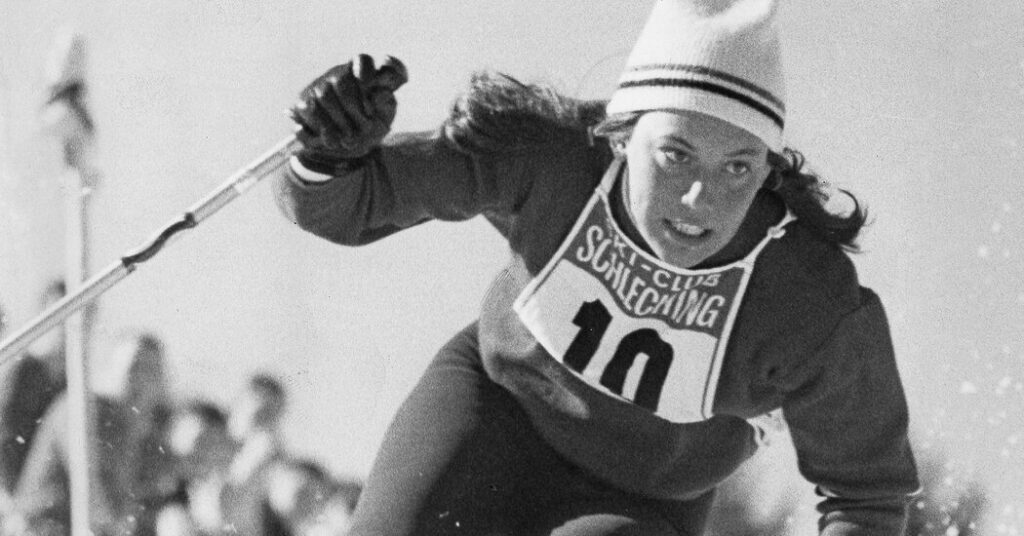
At the 1976 Games in Innsbruck, Mittermaier nearly achieved the unprecedented feat of winning three women’s Alpine skiing events in a single Olympics. But after taking gold in the slalom and downhill, she was bested by 0.12 seconds in the giant slalom by Kathy Kreiner, an 18-year-old Canadian. Mittermaier nevertheless emerged as the star of the Games and became a celebrity in Germany, earning the nickname Gold-Rosi. Read her obituary.
Ludmila Belousova and Oleg Protopopov
Russian figure skaters
This husband (1932-2023) and wife (1935-2017) team revolutionized pairs figure skating in the 1960s with a dreamy, balletic style. In 1998, The Times wrote, “Much of what is prized in a classical sense — the graceful unison, the fluid spins, sometimes even the choice of music — began with them.” They won gold medals in 1964 and 1968 for the Soviet Union and established a national tradition: From 1964 to 2006, Soviet or Russian skaters took the gold in pairs competition in 12 consecutive Olympics. Read her obituary and his.
Toni Sailer
Austrian Alpine skier (1935-2009)
Sailer was the first person to win three gold medals in Alpine skiing at the same Games, in 1956 in Cortina d’Ampezzo, Italy, a site of the 2026 Games. Off the slopes, he was a charismatic national hero, acting in films and recording pop songs. The Times wrote, “He looks like a movie star and skis like a dream.” Read his obituary.
Zachary Woolfe edits and writes obituaries for The Times.
The post How The Times Remembered 15 Winter Olympics Greats appeared first on New York Times.