1 p]:text-cms-story-body-color-text clearfix”>
CORTINA D’AMPEZZO, Italy — Freezing cold speed suits, sleek airbags and cut-resistent underwear. There’s more to Olympic ski racing than meets the eye.
A look at some of the procedures, methods and equipment you might not know about when you tune in:
2
What are those blue lines on the course?
p]:text-cms-story-body-color-text clearfix”>
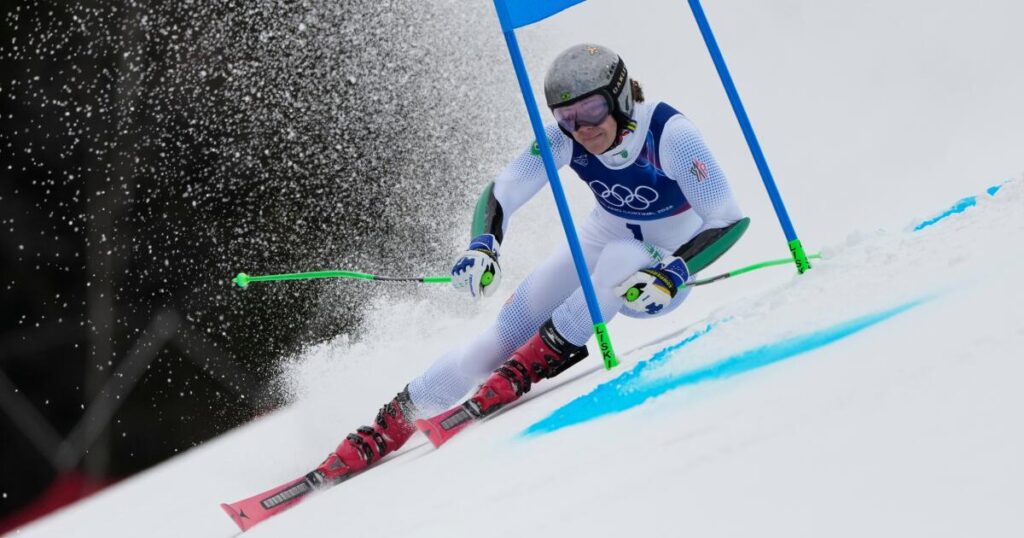
Those blue dye lines were introduced in 2001 on the World Cup tour to help racers — particularly in the speed events of downhill and super-G — navigate courses at high speed, especially in poor visibility. The skier has no obligation to stay within the blue borders, but the markings help them determine the best line down the hill.
If you’ve ever skied in the afternoon light, when it’s difficult to see any articulation in the slope, just white everywhere you look, you can understand how having those points of reference would be helpful.
“Any little bit of extra perception you’ve got about a bump, or the track, or a piece of terrain, then you can move over it much more confidently,” said Nina O’Brien, a member of Team USA.
It isn’t used much in slalom, but it shows up in the speed events and giant slalom. Not everyone loves the dye, however, because the chemical sprayed on the snow can be a little warmer if it’s fresh and might slow a racer by milliseconds if he or she skis over it. On the whole, though, competitors say it’s more helpful than not.
3
Why do slalom skiers intentionally hit the sticks?
p]:text-cms-story-body-color-text clearfix”>
Those poles that delineate the course — not just in slalom but all races — are called “gates,” and they are hinged at the base so they can bend down completely when hit by a racer and then snap back into a vertical position. They are typically screwed or hammered into the snow and often cemented in by water that turns to ice.
The shortest distance between two points is a straight line, and racers aim to take the shortest and most direct route to the finish line.
In downhill, super-G and giant slalom, the gates are two poles with a nylon panel stretched between them. While they try to take the optimal line, racers don’t intentionally hit those. We saw what happened to Lindsey Vonn when she accidentally hooked her arm on one and that apparently contributed to her violent crash.
In slalom, racers typically knock down gates with their arms or shins, which are protected by plastic shin guards. Sometimes, those gates can snap back and deliver a parting gift – a smack on the backside.
4
Is the snow soft for racers?
p]:text-cms-story-body-color-text clearfix”>
Not unless you consider an ice rink soft. A week or two before a race, a team of workers uses hoses to spray down the entire course with the intent of it freezing over by morning. Another method is to use injection-spray bars to create thousands of small holes on a course, using nozzles that force water into the snow. Whatever the method, it winds up a big sheet of ice, which makes it far more challenging and faster.
In the technical events of slalom and giant slalom, that requires razor-sharp edges. In the speed events, the racers spend more time on the bases of their skis.
“Even our coaches don’t go down where we ski; they ski down the side,” downhill racer Sam Morse said. “A recreational skier would just wind up in the nets.”
5
And what about those nets that line the course?
p]:text-cms-story-body-color-text clearfix”>
There are two varieties of fencing: A-net and B-net.
A-net is more rigid, often permanent, and used to prevent racers from flying off the course and into dangerous areas, off cliffs, into rocks and the like.
B-net is temporary and closer to webbing that’s aimed at absorbing the kinetic energy of a falling skier. Frequently, there are multiple layers of B-net with space in between that combined to act as a catcher’s mitt.
“They put nets where you have really big fall zones and high-speed sections, places where you need that extra level of protection,” Morse said.
It isn’t like tumbling into a pit of foam blocks, though.
“The A-net is much more like hitting a trampoline,” Morse said. “The B-net is designed to come out of the ground and wrap you like a blanket. … When you go into the nets, your boot buckles, your bindings, your skis, they all get tangled in the webbing.”
So what does it feel like when you’re going 70-80 mph?
“Terrible,” he said. “It’s like you’re in a washing machine getting hit with sticks.”
6
Do racers wear any protective gear that we don’t see?
p]:text-cms-story-body-color-text clearfix”>
Absolutely. Beneath those skin-tight speed suits, racers wear vests that automatically inflate almost instantly during high-speed crashes to protect the neck, back and chest. An algorithm — relying on accelerometers and GPS — analyzes movements 1,000 times per second to detect any potentially catastrophic falls.
In her crash last Sunday, Vonn’s airbag deployed.
Those vests were made mandatory for downhill and super-G on the World Cup circuit in 2024.
“There was quite a bit of disgruntlement among older athletes, because chest trauma isn’t a super high-occurring injury,” said Morse, who doesn’t mind the vests. “I’d love to see something that protects the knees, because that’s an injury you see a lot of.”
7
Anything else in terms of hidden protection?
p]:text-cms-story-body-color-text clearfix”>
Yes, cut-resistent underwear. That’s right, the racers are required to wear leggings that cannot be sliced through by skis with edges sharp as Cuisinart blades. That was added as a requirement last year.
The leggings are made of an advanced polymer — a distant cousin to a plastic milk jug — with fibers that are incredibly strong and durable.
“It’s not like chain mail or armor,” said Victor Wiacek, founder of VIX Protection, among the companies that make the leggings. “It doesn’t just stop a blade. It spreads the kinetic energy across the fabric. The yards can work almost like a conveyor belt, preventing energy from concentrating at a single point.”
8
Are those speed suits warm?
p]:text-cms-story-body-color-text clearfix”>
Nope. Ask any of the racers. On cold days, they will keep their jackets on as long as possible, before “stripping” — yes, they call it that — in the starter’s hut before they race.
When they cross the finish line, they quickly bundle up again.
Just more incentive to get down the hill as quickly as possible.
The post Airbags, blue lines and good underwear: 6 features of Olympic skiing you should know appeared first on Los Angeles Times.