MILAN — Can you picture it in your head?
Olympic ski racers can and do. Again and again and again.
Visualization is a huge part of racing, particularly in the speed disciplines of downhill and super-G, and a lot of competitors close their eyes and run the course on a loop in their minds, dipping and swaying with every turn, roller and jump.
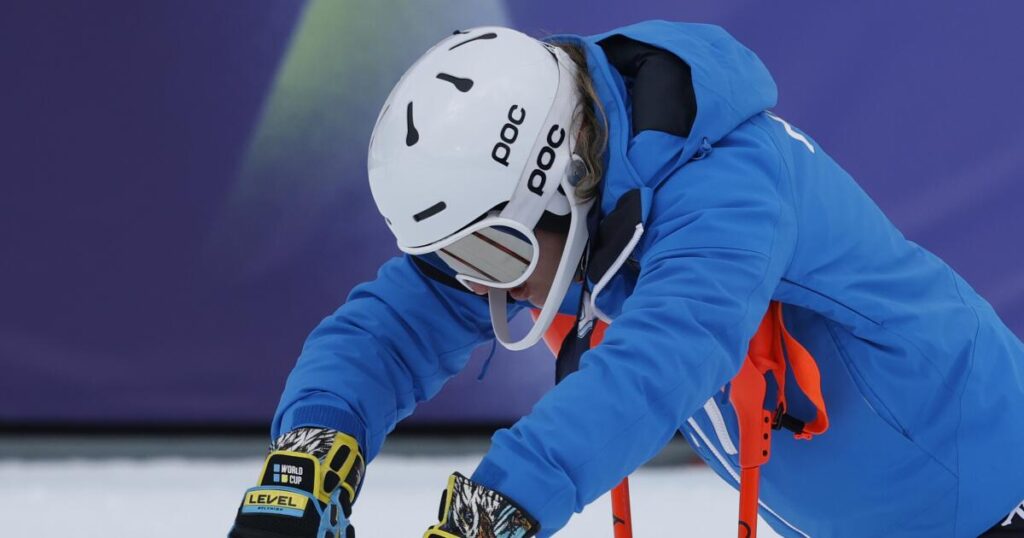
“Pretty much everyone’s visualizing the course turn for turn at this point,” U.S. downhill racer Sam Morse said. “My wife always jokes that after [course] inspection, we all lean on our poles and do the close-your-eyes and move-your-hands-with-the-turns thing, we all look like zombies. She calls it zombie time.”
The practice isn’t unique to skiing. Figure skaters close their eyes and go through their routines. Lugers tilt to an imaginary track. As any sports psychologist can tell you, it’s a fundamental building block for success.
In skiing, there’s a very defined process that leads to that. Each racer is given roughly an hour to “inspect” a course, gradually sliding through each turn and making note of the best line, the steepness of the pitch, the quality of the snow. They are like PGA Tour caddies checking out the pin placements the day before a tournament.
It’s not just about going down, either. It’s going down 100 feet or so, popping off your skis, and hiking back up the section to examine it again.
“The inspections are timed,” Morse said. “You’ve got to be off the course at a very specific time, and if you’re not, you can get sanctioned. So I inspect with a watch on.”
Whereas a caddie jots down notes in a yardage book, Morse keeps observations on his phone and refers to them year after year. Whereas slalom, giant slalom and super-G courses change from race to race, downhill courses tend to stay the same with identical gate placements.
Inspection is only the first step. Then comes the memorization. Some racers learn a course the way an actor learns lines. Memorize the first part, then the first part plus the second part, and so on. Others can look at a piece of paper and commit a course to memory the way a musician reads sheet music.
“We get these sheets that have distances between gates, pitch of the hill, kind of angle between the gates,” said A.J. Hurt, a member of the U.S. women’s team. “I find that honestly to be the most helpful, other than the actual inspection.”
Hurt has a math mind, and she prefers measurable information to imagery.
“You can’t tell the exact distance when you’re slipping through it,” she said. “I can never really tell, so it’s nice to be able to see it on paper.”
In the speed disciplines, finding the ideal line is paramount. But Hurt said that’s not as helpful in the technical events.
“In slalom and GS, I feel like it’s more important just to have a good feeling rather than to know exactly where you’re going,” she said. “I tend to overthink it when I know too much.”
Teammate Nina O’Brien agreed.
“I try to have the best balance of having a plan to execute but not overthinking every turn,” she said. “Because sometimes it’s easy to think too much about every single gate, and you almost lose the flow or athleticism that you really need to ski fast.”
Then comes the physical rehearsal.
“It’s not just purely in your mind,” said O’Brien, who imagines the course through her eyes as opposed to a top-down view or something else that a video game might offer.
“I get my core involved and my legs, and I’m almost trying to fire my muscles as I’m imagining it, just to make it feel a little bit more real.”
Hurt, who relies more on the data, is among the rare racers who doesn’t go through visualization exercises.
“I’ve never found that I’m very good at it,” she said. “I never thought it helped me.”
But in a sport with so many variables, most of all the weather and snow conditions, visualization only helps so much.
“We make an assessment and judgment of how turny it is,” Morse said. “Then we watch the first couple of guys go and change the plan sometimes.
“You really try to visualize to the point where you commit to your subconscious memory,” he said. “Because the course is coming at you fast and you need to be reactive.”
It’s like that axiom in football, about practicing something over and over, so in that flash of a moment your body knows what to do even if your brain hasn’t caught up:
When you think, you stink.
The post Visualizing success: Why Olympic skiers mentally rehearse before every run appeared first on Los Angeles Times.