Just over 40 years ago, Tumbler Ridge, British Columbia, was created as a vision of Canada’s future.
Although it was hacked out of deep mountain woods as a base for two new mines to supply coal to Japanese steel makers, it had little in common with most Canadian resource communities aside from its remoteness.
In this new model of a resource town, the vast open-pit mines were built well outside the community. The province of British Columbia rejected work camps for the miners in favor of tidy family homes linked by carefully designed curving streets, green spaces and a downtown within walking distance of most residents. It is a place where people don’t lock their doors.
Now the peaceful mountain isolation of Tumbler Ridge is over.
To the shock of Canadians, most of whom had probably never heard of the town of 2,400 before Tuesday, six students were shot dead in the high school and two other people were shot and killed at a home. The 18-year-old shooter ultimately killed herself.
[Read: The Young Lives Lost and Upended in Canada’s Mass Shooting]
I arrived in the aftermath. The scene in the town was reminiscent, if different from in many ways, of what I found in Humboldt, Saskatchewan, in 2018 after the bus collision that killed 16 players and staff members from the town’s hockey team.
Despite the unseasonably mild weather, much of Tumbler Ridge took refuge in their homes. The people who did go out wore dazed looks of profound shock.
Most of the victims were just 12 or 13 years old. I’m unable to adequately capture the grief I witnessed when Sarah Lampert remembered, at times in a barely audible whisper, her 12-year-old daughter, Ticaria, or Tiki.
[Read: What We Know About the Deadly Mass Shooting in Canada]
The shooter, Jesse Van Rootselaar, also killed her mother, Jennifer Jacobs, 39, and her 11-year-old brother, Emmett Jacobs, in their home. On Friday, investigators in coveralls were still going in and out of the house. Two bicycles were stuck in the snow in the front yard.
Ms. Van Rootselaar’s history of mental health problems leading up to the shooting rampage also highlighted what several residents told me has been a longtime concern of the community: the limited access to health care generally in the Tumbler Ridge area and the near total absence of mental health support.
Most medical appointments involve a drive of 90 minutes to two hours over mountain highways that are often treacherous in winter. Full mental health services are four hours away and are often overwhelmed. Recent cutbacks mean that emergency services in the town’s medical clinic are now offered only during business hours. Anything else involves a long ambulance ride or an air evacuation.
My colleagues Matina Stevis-Gridneff, Vjosa Isai, Aric Toler, Pranav Baskar, Malachy Browne and Amy Harmon examined and verified the online history Ms. Van Rootselaar left behind. It depicts a young person’s gradual descent into mental health crises and radicalization into extreme violence.
[Read: Before Mass Killing, Mental Breakdowns and Online Violent Extremism]
As the week wore on, most people became reluctant to be quoted about the horror that had fallen on Tumbler Ridge. But they would talk informally. Many spoke about the surrealism of having the world’s attention turned on their small town and its tragedy.
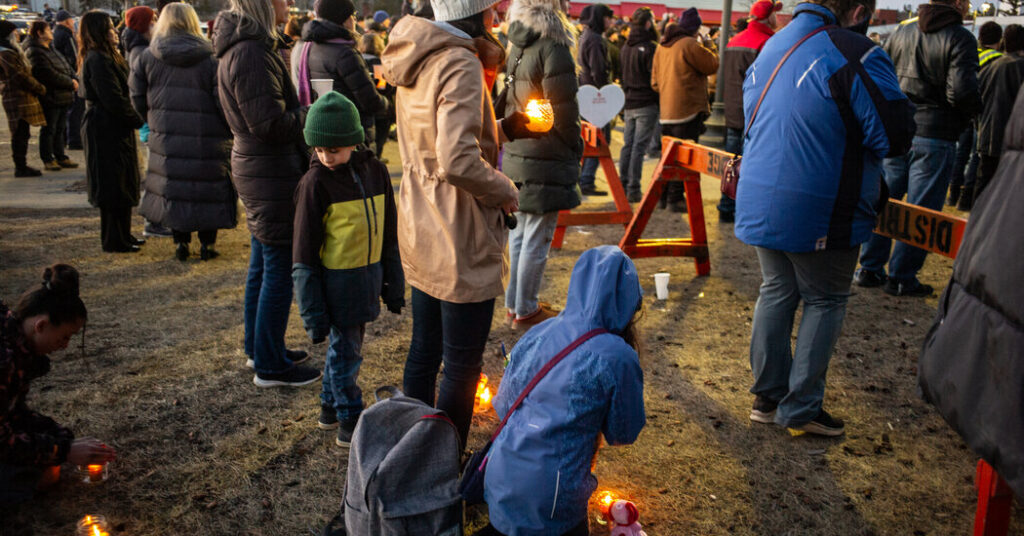
That was further highlighted on Friday night when a contingent of political and ceremonial leaders joined the community vigil in front of the town hall. The group included Prime Minister Mark Carney; Pierre Poilievre, the Conservative opposition leader; and Governor General Mary Simon.
The predominantly red paint scheme of the town hall, along with some holiday lights remaining in trees, was incongruous in appearance but couldn’t hide the community’s sorrow.
After remembering the victims and praying for those still recovering from injuries, Mr. Carney had a message for those who had lost their children.
“When we leave here tonight, some you will go back to quiet houses; some of you will go home to empty rooms,” he said. “Please know that you’re not alone.”
Trans Canada
This section was compiled by Shawna Richer, an editor on the International desk at The Times.
-
My colleagues Vjosa Isai and Ian Austen reported on President Trump’s threats to block a new bridge connecting Canada and the United States that aims to ease congestion at the Windsor-Detroit crossings, the busiest trade corridor between the two nations.
-
And The Times’s Canada bureau chief, Matina Stevis-Gridneff, and Tyler Pager reported on a meeting between the billionaire owner of a competing bridge, Matthew Moroun, and Howard Lutnick, the U.S. commerce secretary, hours before Mr. Trump said he would block the bridge.
-
In Washington this week, the House voted to rescind tariffs that Mr. Trump had imposed on Canada last year. The move is politically consequential but may be mostly symbolic.
-
Michael Levinson reported on the news that Ontario would allow public colleges and universities to raise tuition as part of a broader plan to boost funding for higher education.
-
Catherine O’Hara, the Canadian film and television actress, died of a pulmonary embolism with an underlying cause of rectal cancer, according to a death certificate.
-
At the Olympics in Milan, my colleague Tariq Panja reported on Zachary Lagha and Marjorie Lajorie, the Canadian icing dancing pair, and the challenges they faced in their routine concerning music rights.
-
And from The Athletic: Canada’s men’s hockey team played statement games against Czechia and Switzerland, and the women routed Finland. Here’s a primer on the rivalry between Canada and the United States.
-
The Times’s weather desk took an aerial view of North America’s harsh winter, nowhere colder and snowier than in parts of Canada.
-
Sadiba Hasan has the story of Michael Asibuo, who was born in Montreal and drafted by the Calgary Stampeders in 2020. These days he helps men feel more confident in their dating lives.
-
The mockumentary “Nirvanna the Band the Show the Movie,” an oddball comedy set in Toronto from the Canadian filmmakers Matt Johnson and Jay McCarrol, who also star in the feature. Read our review.
-
A groundswell of scholars and artists are keeping the flame of Edmonia Lewis, an artist with Canadian lineage, alive in new projects.
-
Frances Robles reported on the Trump administration’s crackdown on oil shipments to Cuba as Canadian airlines canceled flights to the island nation.
Ian Austen reports on Canada for The Times. A Windsor, Ontario, native now based in Ottawa, he has reported on the country for two decades. He can be reached at [email protected].
How are we doing? We’re eager to have your thoughts about this newsletter and events in Canada in general. Please send them to [email protected].
Like this email? Forward it to your friends, and let them know they can sign up here.
Ian Austen reports on Canada for The Times. A Windsor, Ontario, native now based in Ottawa, he has reported on the country for two decades. He can be reached at [email protected].
The post Tumbler Ridge Is Forever Changed appeared first on New York Times.