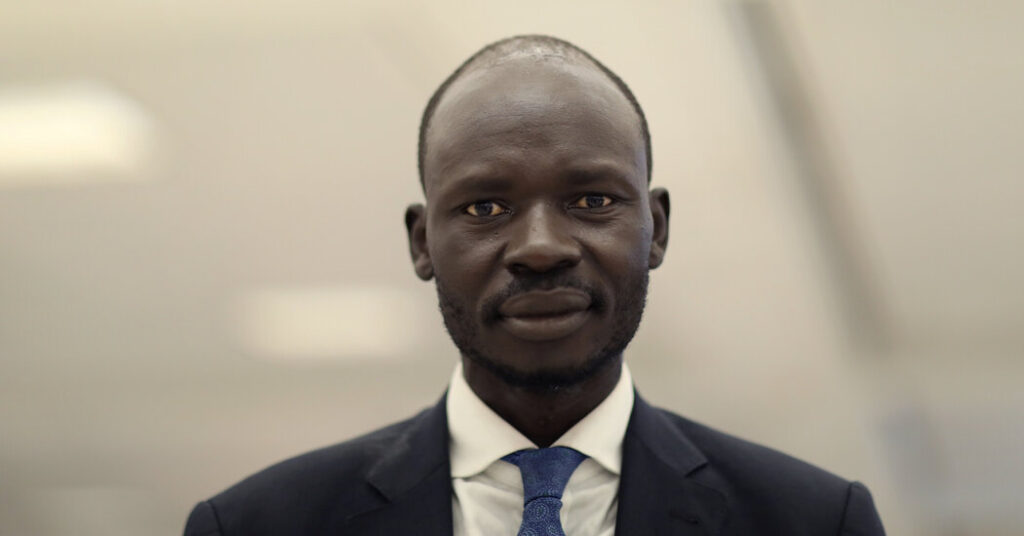
Before Peter Biar Ajak got caught in a sting and was accused of plotting to buy millions of dollars’ worth of weapons for a coup in South Sudan with funds from an unwitting Wall Street financier, he was known globally as a peace activist.
Mr. Ajak came to the United States in 2001 at 17 among a group of young refugees called the “Lost Boys of Sudan.” Trained as a child soldier, he transformed into a vocal champion of peace and of democracy.
But last week, a federal court in Arizona sentenced Mr. Ajak, 42, to prison after he pleaded guilty to conspiring to violate U.S. weapons export laws. He had admitted he tried to buy missiles, grenade launchers, anti-tank weapons, machine guns and ammunition for a revolt in South Sudan, using money provided by the financier for humanitarian assistance.
It was a stunning downfall for a man who had accumulated a long list of academic and professional credentials and was hailed as a luminary for his political and humanitarian activism in academic and activist circles.
His case underlines the unrelenting crises in South Sudan, the world’s youngest country, which is teetering on the edge of starvation and more civil war.
From ‘Lost Boy’ to Harvard
Mr. Ajak’s odyssey from Sudan to an arms warehouse in Arizona where he was arrested in 2024 is laid out in court records, articles, interviews and his writing over the years.
Around the late 1980s, thousands of youths trekked from war-torn Sudan to refugee camps in Ethiopia and Kenya, migrations that continued over the next decade. They came to be known as the Lost Boys of Sudan. Many did not survive these journeys. For those who did, the conditions were difficult. About 4,000 orphans and boys separated from their families, including Mr. Ajak, were resettled in the United States beginning in 2000.
Within a decade of arriving stateside, Mr. Ajak had graduated from high school and college in Pennsylvania, earned a master’s degree from Harvard and made his way back to Sudan as an economist at the World Bank.
In 2010, he married Nyathon Hoth Mai, the daughter of a general who is now South Sudan’s labor minister.
When the Republic of South Sudan was carved out of Sudan in 2011, becoming Africa’s 54th state, Mr. Ajak served as an adviser to the new country’s national security minister. It seemed as if he were living the dream his father had fought for: establishing a democracy in the divided land.
“The peace agreements must be protected, not only by soldiers but also by having the right policies in place,” Mr. Ajak said in an interview at Harvard around that time.
But the dream kept being deferred. Two years after South Sudan gained independence, fighting broke out between competing factions aligned with the president, Salva Kiir, and vice president, Riek Machar.
As the new nation plunged into civil war, Mr. Ajak began leading a youth movement, criticizing leaders and calling for elections. His activities landed him in a South Sudanese prison in 2018, without charges or explanation.
His imprisonment generated widespread alarm, and calls for his release came from around the world.
Still, he was held for about 18 months, during which he was convicted of disturbing the peace and inciting an uprising. In 2020, after Mr. Ajak was pardoned, he emerged from prison, by his own account, underweight, with liver, kidney and back problems and in need of psychological counseling.
Mr. Ajak again sought refuge in the United States, this time with his wife and children in tow. He joined a network of influential people, including Garry Kasparov, the chess grandmaster and democracy activist. It was Mr. Kasparov who connected Mr. Ajak with the Wall Street financier Robert Granieri when the activist said he was seeking money for civic and humanitarian activities, court records show.
Publicly, Mr. Ajak was calling for elections, laying out plans to “provide the best opportunity for establishing a state upon which the South Sudanese people can eventually build a democratic future.”
Privately, he was growing impatient and thought it was time to do “something different,” he told federal agents masquerading as arms dealers in 2023. The agents had been tipped off about South Sudanese operators seeking weapons, and through a series of connections, had linked up with Mr. Ajak.
Mr. Ajak was looking for millions of dollars worth of arms in order to “spark a revolution” and execute “basically a coup,” he told the agents, according to court records.
‘Operation Free South Sudan’
Mr. Granieri, an elusive founder of the quantitative trading firm Jane Street, had agreed to pledge $7 million for what he believed would be humanitarian aid for South Sudan. According to the federal agents, Mr. Ajak said he would use “creative” invoicing to bill the arms as “humanitarian support for democracy,” deceiving his financier and the banks.
Neither Mr. Granieri nor Mr. Kasparov was accused of any wrongdoing, and their connection to Mr. Ajak appeared in court records because Mr. Ajak’s lawyers mentioned them. After the financier’s involvement became public, Mr. Granieri’s lawyer said in a statement that his client had been defrauded, Bloomberg reported.
According to court records, Mr. Ajak shared an 18-page memo called “Operation Free South Sudan” with the undercover agents. It detailed how he would fuel a public uprising in South Sudan by prompting protests that the government was expected to respond to violently, and he would take over.
He would become the “interim president” of South Sudan after the coup, he told the agents. (Later, he told a federal judge that he was just one of several potential candidates for the role.)
After millions of dollars were transferred, Mr. Ajak went to a meeting to inspect the weapons at a warehouse in Arizona in March 2024, the authorities said. He was arrested, and he and an associate were charged with conspiring to export about $4 million in weapons.
Mr. Ajak — who had earned more credentials since his stint in a South Sudanese prison, including a doctorate in politics at Cambridge — was promptly placed on administrative leave at the Harvard Kennedy School, where he had been a postdoctoral fellow in international security.
PaanLuel Wël, the founder and editor of a news blog about South Sudan that had celebrated Mr. Ajak, said that if the charges were true, the activist had “not only jeopardized regional stability, but had also undermined efforts towards peace and security in South Sudan.”
In a recent sentencing memo, prosecutors told the judge that although Mr. Ajak had “endured severe hardships” as a child, he was among “nearly 20,000 other Lost Boys who were similarly displaced” who “did not direct a complex illegal weapons scheme.”
Mr. Ajak “was uniquely capable of bringing about positive change through legal means, had his self-reported ‘impatience’ not gotten the best of him,” the prosecution added. “As a leader in the South Sudanese community, defendant arguably bore a greater responsibility to serve as an example.”
Last year, Mr. Ajak pleaded guilty to reduced charges. Last week, he was sentenced to 46 months, with credit for time served, and three years of probation.
Mr. Ajak’s lawyer, reached by phone, declined to comment.
With his conviction, Mr. Ajak could be sitting in an American prison if the long-delayed elections he has called for in South Sudan are finally held this year as scheduled. But some analysts doubt that a vote will be held.
Ephrat Livni is a Times reporter covering breaking news around the world. She is based in Washington.
The post The Peace Activist Who Was Caught Plotting a Coup appeared first on New York Times.