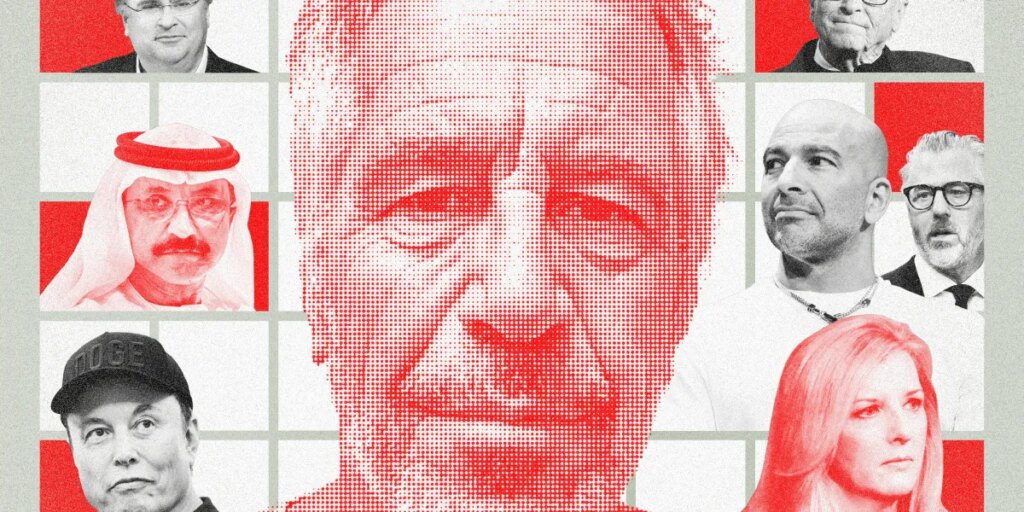
Two weeks after the U.S. Justice Department’s latest batch of 3 million Jeffrey Epstein files revealed the business elite—from Hollywood to New York to Dubai—who were friendly with the late, disgraced financier, the corporate world is still sifting through his murky paper trail. And boards and business leaders are facing tricky questions as they decide how to dole out consequences for executives who were Epstein’s close confidantes even after he was convicted of sex crimes in 2008 and registered as a sex offender.
Among the thorny questions they’re asking: Who knew what, when? Did an executive commit a crime or just exhibit bad judgement? And to what standard do we hold leaders in a society that has developed a high tolerance for scandal?
Now, we are starting to get answers—and some corporate heads are starting to roll.
On Thursday, Goldman Sachs said general counsel Kathryn Ruemmler will leave the bank in June after the documents showed she stayed in close contact with Epstein until 2019, at one point calling him “Uncle Jeffrey” as she thanked him for high-end gifts. And on Friday, Dubai-based logistics group DP World named a new chair and new CEO, signaling the departure of Sultan Ahmed bin Sulayem whose emails with Epstein included references to sexual experiences. Both ousters followed earlier resignations in the U.K. public sector, namely those of former U.S. ambassador Peter Mandelson from the House of Lords and Morgan McSweeney, Prime Minister Keir Starmer’s chief of staff who’d advised on Mandelson’s appointment.
But if Ruemmler and Sulayem have faced professional consequences for their association with Epstein, many others have not. The slow, cautious-to-the-point-of-tepid response of the business world to its leaders’ chummy correspondence with a known sex offender reveals a confounding aspect of the Epstein saga: The documents released so far don’t offer proof that all of his correspondents engaged in criminal behavior. And that grey area can make inaction the most palatable approach in a corporate governance environment in which poor judgement—even exceptionally poor judgement—is not automatically a fireable offense.
Corporate consequences come unevenly
There’s public pressure on companies that employ people named in the Epstein files to act. Questions like “why haven’t they been fired?” or “why weren’t they fired sooner?” are being asked online, by customers, and by clients.
But whether bad judgment costs someone their job is not black and white; it often comes down to a cost-benefit analysis on the part of people with hiring and firing authority, says Jill Fisch, a professor of business law at the University of Pennsylvania’s Penn Carey Law School. “So bad judgment, but weighed against whatever we think the virtues or advantages or strengths of this particular person are.” (Ruemmler, a former counsel to Bill Clinton and Barack Obama, was seen as a superstar.)
And there are a few other factors tipping the scales in favor of Epstein’s associates. For one, the number of business elites in Epstein’s network is now so vast that the public outrage and pressure on CEOs and boards to act is spread thin. “It’s kind of an obvious thing for a board to feel like, ‘Gee, lots of top executives, lots of respected people in industry and finance had some sort of connection [to Epstein]. Therefore, we don’t expect them all to be shunned from industry,” Fisch says.
There may also be a desire among decision makers to be more deliberate in defenestrations than during the MeToo era, when corporate cancellations were swift and arguably, in some cases, rash. “There was a time, possibly, when our instinct to cancel people was overly zealous, and this, in part, might be that we don’t want to keep doing that,” Fisch explains.
And then there’s an overarching sense in These Times that “scandalous, unethical behavior today is just another story, and we kind of move on from it,” says N. Craig Smith, chair in ethics and social responsibility at the business school INSEAD. In the past, he says, “people would be fired for appearances. People [were] fired for doing stuff in their private lives that reflect badly on the company.” But now, Smith argues, the business world is following the example set by the Trump White House, which has brushed off numerous controversies that might have imperiled past administrations, including its own ties to Epstein.
“There’s sort of mimicking,” he says. “There’s sort of an environment where stuff that previously would have been sanctioned is no longer being sanctioned.”
Sometimes optics, not rules, decide the consequences
Of course, these questions apply to only a subset of figures in Epstein’s orbit; there’s a whole other class who seem to answer to no one: the Elon Musks, Bill Gateses, and Reid Hoffmans of the world. (These multi-billionaires all deny any wrongdoing.)
And even Ruemmler’s departure seems to have been her own decision. She told the FT that “the media attention on me, relating to my prior work as a defense attorney, was becoming a distraction.” Goldman has stood by Ruemmler publicly, with CEO David Solomon praising her as “one of the most accomplished professionals in her field” and declaring that “she will be missed.”
To be sure, top-down accountability is not the only kind. Many of Epstein’s allies are suffering reputational damage, Paul Weiss managing director Brad Karp (who once called Epstein “amazing”) stepped down from his leadership role after a revolt by his peers, and clients of the Wasserman talent agency, like Chappell Roan, are leaving due to founder Casey Wasserman’s ties to Epstein’s network. (Wasserman is reportedly putting his firm up for sale.) So it’s possible that consequences for associating with Epstein may still be doled out—in one form or another.
Whatever the reasons, the business world’s apparent reluctance to take its own swift, decisive action against Epstein’s inner circle risks setting the moral bar so low—that illegal acts are the only disqualifier—that it dissolves what little public trust the sector has left.
“Nobody has a right to be a CEO or a managing partner of a huge law firm; that’s an enormous privilege,” says Archon Fung, professor of citizenship and self-government at the Harvard Kennedy School. “Part of why you’re elevated to that position is people think you have really good judgment, certainly about the business part. So is it appropriate in society to say, well, judgment about character and standards of behavior is an important part of what we demand of these people? So far, in the U.S., the answer seems to be no.”
The post The Epstein files reveal an alarming new normal for corporate America appeared first on Fortune.