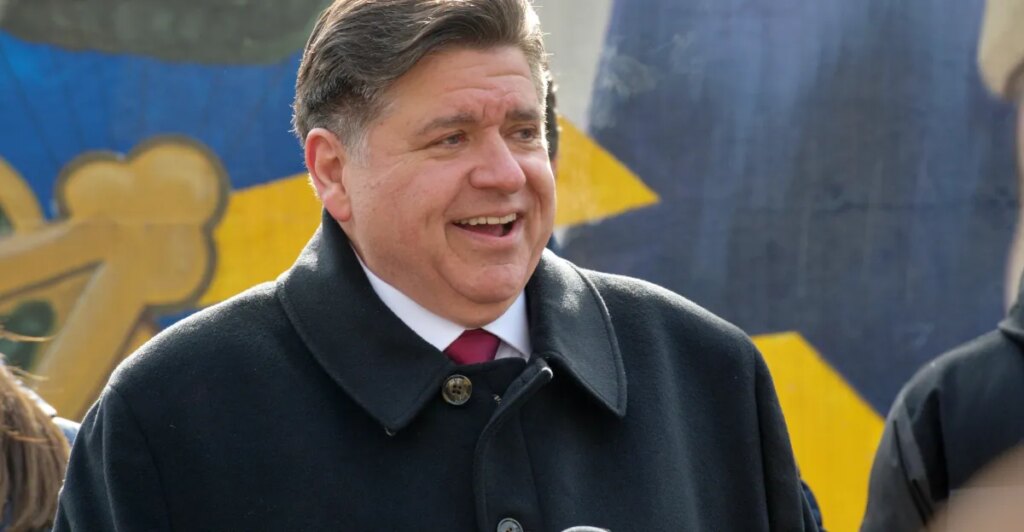
Few Democratic politicians have leaned into the fight against the Trump administration as aggressively as Illinois Gov. JB Pritzker. While some blue-state leaders have tried to find a lane of compromise or quiet resistance, Pritzker has gone the other direction — signing laws to limit ICE operations in the state, creating the Illinois Accountability Commission staffed by retired federal judges, suing the federal government, and successfully blocking the deployment of federalized National Guard troops on Chicago’s streets.
Pritzker has turned Illinois into a test case for what organized state-level opposition to President Donald Trump’s administration looks like — and has modeled a playbook he hopes other blue-state governors can follow.
Pritzker is a unique figure in Democratic politics. A billionaire heir to the Hyatt hotel fortune, he has spent tens of millions of his own dollars pushing for a more progressive income tax in Illinois and advocates for a national wealth tax — policies that would directly cost him money. He’s also a Jewish Democrat who has navigated his party’s shifting positions on Israel and Gaza, and a two-term governor who has drawn some public support as a potential 2028 presidential candidate.
In our conversation, we talked about all of it: the Illinois playbook against ICE, what Democrats are getting wrong on messaging, the wealth tax, health care, antisemitism, AIPAC, and what Pritzker thinks the party needs to do to start winning again. Below is an excerpt of our conversation, edited for length and clarity.
We want to talk about how you’ve positioned Illinois as a ground zero for pushing back against Trump’s immigration enforcement. You signed a law limiting ICE in Illinois. You created the accountability commission. You all sued the federal government. I wanted to know if you could describe the playbook that Illinois has laid out for what to do if Trump comes to town.
It starts with making sure people know what their rights are when ICE agents are banging on your door. Do you have to open the door? What is it that they’re allowed to do and not allowed to do — and then the second thing, and this is what I told everybody very early on: pull out your iPhone, pull out your Android phone, video everything. And I’m talking about not just the people who are being pursued, but you people in the neighborhoods who want to protect their neighbors. And they did that… That evidence came in handy when the ICE and CBP agents were taken to court here. And we won.
I wanted to dig into this because Trump gave you an ultimatum saying to activate the National Guard or they federalize your troops. You called that an authoritarian march. But at the end of the day, 300 Guardsmen still came to Chicago. There were hundreds of arrests there. Trump got the show he wanted, too. What do you think was the tangible impact of that playbook you’re laying out? What do think you all succeeded in resisting?
Well, he federalized our National Guard, but was not allowed to deploy them in our streets. They were never deployed in the city of Chicago. They had to stay on a federal base until it was determined by the court — including the Supreme Court — that indeed he doesn’t have the ability to send his, you know, federalized National Guard or my National Guard into our streets.
I wonder if the implication here is somewhat that blue states have been too timid in pushing back against Trump. It seems like implied in what you’re laying out is a kind of call to action for other Democratic states.
Well, it’s certainly true that we’ve got to stand up and push back. And I’m talking about peaceful protests and encouraging people to do as I’ve described, to video everything, to stand up. And by the way, I know that protesters hold up signs and they say — maybe the law enforcement agents feel like it’s terrible things they’re saying. But that is what protest is about, right? People showing up and making their voices heard. And it’s very important for us to protect that right.
Democrats have also been a part of funding and expanding ICE over the years. As recently as 2024, I remember Democrats on the presidential campaign trail agreeing that illegal immigration was a problem. Cities like Chicago have struggled with the increase of undocumented migrants in recent years — I remember my family who lives in the suburbs here talking about how they see more people on the street over the last four or five years.
Sometimes it feels as if Democrats want deportations to happen. They just want them to happen quietly and not necessarily like we’re seeing from the Trump administration. Is it just a matter of tone here, or what is the tangible difference between what Democrats want to happen versus what Donald Trump is doing?
The tangible difference is ICE and CBP today under Donald Trump are stopping US citizens who are Black and brown and demanding to see citizenship papers. Now, I don’t know about you, I don’t get asked for citizenship papers. I don’t have any on me. But they’re doing it, and they’re doing it to people who are not undocumented, they’re doing [it] to people who are here legally, people who have lived here maybe generations, US citizens… The difference is that they’re racially profiling.
So should ICE be abolished?
It is fundamentally different, what Donald Trump is doing with it. What he’s doing with it should absolutely be abolished. And it’s got to be replaced. It’s just got to be wiped away and replaced. Donald Trump has turned them into a secret police. And I do not believe that we want secret police on the streets of our cities and of our country.
So when you say stop the funding, stop your occupations, stop the killing, that is meant to be —what you’re saying is that that amounts to a call to defund and replace ICE.
That’s what I’m saying. I think what they’re doing in the Senate right now, holding up DHS funding, precisely to get a lot of rules and regulations around what’s happening, because people are getting shot in the streets by ICE and CBP, is the right thing to do.
I want to also talk about taxes. You’ve spent $58 million of your own money trying to pass a graduated income tax in 2020 that voters rejected 55 to 45. I know you’re in favor of a wealth tax nationally. You yourself are someone who would fall under said wealth tax. Tell me how you came to supporting an idea of something that would cost you money.
I’m a Democrat. I believe that it is our obligation to have a government that stands up for the middle class, the working class, the most vulnerable. You’ve got to pay for that somehow. And it shouldn’t fall on the backs of the middle class and the working class mostly. It should fall on the backs of the people who can afford it. And so I really believe in a graduated income tax. We have constitutionally in the state of Illinois, a flat tax. I know there are lots of people who like that fact, but mostly they’re the wealthiest people who like that fact because they don’t like the graduated income tax that exists at the federal level either.
So is it about raising revenue or is it more ideological? Were you always someone who was supportive of a wealth tax? Tell me about your kind of journey on that question.
You call it a journey. Listen, I’ve been a Democrat my whole life. I grew up in a household where we were…
There’s a lot of Democrats, particularly wealthy ones, who don’t believe in something like a wealth tax.
I don’t know what to say about that. I can tell you this — that we need…you got to pay for roads. You got to pay for, you know, government. You got to pay for the supports that the most vulnerable need, somehow. And so the question is, who should that burden fall on? People who can’t afford it or people who can?
Fair. You’ve been traveling to New Hampshire. The state has pushed to move Illinois up in the Democratic primary. I recently read James Carville publicly backed you for president in 2028. I know you’re immediately running for a third term for Illinois governor, but I would not be a journalist if I didn’t just directly ask you — are you someone who we should be thinking about as a 2028 presidential candidate?
I’m running for reelection like you just said. Now that is what I’m focused on. I’m obviously flattered that people have talked about me for national office. I, you know, look, I’m the governor of the fifth-largest state in the country. And I’m very proud of that fact. But I’m focused on the accomplishments that we need to make and that we’ve made, in the state of Illinois and for the people of Illinois.
Today, Explained publishes compelling interviews with key figures in politics and culture every Saturday. Subscribe to Vox’s YouTube channel to get them or listen wherever you get your podcasts.
The post The Democratic governor building a playbook to resist ICE appeared first on Vox.