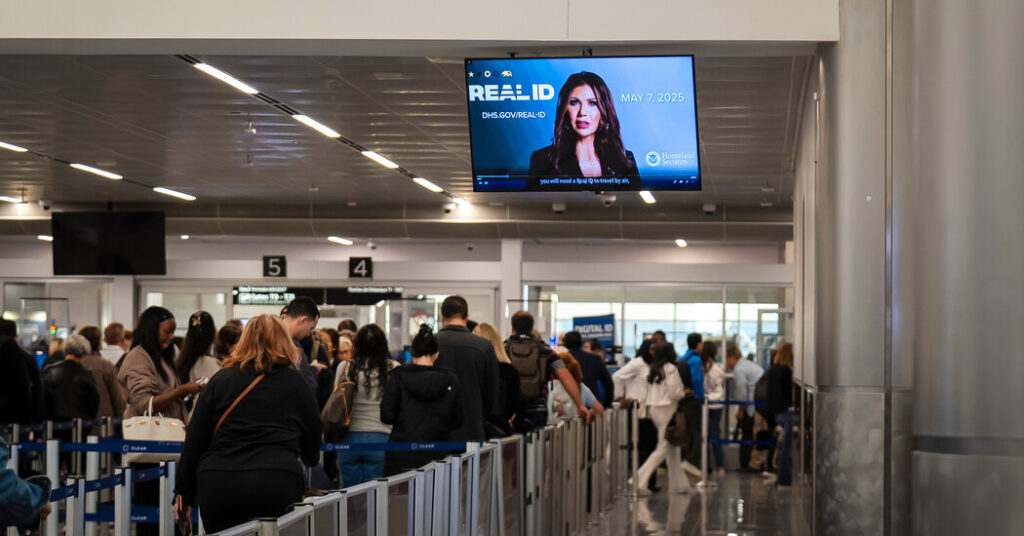
When the Department of Homeland Security ran out of funding early Saturday, employees at the Transportation Security Administration assumed an unfortunately familiar role: the face of the latest impasse in Congress.
Lawmakers left town this week without a deal to fund the department over a disagreement about reining in the Trump administration’s hard-line immigration enforcement tactics. Most of the hardships faced by employees — who are working without pay — will go unnoticed by the public with a few possible exceptions, including the people who check IDs, scan baggage and complete other security tasks at U.S. airports.
Several previous government shutdowns ended when the T.S.A.’s work force began to buckle in a way that started to inconvenience travelers, a pressure point that could come in about two weeks from now when T.S.A. employees will miss their first full paycheck while continuing to incur normal costs of living.
It is an especially hard hit for T.S.A. employees this time around, because many are just coming out of the financial strain they suffered during last year’s 43-day shutdown. Some were evicted from their homes, others could not afford gas to commute to and from the airport, and some could not afford medicine or day care for their children.
And some are still bitter they did not receive a $10,000 bonus that the homeland security secretary, Kristi Noem, said would be awarded to those with “exemplary service” during the last shutdown.
“Everybody’s really nervous,” said Roberto Echeverria, a lead transportation security officer at Salt Lake City International Airport. He said some of his colleagues had been preparing for this scenario for the past month, trying to pick up as much overtime as possible to have somewhat of a cushion for when they missed their first full paycheck.
Mr. Echeverria, a member of a local union chapter of the American Federation of Government Employees, said T.S.A. employees in the Salt Lake region made a base pay ranging from $36,480 to $49,920 a year. Pay varies based on location.
He said that he and many of his colleagues were asking themselves the same question: “How many more times am I going to be able to do this?” Even though they will eventually be paid back for the hours they worked, it is an extremely stressful situation, he said, adding that Salt Lake lost nearly 100 officers since the beginning of the last shutdown.
Officers are frustrated that they have to pay the price for a political fight that has nothing to do with them. It’s even worse this time, because they have to work without pay while immigration officers will continue to be paid through a separate fund.
“This totally affects the wrong people that they’re trying to target,” said Rebecca Wolf, a longtime T.S.A. employee and the president of the American Federation of Government Employees T.S.A. Local 1127 union.
Last year’s shutdown affected all federal agencies that relied on congressional appropriations. That stalemate was over extending health care subsidies. Democrats wanted to continue offering government subsidies for health coverage for certain Americans, which expired at the end of last year. Republicans did not.
There was a partial government shutdown earlier this year that lasted just a few days.
“We’re never the focus, but we’re the ones that are — for lack of a better word — punished, because those on the Hill can’t come to an agreement and do their jobs,” said Ms. Wolf, whose local union chapter represents employees across six states.
The latest shutdown also comes as the Trump administration is trying to strip the agency of its collective bargaining rights, a move that was initiated last year but was halted by a judge’s order. Lawyers for the T.S.A.’s union were in court again last month fighting to retain union rights. The judge ruled in the union’s favor, but the threat of losing bargaining rights hangs heavily over the work force, Ms. Wolf said.
And the financial hardship on the T.S.A.’s work force inevitably reaches the traveling public.
Ha Nguyen McNeill, the agency’s senior official performing the duties of the administrator, told Congress on Wednesday that financial hardships, such as a lack of child care, could lead to officers’ calling out at the last minute, which could “result in longer wait times at checkpoints, leading to missed or delayed flights, which has a cascading negative impact on the American economy.”
The prospect of long lines at the airport could deepen worries for travelers, who already cite concerns about the stability and safety of the aviation system. Last-minute announcements and changes by the government, such as the recent brief suspension of all flights in the El Paso area, have already rattled travelers recently.
And there has been no mention about the possibility of bonuses for transportation security officers after this shutdown.
The criteria for those bonuses was never clear, and several officers told The New York Times that they were not awarded fairly.
“It’s like being in a contest where you don’t know the rules,” said William Kincaid, a lead transportation security officer at Helena Regional Airport in Montana.
The Homeland Security Department did not respond to questions about the bonus recipients. A spokesperson for the Transportation Security Administration said bonuses were awarded to employees for their “extraordinary efforts,” including showing up for work and often volunteering for extra shifts.
Going into this next shutdown brings the added stress of uncertainty around whether there will be clear guidance from management about schedules and pay, the T.S.A. employees said.
Mr. Kincaid, a union shop steward in Helena, Mont., said T.S.A. employees were still not getting much guidance from management beyond instructions to stay off social media while they were in their uniforms. He said some managers have told officers not to wear their T.S.A. jackets in public after an incident in last month in which T.S.A. employees eating at a Los Angeles-area restaurant were mistaken for ICE officers.
Mr. Kincaid said that type of mix-up was ridiculous, even though they all worked in the same department. “We’re just helping people get through the airport so they can go on a trip,” he said.
Eileen Sullivan is a Times reporter covering the changes to the federal work force under the Trump administration.
The post T.S.A. Workers Brace for Another Shutdown They Didn’t Cause appeared first on New York Times.