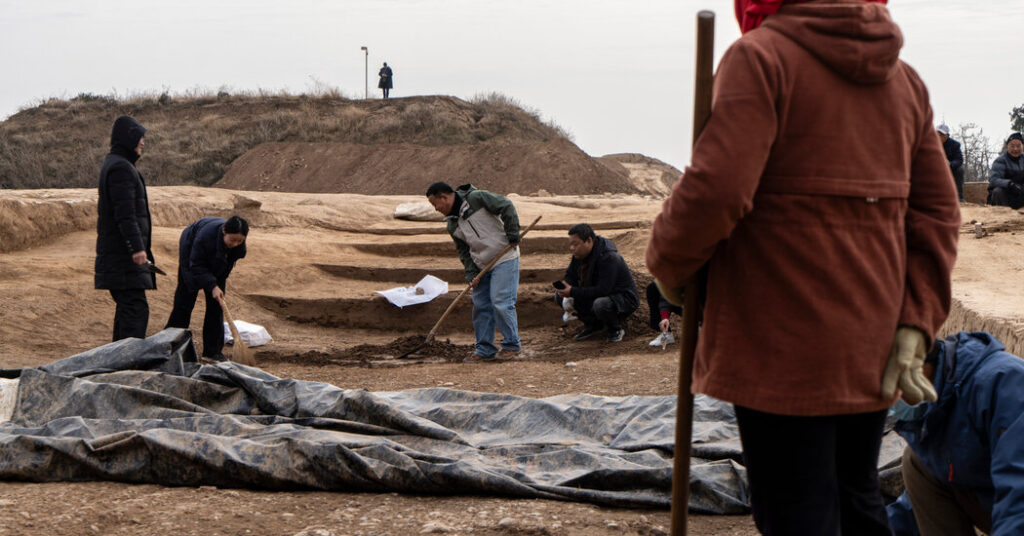
Digging deep into a field in northwestern China, archaeologists recently uncovered chariot tracks, plumbing and the remnants of an elaborate city gate dating back more than 3,000 years — all traces of an early Chinese dynasty that has been celebrated by Confucian scholars, and also by the Communist Party, as a model of political and social harmony.
The discoveries suggest that the area that is now farmland west of the city of Xi’an, in Shaanxi Province, is part of the long-vanished capital of the Western Zhou, a dynasty exalted throughout Chinese history as the acme of good governance.
The digging, part of decades-long excavation work in the area, has also shed new light on a bigger question: If the ancient dynasty was so perfect, why did it collapse in chaos, unable to contain external and internal threats? It lasted nearly 800 years, longer than any other Chinese dynasty, but still fell apart in 771 B.C. under pressure from “barbarian” invaders and estranged former allies.
Why seemingly robust political systems crumble has been a central preoccupation of China’s top leader, Xi Jinping, since the 1991 downfall of the Soviet Union. An avid fan of ancient history and archaeology, he visited a museum in Baoji, a city in Shaanxi near the excavation site, in 2024 and inspected ancient bronzes from the Western Zhou dynasty, including one inscribed with “zhongguo,” meaning “middle kingdom,” the earliest known written record of China’s name.
The traditional explanation for the downfall of the Western Zhou, enshrined in the first century B.C. by Sima Qian, the father of Chinese history, is that the dynasty unraveled because of a beautiful woman who bewitched and led astray its ruler, King You.
Recent archaeological and other evidence, however, has debunked this reading of dynastic decline as a morality play. Instead, the new findings highlight the frailties of a rigidly hierarchical political system grown brittle over time that could not withstand disruptions caused by climate change and internal division.
Chong Jianrong, the director of the Shaanxi Institute of Archaeology, who been hunting traces of Western Zhou’s rise and fall for decades, said the woman often blamed for the dynasty’s demise — a concubine named Bao Si — was “just a scapegoat” to explain the ruin of a supposedly golden age.
Edward L. Shaughnessy, a leading American authority on ancient China, said Bao Si’s role in the end of the dynasty “is of course just a fairy tale,” possibly concocted as part of “some sort of factional strife at the Zhou court.”
Hailed by Confucius and his followers as a model undone by lust, the dynasty produced many of the core concepts of Chinese civilization, like the “mandate of heaven,” the idea that a ruler holds power because of good governance and loses it through immoral misbehavior.
But, Mr. Chong said of the fall of Western Zhou, “this is not about a beautiful woman causing trouble.”
A recent study led by Chinese scientists in Beijing has now provided what many historians see as a more plausible theory. Using evidence collected from stalagmites, it blamed rapid climate change. Drought and unusual cold caused by a sudden change in the climate 2,800 years ago — just before the collapse of Western Zhou — played a “critical role” in the dynasty’s demise, according to a study published in Communications Earth & Environment, a sister publication to the British scientific journal Nature.
A separate study based on the analysis of ice cores from Greenland and Antarctica, which provided a chronology of volcanic activity over two millenniums, found that 62 of 68 Chinese dynastic houses over that period fell after one or more volcanic eruptions — a major cause of short-term climatic shocks throughout history.
Francis Ludlow, an associate professor of medieval environment history at Trinity College, Dublin, who carried out the research with Chinese and other scholars, said in a telephone interview that he had been surprised by the close correlation between volcanic activity and dynastic decline. “There were way too many eruptions just before collapse dates to be just random coincidences,” he said.
Professor Shaughnessy said he had long believed that climactic events before Western Zhou collapsed “probably contributed to the fall, but there were many other reasons for it as well.”
Volcanoes spew out aerosol particles that cut sunlight and can play havoc with farming thousands of miles away. Whether an eruption “tips a dynasty over the edge,” however, depends heavily on the extent at the time of warfare and instability, Mr. Ludlow said.
“Our most interesting finding,” he said, “is not that volcanoes are implicated in dynastic change but that the impact of climatic shock depends on how stable a society was in the lead up to that shock.”
Mr. Chong, the archaeology institute director, also said that Western Zhou’s own “internal and external contradictions” were key to its downfall.
These included a steady weakening of the royal court’s control over regional rulers as ties of blood to the center were diluted by time, and also a growing conflict with rival “barbarian” powers to the northwest and southeast.
For centuries, Chinese scholars have struggled to square the Western Zhou’s sudden collapse with the glowing praise heaped upon it by Confucius. “If the Western Zhou dynasty was so perfect an age of good politics and institutions as Confucius tended to suggest, then why had it to fall, and to give rise to a time of political disorder and moral decline?” asked Li Feng, a professor of early Chinese history at Columbia University, in a 2006 book.
Yan Yongqian, a young archaeologist who is part of a team now digging up what is believed to be a side gate to the Western Zhou capital, said the excavation work had revealed evidence of the dynasty’s highly stratified and sophisticated society, as well as its darker side, including human sacrifices.
The collapse of the Western Zhou, Mr. Yan said, seems to have happened quickly, accelerated by military attack from outside against defenses weakened by internal discord. An earlier round of excavation uncovered the remains of burned ancient buildings, suggesting a violent end.
“The fall of this state was likely a very sudden event,” Mr. Yan said. Whether Bao Si, the beautiful consort, who, according to ancient legend, was conceived from dragon spittle, existed is unclear and even if she did, he added, “a single person cannot destroy a dynasty.”
Since Sima Qian wrote “Historical Records,” each new Chinese dynasty has traditionally commissioned an official history of its predecessor, enumerating supposed moral and other failings that led to its demise.
Though widely dismissed by modern scholars as fairy tales, stories about the Western Zhou king’s dynasty-destroying infatuation with Bao Si still sometimes crowd out other explanations. At a museum near the excavation site showcasing Western Zhou’s cultural achievements and its sudden demise, exhibits recount how the king grappled with natural disasters and other problems but lost power largely because of his wayward love life.
To entertain Bao Si, who was famous for her great but unsmiling beauty, the story goes, he lit beacon fires that were supposed to be used to summon help in times of emergency, a stunt that cost him his life and kingdom when a real attack came in 771 B.C.
Whether such beacons even existed, however, is disputed and Mr. Yan, the archaeologist, said the story had probably been fabricated to demonize Bao Si and cover up the dynasty’s real problems.
Mr. Chong, the Shaanxi province archaeology institute director, said: “When things go wrong you have to find someone to take responsibility,” and, in China’s patriarchal society, that person “is always a woman.” He added, “The real collapse of a society is caused by the system and its mechanisms.”
Li You contributed research.
Andrew Higgins is the East and Central Europe bureau chief for The Times based in Warsaw, on temporary assignment in Shanghai.
The post New Research Absolves the Woman Blamed for a Dynasty’s Ruin appeared first on New York Times.