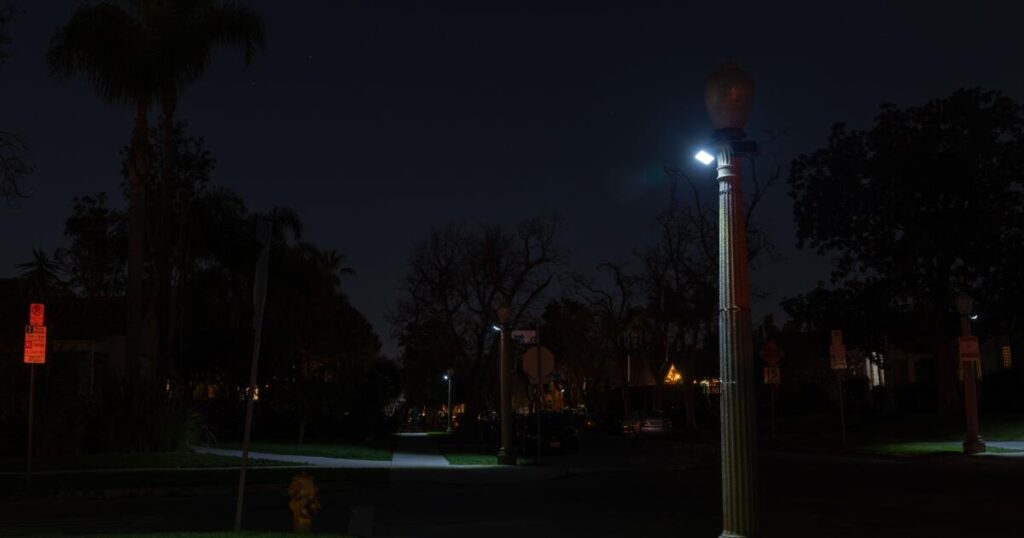
Faced with numerous complaints about broken streetlights that have plunged neighborhoods into darkness, two Los Angeles City Council members unveiled a plan Friday to spend $65 million on installing solar-powered lights.
With 1 in 10 streetlights out of service because of disrepair or copper wire theft, Councilmembers Katy Yaroslavsky and Eunisses Hernandez launched an effort to convert at least 12% of the city’s lights to solar power — or about 500 in each council district.
Broken streetlights emerged as an hot-button issue in this year’s election, with council members scrambling to find ways to restore them. Councilmember Nithya Raman, now running against Mayor Karen Bass, cited the broken lights as an example of how city agencies “can’t seem to manage the basics.”
By switching to solar, the streetlights will be less vulnerable to theft, said Yaroslavsky, who represents part of the Westside.
“We can’t keep rebuilding the same vulnerable systems while copper theft continues to knock out lights across Los Angeles,” she said.
Three other council members — Traci Park, Monica Rodriguez and Hugo Soto-Martínez — signed on to the proposal. All five are running for reelection.
Miguel Sangalang, director of the Bureau of Street Lighting, said there are 33,000 open service requests to fix streetlights across L.A., although some may be duplicates. The average time to fix a streetlight is 12 months, he said.
Repair times have increased because of a rise in vandalism, the department’s stagnant budget and a staff of only 185 people to service the city’s 225,000 streetlights, he said.
About 60,000 street lights are eligible to be converted to solar, according to Yaroslavsky.
Council members also are looking to increase the amount the city charges property owners for streetlight maintenance. Yaroslavsky said the assessment has been unchanged since 1996, forcing city leaders to rely on other sources of money to cover the cost.
Last month, Soto-Martínez announced he put $1 million into a streetlight repair team in his district, which stretches from Echo Park to Hollywood and north to Atwater Village. Those workers will focus on repairing broken lights, hardening lights to prevent copper wire theft and clearing the backlog of deferred cases.
On Monday, city crews also began converting 91 streetlights to solar power in Lincoln Heights and Cypress Park. Hernandez tapped $500,000 from her office budget to pay for the work. The shift to solar power should save money, she said, by breaking the cycle of constantly fixing and replacing lights.
“This is going to bring more public safety and more lights to neighborhoods that so desperately need it and that are waiting a long time,” she said.
In recent years, neighborhoods ranging from Hancock Park and Lincoln Heights to Mar Vista and Pico Union have been plagued by copper wire theft that darkens the streets. On the 6th Street Bridge, thieves stole seven miles’ worth of wire.
Yaroslavsky and Park spoke about the problem Friday at a press conference in the driveway of a Mar Vista home. Andrew Marton, the homeowner, pointed to streetlights around the block that have been targeted by thieves.
Many surrounding streets have been dark since shortly after Christmas, Marton said. He has changed his daily routines, trying not to walk his dog late at night and worrying for the safety of his family.
He said he reported the problem to the city and was told it would take 270 days to fix. He then reached out to Park, who contacted the police department, he said.
A couple of neighboring streets had their lights restored, he said, but his street remains dark at night.
Park said she and Yaroslavsky identified $500,000 in discretionary funds to pay for a dedicated repair team to fix streetlights, either by adding solar or by reinforcing the existing copper wire, in their respective Westside districts.
The post L.A. streetlights take a year to fix. Council members say solar power is the answer appeared first on Los Angeles Times.