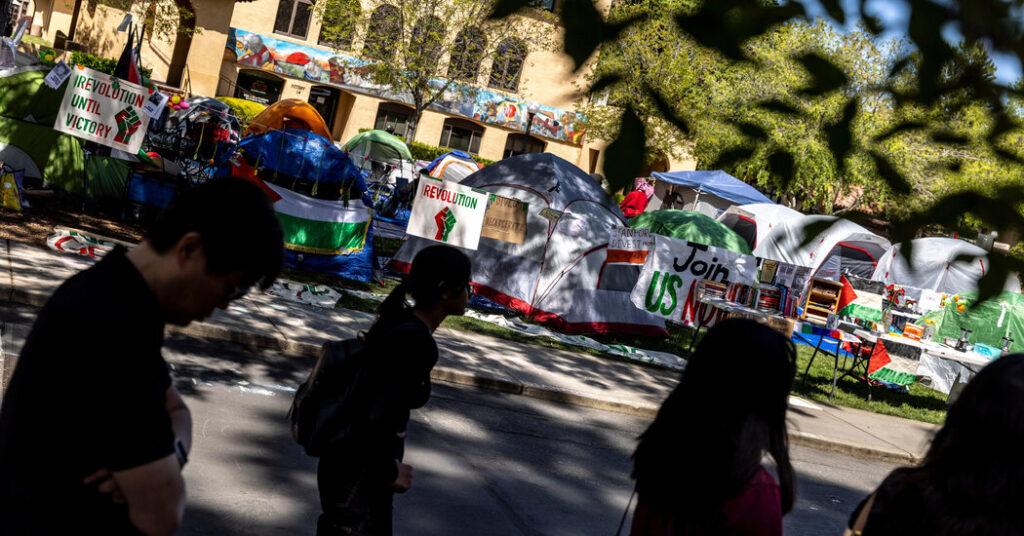
A California judge declared a mistrial on Friday in the case of five current and former Stanford University students in connection with pro-Palestinian protests, during which demonstrators broke into the office of the university president and barricaded themselves inside.
The charges were among the most severe leveled at participants in pro-Palestinian demonstrations on college campuses in 2024. More than 3,000 people were arrested at protests and encampments in the spring of that year, and most faced misdemeanor charges or saw their charges dropped.
In the Stanford case, which was tried in Santa Clara County Superior Court, the five defendants were charged with felony vandalism and felony conspiracy to trespass. They faced a maximum of three years and eight months in prison if convicted.
But the jury deadlocked — with nine jurors for and three against convicting on the vandalism charge, and eight for and four against convicting on conspiracy — and was unable to reach a verdict. So the judge on Friday declared a mistrial.
Jeff Rosen, the district attorney for Santa Clara County, said he planned to retry the case. He had initially charged 12 protesters, last year, in connection with the demonstrations at Stanford, but the rest accepted plea deals or diversion programs.
“This case is about a group of people who destroyed someone else’s property and caused hundreds of thousands of dollars in damage. That is against the law, and that is why we will retry the case,” Mr. Rosen said in a statement.
The court has set a conference date for later this month, to pick a new trial date.
On June 5, 2024, police arrested 13 people in connection with breaking into the office of the Stanford president early that morning and barricading themselves inside. They had made several demands, including that the university trustees vote on whether to divest from companies that support Israel’s military.
They had been cleared out of the building and arrested within a few hours, but not before they had broken windows and furniture, disabled security cameras and splashed fake blood inside the building, according to Mr. Rosen.
Anthony Brass, a lawyer for one of the protesters, Hunter Taylor-Black, said he was gratified to see that the jury could not reach a unanimous verdict to convict. He said that he and the other lawyers had not been defending lawlessness but “the concept of transparency and ethical investment.”
“This is a win for these young people of conscience and a win for free speech,” Mr. Brass said in an email. “We also hope that this sends a message that humanitarian activism has no place in a criminal courtroom.”
Soumya Karlamangla is a Times reporter who covers California. She is based in the Bay Area.
The post Jury Deadlocked in Trial of Pro-Palestinian Demonstrators at Stanford appeared first on New York Times.