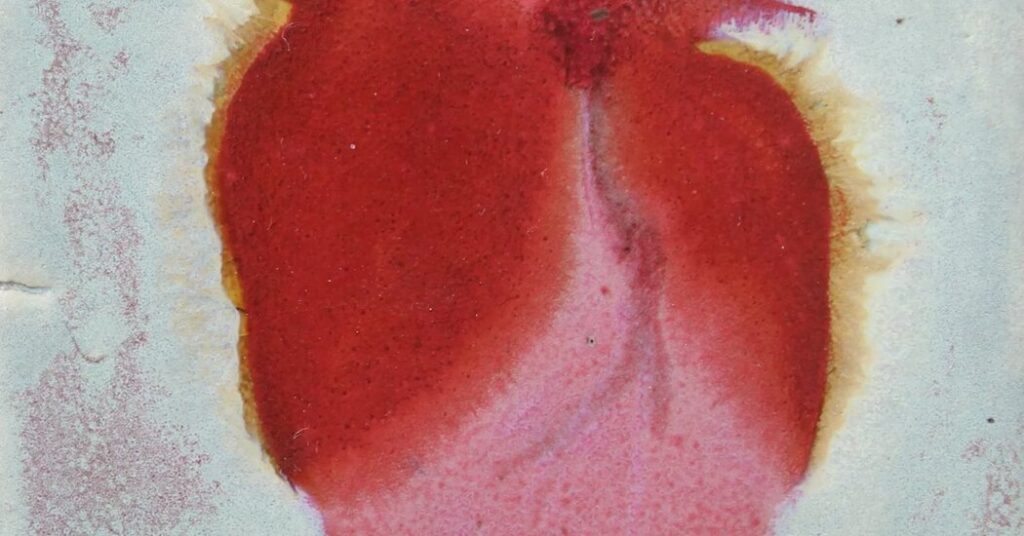
That double-humped triangle that we immediately understand as a heart — or love — appeared as an ideogram stamped on coins as far back as the sixth century B.C. Similar to the shape of the silphium seed, which was most likely used as an early contraceptive, the heart symbol’s first iteration may have represented eros uncomplicated by fertility. By the 15th century, the heart decorated playing cards, hair combs, sword handles and jewelry. Now, there are over 30 different heart emojis. I still remember how surprised I was in grade school when I learned that the heart inside my body was lumpish and fist-shaped and looked unrelated to the heart I wore on a chain around my neck.
Language bends to the heart’s romantic reputation. The ancient Greek poet Sappho wrote about the “mad heart,” quivering with love. Aristotle argued that the heart was the “acropolis of the body,” the high city of all our emotions. We follow our hearts, have affairs of the heart, open our hearts, and give our hearts to our lovers. Nobody wants our spleens or our kidneys.
The physical reality of the heart, though, as anyone who, like me, has woken up in the night with a tight chest will tell you, is much darker and more complicated. The heart may be full of love and boldness, but it is also full of blood, muscle and electricity. It’s the organ that guards the line between life and death.
I am unsure if my mother knew about the heart disease that killed her. Was she afraid of every twinge and thickness in her chest? Five years ago, after a year of intense back pain that ended in surgery, I decided to write a book about the body and pain. Each chapter focused on a different body part. As I researched the heart, I started to increasingly feel I might have heart problems. Sometimes when I climbed the stairs up from the subway, I had trouble catching my breath, and in the night I often woke sweaty with strange twinges in my chest. For a while, my fear engulfed me. I worried that anxiety about having a heart attack might actually give me a heart attack. I read about cardiophobia, where people, though they do not have any heart problems, are certain that their heart will stop. I went to cardiologists who told me I had nothing to worry about.
For my research, I longed to break through the symbolism of the heart to its reality. I posted an open call on social media to heart attack survivors who might be able to explain heart pain and fear firsthand. To my surprise, it was the heart’s doctors who wanted to talk. Stephen J. Moorman, an anatomy professor at Touro College of Osteopathic Medicine, Middletown, asked if I wanted to see a human heart. His medical students had dissected the hearts of cadavers the week before, and I had better come soon, before the hearts shriveled and dried out.
I met Dr. Moorman, a man in his early 70s with long gray hair and a small gold earring in each ear, in a lobby, and we took an elevator up to the dissection lab. We entered a bright room with big stainless steel sinks against one wall and half a dozen gurneys in the center, each with a cadaver on it. The bodies were covered with blue towels, soaked in Pine-Sol and fabric softener to keep their skin from hardening, and on top of each was a layer of clear plastic. Dr. Moorman told me the face would remain shrouded, as he peeled back the towels and exposed the body of a very small, very dead woman. His student had already dissected the chest, cutting out the various organs before placing them back inside. Dr. Moorman removed each lung easily, and then lifted out the heart.
The heart, in my hand, was the size of a large fist and heavy like a glass paperweight. Hearts may be metaphorically fragile, but materially they are not. The amount of blood that passes through a heart each year could fill up a swimming pool. Dr. Moorman pointed out the aorta, the arteries, the left atrium and the right one, the valves — pulmonary, mitral and tricuspid — and the thick, wormlike veins that run outside and around the heart. Little windows cut into the heart let me see into its various passages and chambers. Dr. Moorman explained how blood is collected from the body, pumped into the lungs, oxygenated, pumped back into the heart, and then sent out to the other organs. He described the heartbeat as a kind of spasm, like “ringing out a dish towel, if that dish towel was also a tube of toothpaste.”
I was surprised at my composure while I held the heart. I thought I’d be upset at the sight of a dead body’s driving force in life isolated from its purpose. Instead, my mind had refused to recognize the stilled hearts as being like my own beating one. On the drive home, though, as rain stabbed the car window, my own heart crashed against my ribs as if the sight of its dead double had made it insane.
I went to a new cardiologist, Dr. Peter Virzi at Mount Sinai, who listened to my complaints, put a stethoscope to my heart, and then placed EKG tabs over my body. Because my mother had died of a heart attack at 70, he ordered both an echocardiogram and a CT scan. Later, my phone pinged with the test results. One of my arteries to the left ventricle, known as the widow maker, was partly blocked, giving me a coronary artery plaque score of 84 — indicating more buildup than 88 percent of people in my age, gender and ethnicity group. I flipped through the X-rays, spectral images of darkness and light.
The next week, he showed me a model of a heart, a bright red, purple and blue object held in a clear plastic case. This replica heart, so different from the gray one I’d held, reminded me of the still-beating hearts kept in boxes in fairy tales. But I feared my heart, unlike this Technicolor version, would not have a storybook ending. There had been talk of a stent, a common procedure in which a catheter is threaded up through a vein, a balloon opens up the blocked artery, and a tiny tube is inserted to keep the blood flowing. But my stress test was normal, so Dr. Virzi prescribed a statin and suggested I eat a Mediterranean diet.
About 48 percent of Americans have some type of heart disease, and more than 900,000 die from it each year. The more I read about the heart, the more it impresses me. The human heart generates a force that can shoot blood 30 feet into the air. Its aorta is wider than a garden hose, and some of its capillaries are one-third the thickness of a human hair. Mondays, for unknown reasons, are the most common day for heart attacks. The 18th-century physician William Heberden described the pain of some heart attacks as being set off by “the motion of a horse or a carriage, and even by swallowing or coughing, going to stool, or speaking, or by any disturbance of the mind.”
The heart may connect us to our loved ones, but it will also, in time, separate us from them. There is no way for the living to know what the pain feels like just before the heart quits and emptiness rushes in. My meditation app suggests I open my heart. The heart blown open is a dead heart. It is the abandoned home of a soul beginning its next adventure.
During a recent catheterization, part of an ongoing monitoring to check blood flow, I saw on the screen beside the operating table my heart jerking around like a spasmodic ghost. It was a nexus of glamorous electricity. The offending left artery, blackened by dye, swayed rhythmically like a frantic branch in a gothic novel. I understood better what had happened to my mother in her dark house as she got up from her bed, walked down the hallway and collapsed by her front door. Her heart, no longer able to move blood through her narrowing arteries, would have struggled to pump, leading to cardiac arrest.
To separate the heart from its symbolism is to confront mortality without ornament. The heart is not romance; it’s muscle tightening and releasing, blood forced forward, flares of electricity. The inside of the body can feel like a netherworld. But to hold the dead organ in my hand, heavy as a paperweight, was not to drain it of meaning. It was to confront the fact that it is just this muscle, not love, that keeps us alive. The heart is precise, vulnerable and finite. To see it clearly is to face grief and still find awe.
Darcey Steinke is the author of “This Is the Door: The Body, Pain and Faith,” which comes out on Feb. 24.
The Times is committed to publishing a diversity of letters to the editor. We’d like to hear what you think about this or any of our articles. Here are some tips. And here’s our email: [email protected].
Follow the New York Times Opinion section on Facebook, Instagram, TikTok, Bluesky, WhatsApp and Threads.
The post I  My Heart appeared first on New York Times.