In many ways, the story of Deanna Stellato-Dudek’s quest for a gold medal in Olympic figure skating is just like any other.
She started skating at age 5 while growing up in Chicago and dreamed of going to the Olympic Games. She traded a normal adolescence for early mornings at the rink, college preparation for nationals preparation. A hip injury seemed to end her career when she was 17. She fought her way back and will compete this month at the Milan-Cortina Winter Olympics.
So far, so familiar — except for one thing. Ms. Stellato-Dudek is 42.
The Olympics she had originally aimed for were the 2002 Games in Salt Lake City. She took not six months but 16 years off, and in those 16 years, she did not coach or do other skating-adjacent work. She became the director of aesthetics for a plastic surgeon.
When she returned, she did so as a pairs skater, and when she and her partner, Maxime Deschamps, won the world championship in 2024, she made history as the oldest woman to win a world title in any figure skating discipline. (They also won the Canadian national championship in 2023, 2024 and 2025 and were silver medalists this year.)
When they skate in Milan on Sunday, representing Canada, Ms. Stellato-Dudek will once again be the oldest woman on the ice. Like Tom Brady and LeBron James, she is redefining the limits of what is possible in her sport.
Skating, after all, has long been seen as the province of the young, nimble and light. Tara Lipinski won her Olympic gold medal for singles skating at 15, in 1998; so did Alina Zagitova, in 2018. It took the doping scandal surrounding the 15-year-old Russian skater Kamila Valieva during the 2022 Beijing Olympics to get the International Skating Union to raise the minimum age for competition — to 17.
Amber Glenn, an American singles skater who is among the favorites for a gold medal, has called herself the “fun aunt” because at 26 she is much older than many of her peers. Though pairs skaters tend to be older, only four of the female pairs gold medalists since 1956 have even been in their 30s (and all of those were under 35). When social media commentators want to be mean, Ms. Stellato-Dudek said, they refer to her as “Grandma Deanna.”
“I mean, I am a whole legal human being older than almost everybody else,” she said, laughing.
Which explains why, when Ms. Stellato-Dudek announced her return to skating, people thought it was “crazy,” said her coach, Josée Picard, who came out of retirement to work with Ms. Stellato-Dudek and Mr. Deschamps.
“Crazy,” Ms. Stellato-Dudek’s mother, Ann Stellato, said. “Nobody expected her to persevere and to do what she has done. Nobody.”
Defying Society’s Expectations
“The age pendulum for me swings both ways,” Ms. Stellato-Dudek said. She had just come off the ice after a four-hour practice with Mr. Deschamps at the skating complex outside Montreal, where they are based.
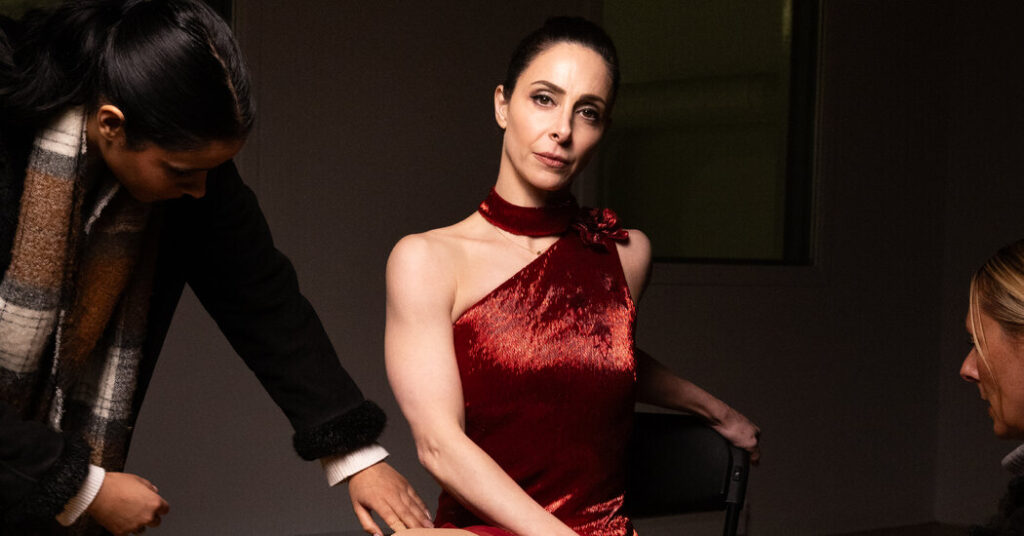
She was wearing four layers of tops, a thin puffer, a neck warmer and a head warmer. Her dark hair was pulled into a topknot, and she had the sort of unlined skin you would expect on someone whose previous professional life included chemical peels and CoolSculpting. She is only five feet tall but has the muscled body of an athlete. She looked like a “Frozen” version of the Energizer bunny rather than the usual figure skating fawn.
“When I do well, I am celebrated more than my younger counterparts,” she said. “After worlds, I had, like, 20,000 messages on Instagram. But when we do poorly, there are so many trolls DMing me about my body, my face, my hair, that I’m not strong enough.”
It’s as if, she said, people are offended that she would continue to compete, or they think she’s trying to be famous. “If I was trying to be famous, I would have gone on a reality show,” she said. “‘Survivor’ would have been a better option for me than trying to get an Olympic medal.”
Ms. Stellato-Dudek decided to return to skating when she was in her early 30s. She did not want to look back and regret not trying to get to a podium because she had listened to “society telling you that’s the age you should stop.” She didn’t want to be a sideshow, famous only for being the oldest competitor on the ice. She wanted to be a serious contender who also happened to be older.
For six months, she got up at 4 a.m. to train and then went to her day job. When she could do triple jumps again, she contacted her old coach, quit the plastic surgeon’s office and decided to try pairs skating. (As a singles skater, she had often been asked if she would consider pairs; she is the ideal size for the lifts required.)
“She was never a prodigy,” her mother said. “She just works very, very hard. Even as a child, anything that Deanna could do that was a little daring she would do. She loves being thrown, she loves being up in the air, all the dangerous stuff.”
Ms. Stellato-Dudek’s first partner was based in Florida, so she moved there. When he needed surgery, she called every coach she knew until one recommended Mr. Deschamps, who was in Canada. At 34, he is also on the older end for a male figure skater, but it is the older end of normal.
Ms. Stellato-Dudek and Mr. Deschamps knew they were on a clock if they were aiming for 2026, so they had to choose nationalities. It was unlikely that Mr. Deschamps would get American citizenship on their schedule, so Ms. Stellato-Dudek applied to become Canadian and was approved in late 2024.
(This was the right choice. The current U.S. pairs champions, Alisa Efimova and Misha Mitrofanov, will not be able to compete in Milan because Ms. Efimova is still waiting for her American citizenship.)
Ms. Stellato-Dudek moved to Montreal in mid-2019. She knew no one except her partner and coach and spoke no French. Because Covid lockdowns began not long after, she didn’t really make friends until she had been living there for three years. Though she had married during her time away from the ice, she has said that she “sacrificed a relationship” for her sport (she declined to discuss her personal life further). She does not have children.
She currently lives with Goldy, the half-Maltese, half-poodle that Mr. Deschamps and Ms. Picard gave her for her 40th birthday. Goldy has her own hat and coat and goes with Ms. Stellato-Dudek to the rink. The dog is particularly good at standing on her hind legs and, like her owner, can even do a twirl. A couple of them, actually.
Defying Age
Before the Olympics, Ms. Stellato-Dudek and Mr. Deschamps trained five days a week on the ice, spent Sunday in the gym and had Saturday off. Ms. Stellato-Dudek’s entire life was built around skating and preserving her physical resilience, from waking up at 6 a.m. so she could warm up for an hour to a three-hour recovery process at night involving rolling out her muscles, cupping, wearing compression pants and using red-light therapy.
Sometimes, she also did a cold plunge. “Truly, I hate the cold plunge,” she said. Because she spends so many hours at the rink, she explained, “I’m cold all the time.”
The extra warm-up and cool-down time are concessions to her age. “I have to do a lot more recovery to start at the same point as my younger counterparts the next day,” she said. “When I was a kid, I did no post-skating recovery. Literally zero.”
She has to eat 70 grams of protein a day in order to maintain her muscle mass and drink half her weight in water, numbers recommended by the Canada team nutritionist. Since she is about 100 pounds, that equates to 50 ounces. “The diet and the water intake are some of the hardest things,” she said.
She starts every morning by dumping a collagen packet in her coffee, and she eats beans with pretty much everything. She generally doesn’t eat after 3 p.m., when she has a meal she calls “linner.” She avoids gluten, fried foods, dairy and sugar, though she does allow herself a “cheat day” once a month. Then she might have some chocolate.
She also takes a lot of supplements — vitamin D, vitamin C, protein peptides — all of which are checked for banned substances. Unlike other sports outliers, like Mr. Brady and Mr. James, Ms. Stellato-Dudek, as an amateur athlete, is figuring out how to extend her athleticism pretty much on her own. She doesn’t have a chef or a physiotherapist on call. Like all Canadian Olympic athletes, she has funding from the government, but skating is not exactly a money sport. Ms. Stellato-Dudek buys most of her gear on Amazon.
There are advantages, though, to being older. “Having lived through experiences, having loved, having lost, I can portray those experiences on the ice,” she said. “A 20-year-old might be uncomfortable doing so.” And, she said, she had learned patience.
That was important when, the week before she was scheduled to fly to Milan, she hit her head on the ice during training. For a few days, it was unclear whether she and Mr. Deschamps would be cleared by the Canadian Olympic Committee to compete. Though they had to drop out of the team competition on Feb. 10, they were OK’ed for the individual program.
The Olympic End Game
A week before her accident, Ms. Stellato-Dudek was skating around the rink in Montreal, hands on her hips, mouth tight, catching her breath. She and Mr. Deschamps had been practicing a throw triple loop (he tosses her outward; she spins three times in the air before she lands), and she didn’t like the way it felt. She wanted it bigger. Ms. Picard wanted them to take a break, but Ms. Stellato-Dudek wanted to go again.
Since winning the world championship in 2024, Mr. Stellato-Dudek and Mr. Deschamps have had uneven results in competition. Still, whatever happens, she will make history in Milan — and not just because of her age.
In 2025, she became the first woman to perform a backflip in her program since Surya Bonaly in 1998 — and then it was illegal in competitive ice skating. (It was accepted by the International Skating Union only for the 2024-25 season).
“It was her idea,” Mr. Deschamps said. “It took her almost a full year to convince me.” He was concerned about her blades, and given that the backflip has no scoring value, he didn’t think it was worth the risk.
“My thought process was, How can I make this product more alluring to the audience and to the judges?” Ms. Stellato-Dudek said. “It’s like I’m trying to sell something in a business.”
She had done gymnastics as a child but hadn’t done a flip since she was 14. Bringing the trick back for ice and making it assisted (she flips off Mr. Deschamps’s hands) was a way, she said, to honor the legacy of Ms. Bonaly, to show girls it could be done and to create a pairs version of a trick that could be adopted by others.
She will be wearing skating dresses by Oscar de la Renta, also her idea. (Previously, the only designer who regularly worked with skaters was Vera Wang, who dressed Nathan Chen, Nancy Kerrigan and Michelle Kwan.) The Oscar de la Renta label had never collaborated with an athlete, but Laura Kim, a creative director, said, “We’re the same age, and when I heard her story, I thought, I can relate.”
The result is a champagne-colored short program dress with Art Deco beading inspired by a dress from the label’s spring 2026 collection, and an asymmetric red number with more than 200,000 hand-sewn glass beads for the long program, to match its flamenco soundtrack. Ms. Stellato-Dudek hopes her more-haute-than-usual outfits will start a skating trend of partnering with fashion designers.
All of which is notable, but none of which means she doesn’t want to win despite her accident.
“I want to leave my mark on this sport,” Ms. Stellato-Dudek said, “and I have to be wearing a medal around my neck to really get that happy ending.” Worst case scenario: At least everyone is “watching me try,” she said.
Mr. Deschamps and Ms. Picard said they were considering retiring (or, in Ms. Picard’s case, re-retiring) after the Olympics. Ms. Stellato-Dudek acknowledged there were perks to the idea — “I haven’t had a margarita in 10 years,” she said. “That would be a nice treat,” she added, but she is not sure.
“That is my decision and my decision alone,” she said. “If I want to continue to the 2030 Olympics when I’m 46, that’s what I’m going to do. And nobody can tell me I can’t.”
Vanessa Friedman has been the fashion director and chief fashion critic for The Times since 2014.
The post Figure Skating Is a Young Woman’s Sport. She Wants to Change That. appeared first on New York Times.