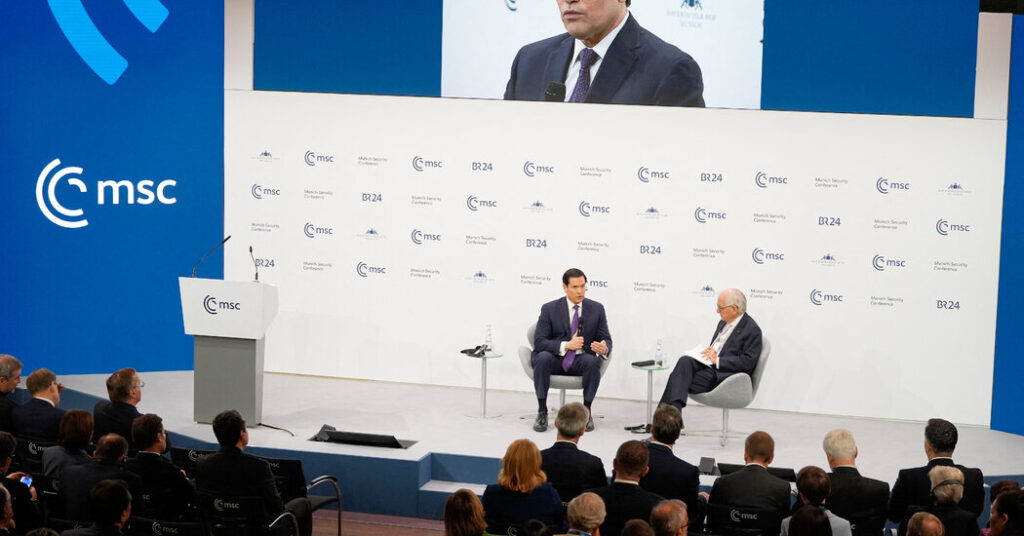
Secretary of State Marco Rubio called for a stronger Europe in a sweeping speech at the Munich Security Conference, emphasizing America’s European heritage even as he slammed “mass migration” and echoed U.S. officials’ past warnings of “civilizational erasure.”
His remarks were received with relief by European leaders. They had watched the speech nervously, afraid that Mr. Rubio might reprise Vice President JD Vance’s scorching takedown of the continent’s governance at last year’s conference.
“I was very much reassured by the speech of the secretary of state,” said Ursula von der Leyen, the president of the European Commission.
But while Mr. Rubio’s tone was more flattering and less caustic than Mr. Vance’s was last year, the content of his remarks was enough to sustain unease, and to underscore that the trans-Atlantic relationship was still in the midst of fundamental change, a year into President Trump’s second term.
Gabrielius Landsbergis, a former Lithuanian foreign affairs minister, said Mr. Rubio had painted over cracks that Mr. Vance created last year. But while he was more polite, Mr. Landsbergis said, the message was not fundamentally different.
“It is now clear that this is all about interests, not common values,” Mr. Landsbergis wrote in a statement. “And do we actually have common interests?”
As Mr. Rubio spoke, audience members huddled outside the conference hall seemed to visibly relax, chatting calmly after a period of apprehensive silence.
Carl Bildt, a co-chairman of the European Council on Foreign Relations, wrote on social media that Mr. Rubio had “avoided the worst of JD Vance.”
Still, he said, the speech “presented a view of the world and the challenges ahead” that was very different from the European perspective.
A panel discussion shortly after Mr. Rubio’s remarks demonstrated how drastically the Trump administration had changed America’s relationship with its partners on the continent. European leaders on the panel said they needed to be less dependent on the United States, to work more closely together, and to firmly protect their own belief systems.
“In today’s fractured world, Europe must become more independent — there is no other choice,” Ms. von der Leyen said. She later said the European Union would deepen ties with its “closest partners, like the U.K., Norway, Iceland or Canada.”
That message of teaming up was echoed by Keir Starmer, the British prime minister, in his remarks at the conference.
He said that “as Europe, we must stand on our own two feet,” emphasizing that Britain must build stronger links to the European Union, which its people voted to leave in 2016.
Mr. Starmer added that Britain would show that “people who look different to each other can live peacefully together — that this isn’t against the tenor of our times,” he said. “Rather, it’s what makes us strong.”
The British leader also emphasized that Europe should not take too much comfort from Mr. Rubio’s remarks.
“We shouldn’t get in the warm bath of complacency,” he said. “That would be a mistake, and it would be a particular mistake for Europe.”
Jeanna Smialek is the Brussels bureau chief for The Times.
The post Europe’s Reaction to Rubio: Relief, Up to a Point appeared first on New York Times.