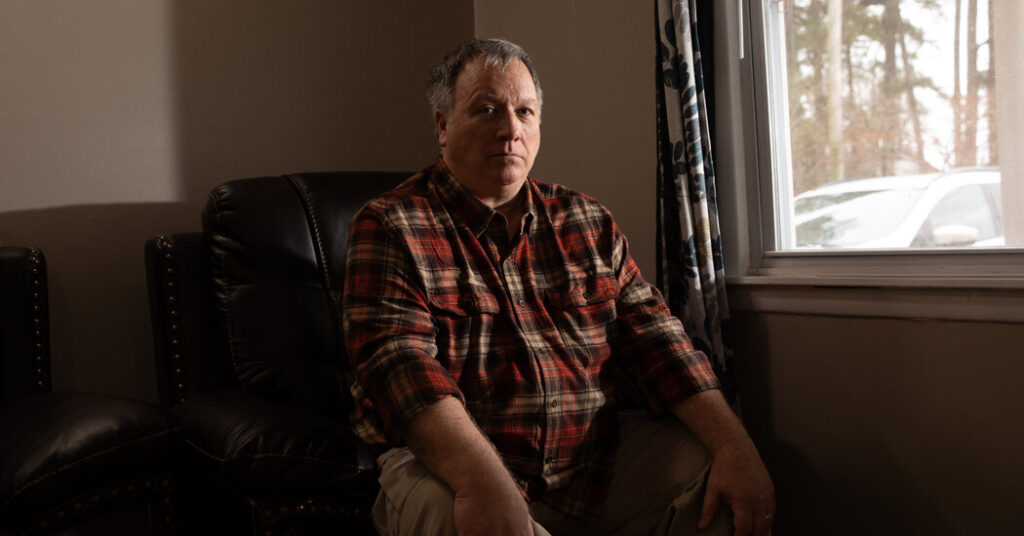
Not that long ago, Larry Bushart, a 61-year-old retired police officer, would somewhat jokingly describe himself as a warrior. His weapon was a keyboard and the trenches were on Facebook. Most days, he would spend hours posting political memes and jumping into comment threads, airing left-leaning views that were not widely shared in his patch of Tennessee.
In this war of his, he was not trying to win hearts and minds. The victory he sought was the sweet satisfaction that came from believing he had debated his adversaries into a corner. If they lashed out, used talking points that he considered misinformed or retreated, he had won.
When a gunman killed the conservative activist Charlie Kirk in Utah last September, Mr. Bushart logged onto Facebook and leaped into the fray.
He was by no means alone. The killing set off an avalanche of social media commentary that, in turn, led to firings, resignations, broken friendships and a national discourse about the tone of political debate and the boundaries of free speech.
That said, Mr. Bushart was quite possibly the only person who was hauled off by police officers, charged with a felony and jailed on $2 million bail after weighing in on Mr. Kirk’s assassination. A sheriff in a county near his home said that a meme Mr. Bushart had reposted on a community Facebook page could be perceived as a violent threat.
“I played on Facebook,” he told an officer after he was taken into custody. “I threatened no one.”
He was released in October after 37 days, when the charge against him was dropped.
Mr. Bushart’s arrest and detention were widely condemned as overreach. The Foundation for Individual Rights and Expression, a free-speech advocacy organization, has filed a lawsuit against the sheriff on his behalf.
But now, as Mr. Bushart navigates a strange new reality, where he has returned home but not to his old ways, he has spent a lot of time reconsidering the addictive allure of fighting on Facebook.
“I probably needed a new habit, a new hobby,” Mr. Bushart said, sitting in his living room in Lexington, Tenn., a city of about 8,000 people between Memphis and Nashville.
His relationship with social media had changed in the disorienting days of 2020. There was the pandemic, the gusher of disinformation that accompanied it and the many ways it became politicized. There was also the police killing of George Floyd, and the racial justice protests that followed. He was like a lot of Americans back then: cooped up, frustrated, confused, eager to vent.
After he retired from the state corrections department in 2024, he had plenty of other things he could focus on: his wife, grandchildren, a collection of books he had not read. Instead, he was online more and more. Sometimes, his wife, Leanne, would wake up in the middle of the night and find him sitting at their desktop computer in the dining room.
“You’re looking for stimulation,” Mr. Bushart said of his restless mind, “and I don’t play video games.”
The habit bothered his wife. He loved to debate — she knew that all too well, she said. But she didn’t understand the point of spending so much time and energy sparring with acquaintances and, more often, strangers on the internet.
On her own social media, “you will never see anything political,” she said in an interview. “You’ll see my grandson. You’ll see religious quotes.” She occasionally posts pictures of her embroidery work, too.
The two of them had met years ago when they both served in the U.S. Army Reserves and reunited after he went through a difficult divorce. In 2018, they were married by an Elvis impersonator in Las Vegas. She fell for him, she said, because he was funny and thoughtful and a reliable provider.
Those aspects of his personality became harder to see the more time he spent online, she said. She struggled to pull him away from the screen.
“He was scared he was going to miss something,” Mrs. Bushart said. “I told him, ‘You can’t save the world, you know.’”
Mr. Bushart describes himself as a progressive, a supporter of Senator Bernie Sanders and Representative Alexandria Ocasio-Cortez — a true outlier in a Tennessee county where President Trump won 83 percent of the vote in 2024.
Still, Mr. Bushart has been something of an ideological nomad, motivated by a consistent contrarian streak. The first president he voted for was Ronald Reagan, whose sunny patriotism he admired. Later, he supported Ross Perot, the billionaire gadfly who ran in 1992 as an independent. And then Patrick J. Buchanan, a candidate who preached social conservatism.
Al Gore was the first Democrat he supported for president, and he has stuck with the party ever since.
He does not feel like he drifted much in terms of what he believed: He has always wanted a robust middle class, with financial stability and access to health care. He wants limits on gun rights, based on what he learned in his years as a police officer. He had contemplated a career as an educator — he still imagines a version of his life where he teaches history at a community college — and believes Republican policies have undermined public education.
He had been convinced that Mr. Trump would not win in 2016. Then, in 2020, he thought Mr. Trump would retire to Mar-a-Lago. Five years later, he was bewildered by Mr. Trump’s return to power, with Republicans controlling Congress and a judiciary that Mr. Bushart saw as less inclined to rein him in.
Posting on social media was no longer just a sport, he said. It was a form of resistance.
“I don’t know if we’re relevant or not, but we’re still here,” he said of Americans who vocally oppose the president. “We’re not dead. We’re not lying down without a fight.”
He had friends, neighbors, relatives who supported Mr. Trump. He got along with many of them just fine. But on social media, the president’s supporters were his enemies, two-dimensional avatars of all that he disagreed with. And to them, he was the same.
“Facebook’s this magical, mystical internet world,” he said. “Maybe it gives us a little freedom, or we perceive it like that.” He felt empowered to interact with a brashness he would never use in person.
“You don’t go out here in public just being a manic political animal,” he said.
Ten days after Mr. Kirk was killed, Mr. Bushart noticed that a group in Perry County, Tenn., about 30 miles from Lexington, was organizing a prayer vigil. He was perplexed by how deeply affected they were by his death.
“I’m not going to call Charlie a bad person,” Mr. Bushart said, “but I thought, what made him worthy of all that?”
In posts on a community Facebook page advertising the vigil, he responded with a flurry of memes, none of which he created. One accused Mr. Kirk’s organization, Turning Point, of perpetuating hate. Another said, “Everyone forgot about Rush Limbaugh, and everyone will forget about what’s-his-name.”
Then there was the meme that quoted Mr. Trump saying, “We have to get over it,” after a school shooting in Perry, Iowa, in 2024. “This seems relevant today…,” the original poster had written.
The responses to Mr. Bushart’s posts were mostly on the mild side.
“Jeez Larry, take a stress pill or something…,” one person replied.
But Nick Weems, the sheriff in Perry County, said some who saw the post about the shooting in Iowa interpreted it as Mr. Bushart threatening Perry County High School in Linden, Tenn. Mr. Bushart was charged with recklessly threatening mass violence at a school, a felony offense.
Mr. Weems did not respond to requests for comment. But in a television interview after the arrest, he said he knew the meme had been circulating long before Mr. Bushart shared it, and that it was referring to the school shooting in Iowa.
“We knew,” he said. “The public did not know.”
While he was in jail, Mr. Bushart lost his part-time medical transport job; his wife was so distracted by the case that she had to quit hers in a sewing factory, she said. He assumed he would be out perhaps in a few days, certainly within a week, and was stunned when his bail was set at $2 million.
He had no idea how far and wide his story was circulating. His wife, however, could not escape it. Her phone constantly dinged. An old boss of Mr. Bushart’s kept needling her with antagonistic text messages. “Jailbird Larry,” he called him.
Eventually, Mr. Bushart saw a news report about his case on television in jail. Another inmate put up a sign: “Justice for Larry.”
As the scrutiny intensified, officials relented. They abandoned the criminal case.
When Mrs. Bushart retrieved her husband from jail, she said she would take him anywhere. He wanted to have a meal with her at Texas Roadhouse, to make up for the anniversary he had missed while in custody, but it was too busy. They stopped for chicken wings instead.
In the months since his release, he has applied for jobs but has either been turned down or heard nothing back. He watches the news. He takes long drives. He avoids going to the store or running errands, but not because he’s a pariah or concerned for his safety; he knows he has been a topic of conversation, and the attention makes him uncomfortable.
He does not regret posting what he did.
“I could have been more dignified, classy,” he acknowledged. “But, hell, we all could be.”
With the encouragement of his wife and on the advice of the lawyers representing him in the free speech case, he is staying away from Facebook. It has been an adjustment, but a largely successful one.
He can’t get into his account. With his permission, Mrs. Bushart changed the password and she’s the only one who knows it.
But after he got home, and before he was locked out of his account, he posted a video of Elton John singing “I’m Still Standing.”
He’d had the last word.
Rick Rojas is the Atlanta bureau chief for The Times, leading coverage of the South.
The post A ‘Facebook Warrior’ Retreats After a Charlie Kirk Post Got Him Jailed appeared first on New York Times.