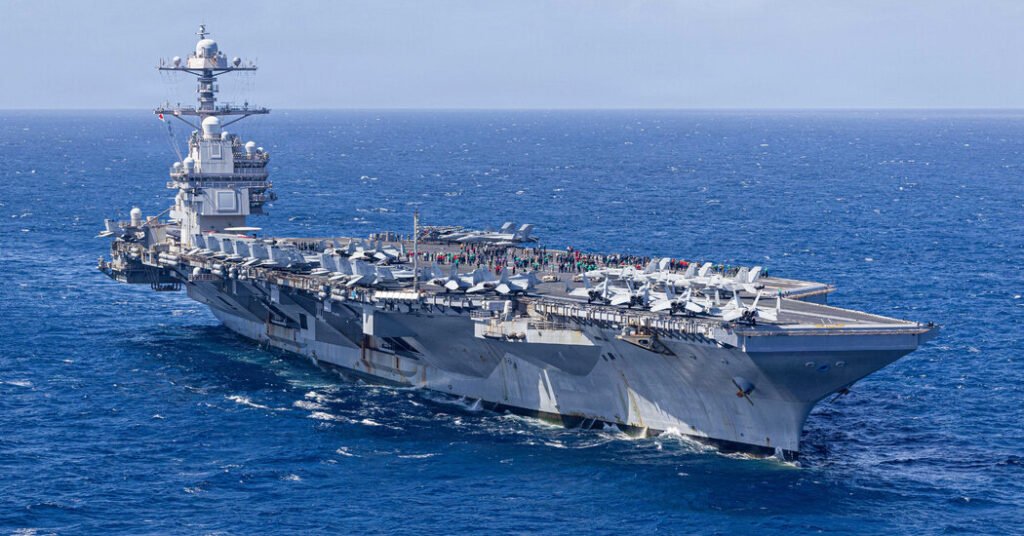
The aircraft carrier U.S.S. Gerald R. Ford and its escort ships deployed to the Caribbean will be sent to the Middle East and are not expected to return to their home ports until late April or early May.
The ship’s crew was informed of the decision on Thursday, according to four U.S. officials who spoke on the condition of anonymity because they were not authorized to speak publicly about the decision.
The Ford strike group’s new orders will have it joining the U.S.S. Abraham Lincoln carrier strike group in the Persian Gulf as part of President Trump’s resurgent pressure campaign against Iran’s leaders. Mr. Trump had indicated earlier this week that he wanted to send a second carrier to the region, but neither he nor the Navy had identified the vessel.
The ship’s extraordinary deployment, which began June 24 when the Ford left port in Norfolk, Va., was originally meant to be a European cruise but was redirected to the Caribbean as part of Mr. Trump’s pressure campaign on Venezuela.
The Ford’s warplanes participated in the Jan. 3 attack on Caracas that captured President Nicolás Maduro. The strike group’s current deployment has already been extended once, and its sailors were expecting to come home in early March.
The new delay will further jeopardize the Ford’s scheduled dry dock period in Virginia, where major upgrades and repairs have been planned.
John Ismay is a reporter covering the Pentagon for The Times. He served as an explosive ordnance disposal officer in the U.S. Navy.
The post U.S. Aircraft Carrier Will Be Sent to the Middle East From Venezuela, Officials Say appeared first on New York Times.