The British government’s designation of Palestine Action as a terror group has been deemed unlawful by London’s High Court.
In a ruling issued on Friday, three senior judges said the decision implemented last July was “disproportionate” and breached free speech rights.
[time-brightcove not-tgx=”true”]
“At its core, Palestine Action is an organization that promotes its political cause through criminality and encouragement of criminality. A very small number of its actions have amounted to terrorist action within the definition at section 1(1) of the 2000 Act, ” the ruling stated. “We propose to make an order quashing the Home Secretary’s decision to proscribe Palestine Action.”
The High Court determined that former Home Secretary Yvette Cooper (who now serves as Foreign Secretary) had not properly followed her own policies when deciding what constitutes an organization being proscribed under the Terrorism Act.
The government has vowed to appeal the decision.
For now, Palestine Action will remain a proscribed terror group until a consequential hearing takes place on Feb. 20. Any appeals will have to be laid out in that hearing and it will be determined what happens next.
As such, the High Court judges stressed that due to the proscription remaining in place, it is still an offence to support, fund, or belong to Palestine Action.
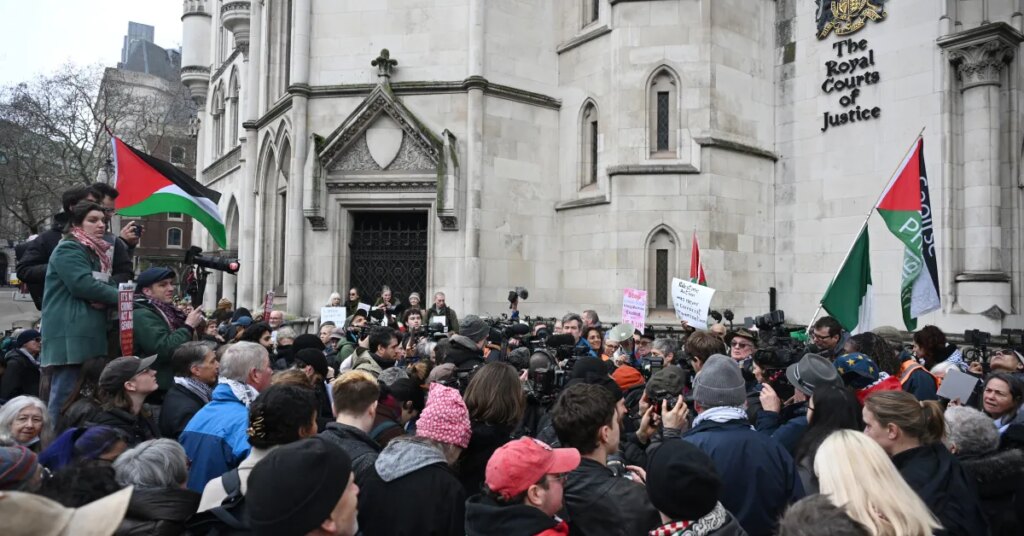
Despite that, demonstrators gathered outside of the court on Friday in support of the group, holding placards that read “we won” and “I’m not a terrorist.”
Huda Ammori, the co-founder of Palestine Action who brought the appeal over the designation to the High Court, also celebrated the decision. “We won. The High Court ruled the Palestine Action ban is unlawful as it is disproportionate to free speech,” she said.
Home Secretary Shabana Mahmood intends to fight the ruling in the Court of Appeals.
“Supporting the Palestinian cause is not the same as supporting Palestine Action,” said Mahmood. “The court has acknowledged that Palestine Action has carried out acts of terrorism… and that its actions are not consistent with democratic values and the rule of law.”
“I am disappointed by the Court’s decision and disagree with the notion that banning this terrorist organization is disproportionate,” she argued.
Prior to its designation as a terror group, Palestine Action was linked to a break-in at the Royal Air Force’s Brize Norton air base in Oxfordshire, England, in June last year. Two planes were damaged during the incident.
Former Home Secretary Cooper cited the break-in when explaining her decision to add Palestine Action to the list of proscribed organizations.
“The disgraceful attack on Brize Norton in the early hours of the morning on Friday 20 June is the latest in a long history of unacceptable criminal damage committed by Palestine Action,” she told the House of Commons. “The U.K.’s defence enterprise is vital to the nation’s national security and this Government will not tolerate those that put that security at risk. Counter Terrorism Policing are leading the criminal investigation into this attack.”
Last month, five alleged Palestine Action protesters pleaded not guilty to offences relating to the air base break-in.
The government’s designation of Palestine Action as a terror group last year drew significant criticism from high-profile organizations such as Amnesty International, the U.K.-based Jewish Voice for Labour, and others.
United Nations Human Rights Chief Volker Türk referred to the decision as “disproportionate and unnecessary.”
In August, hundreds of protesters were arrested by police as they gathered outside the British Parliament, holding placards in support of Palestine Action. By doing so, they broke the law in showing support for the group.
The post U.K. Ban on Palestine Action Group Under Terrorism Legislation Ruled Unlawful appeared first on TIME.