One owned apartments in New York and Paris, and a private island in the Caribbean, acquired through financial wizardry and a fat Rolodex of politicians and investors.
The other handed out the Nobel Peace Prize, governed Norway and then led the Council of Europe, all while amassing the sort of diplomatic stature that gave him access to world leaders like President Vladimir V. Putin of Russia.
Together, Jeffrey Epstein and Thorbjorn Jagland built a relationship that was beneficial to each other. A recently released tranche of emails reveals how friendly, and transactional, that relationship was, even after Mr. Epstein became a convicted sex offender and Mr. Jagland a champion of gender rights.
The new revelations have stunned Norway, a society that has prided itself on the integrity of its officials, and they could lead to a steep fall from grace for one Europe’s most prominent diplomatic figures.
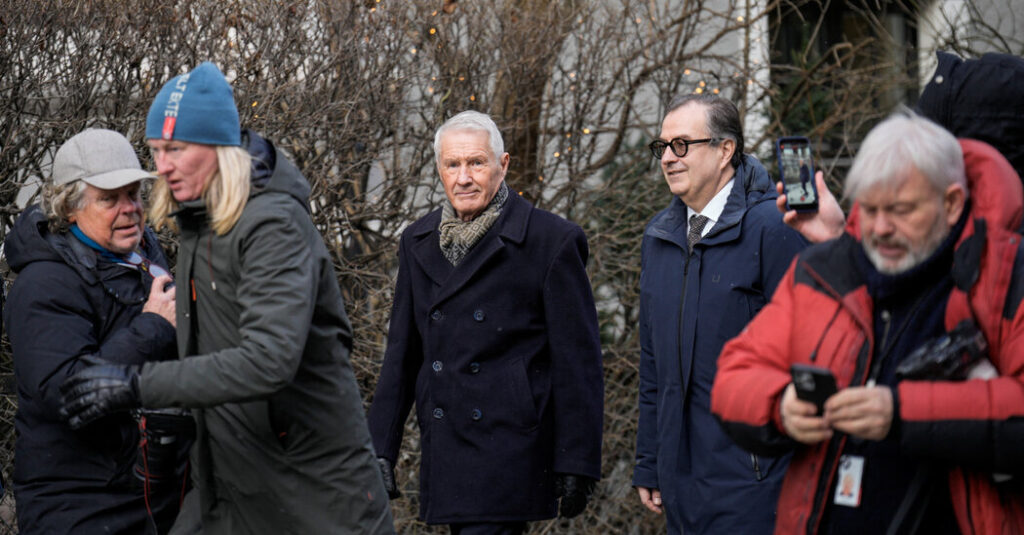
On Thursday, the Norwegian police charged Mr. Jagland with “gross corruption” over his relationship with Mr. Epstein. If convicted, the top diplomat could face up to 10 years in prison, according to Norwegian law.
Norway’s economic crimes unit is investigating whether Mr. Jagland misused his positions to receive gifts, travel and loans from Mr. Epstein. The charges came after an investigation and a search of Mr. Jagland’s home in Oslo and his properties on the coast and in the countryside in Norway. Until now, Mr. Jagland had diplomatic immunity, but on Wednesday, the European Council waived his protection at the request of the Norwegian authorities.
It is the first time in Norway since the end of World War II that a former prime minister has faced criminal charges. The scenes of police carrying computers and boxes of documents out of Mr. Jagland’s Oslo home left the country questioning how it had become caught up in a global scandal.
“One is money. The other is that contacts, influence and proximity give access to wide-ranging decisions,” Jonas Gahr Store, the current prime minister, told Norway’s national broadcaster, NRK, in comments published on Friday. “And if you have a position of trust, whether it is on behalf of the Norwegian state or in the Council of Europe, then there are very clear rules for such things.”
Mr. Jagland, 75, is among several prominent Norwegians named in the documents released by the United States Justice Department in recent weeks, exposing how Mr. Epstein courted decision makers in the wealthy oil-producing nation.
The others include Norway’s future queen, Crown Princess Mette-Marit; Borge Brende, Norway’s former foreign minister and current head of the World Economic Forum; and the high-flying diplomatic couple who inspired the Broadway play “Oslo,” Terje Rod-Larsen and Mona Juul. All, onetime friends of Mr. Epstein, are facing scandals that could upend their careers and their hard-earned international stature.
In Parliament, lawmakers have demanded a commission of inquiry, which will include public hearings and take place alongside the criminal process, to investigate how Norway’s elites misused their roles in representing the country abroad.
“People are tired of power and money merging behind closed doors while ordinary citizens are told to ‘trust the system,’” Julie E. Stuestol, a member of Norway’s Parliament, said in an email.
Norway, a country of 5.6 million, has ambitiously pursued top posts in international organizations, spending millions to place former politicians in highly visible roles, experts said. It has used its role as a champion of human rights and the keeper of the Nobel Peace Prize — in addition to its trillion-dollar sovereign wealth fund — to punch above its weight.
This has made Norway’s officials vulnerable to corruption, said Halvard Leira, the head of research at the Norwegian Institute of International Affairs.
“Norway gains visibility on the global scene, which again can be turned into real politics, and trade benefits,” he said, adding that some of Norway’s diplomats appear to have lost their way in believing they were acting for the greater good.
“This is an example of how Epstein used friendships as a sort of currency,” added Mr. Leira, who focuses on diplomacy.
It was this global status that appears to have drawn Mr. Epstein to Mr. Jagland. He used his relationship with the Norwegian diplomat, whom he referred to as “a great friend” and “Mr. Human Rights,” to curry favor with politicians and business people.
Mr. Epstein offered his homes to Mr. Jagland, and as soon as the visit was confirmed, he sent a flurry of emails to let Bill Gates, Larry Summers and Richard Branson, among others, know that the head of the Nobel Committee was his guest.
“Head of the Nobel Peace Prize staying with me, if you have any interest,” he wrote on Sept. 26, 2012, to Mr. Summers, a former Harvard president and ex-Treasury secretary.
Mr. Jagland, in turn, stayed at Mr. Epstein’s homes in New York and Miami, and visited his private island in the Caribbean, emails show. Mr. Jagland’s wife and adult children vacationed in Palm Beach, Fla., in 2014, paid for with Mr. Epstein’s credit card, according to an email from the financier’s assistant.
Emails show that Mr. Jagland visited Mr. Epstein’s apartments as recently as September 2018, less than a year before Mr. Epstein was charged with sex trafficking.
Mr. Jagland seemed taken by Mr. Epstein, writing in June 2012 that he thought the financier was “a fabulous person, easy and at the same time demanding to be together with.” At the time, Mr. Epstein had been convicted of and served time for sex crimes in 2008, and was trying to rehabilitate his image.
And by then, Mr. Jagland was the secretary general of the European Council, a role he had taken up after serving as Norway’s prime minister, from 1996 to 1997. His signature cause was preventing violence against women, in a convention that was first signed in 2011.
In emails to Mr. Epstein, Mr. Jagland comments about the “extraordinary girls” of Albania, where he was on a trip in 2012. In another, he appeared to joke about relations with younger women as he prepared to celebrate his wife’s 60th birthday.
“I can’t keep it going only with young women as you know,” Mr. Jagland wrote in 2013.
Mr. Epstein introduced Mr. Jagland to many of his friends, including Kathryn Ruemmler, the former White House counsel under President Barack Obama who resigned as Goldman Sachs’s top lawyer on Thursday.
In exchange, Mr. Epstein hoped Mr. Jagland would get him into the same room as Mr. Putin. In several emails, Mr. Epstein raised the possibility of meeting the Russian president, and Mr. Jagland tried to make that happen.
“The Russians are in a very bad mood,” Mr. Jagland wrote in September 2013, explaining his frustrations with Russian representatives in Strasbourg, France, the headquarters of the European Council, before suggesting plans to spend the holidays on Mr. Epstein’s island.
In 2013, as Mr. Epstein tried to sell Mr. Jagland on why he thought Russia was uniquely placed to take advantage of digital currencies, Mr. Jagland suggested how he could get the financier in front of Mr. Putin to explain it himself.
“Hi Jeffrey, all this is not easy for me to explain to Putin. You have to do it. My job is to get a meeting with him,” he writes. He went on to share his strategy and imagined communication with Mr. Putin: “Can I say this: I know that you want to attract foreign investment to diversify Russian economy,” he wrote, adding, “I have a friend that can help you to take necessary measure (and then present you).”
It does not appear to have worked, and in 2015, Mr. Epstein nudged: “I still would like to meet Putin and talk economy, I would really appreciate your assistance.”
Mr. Epstein dangled the idea that he could help the Russians better understand President Trump, with whom he had once been friendly.
“I think you might suggest to Putin that Lavrov can get insight on talking to me,” he wrote to Mr. Jagland in June 2018, during Mr. Trump’s first term, referring to Russia’s foreign minister, Sergey Lavrov. A few hours later, Mr. Jagland responded: “I’ll meet Lavrov’s assistant on Monday and will suggest.”
It is not clear that Mr. Jagland ever arranged such a meeting, but the diplomat and the financier appear to have remained close.
Months before Mr. Epstein died in prison while awaiting trial in 2019 on sex-trafficking charges, he sent his lawyer an email with the subject line, “Numbers in case of trouble.” Among them was Mr. Jagland’s.
Lynsey Chutel is a Times reporter based in London who covers breaking news in Africa, the Middle East and Europe.
The post The Mutually Beneficial Ties Between Jeffrey Epstein and ‘Mr. Human Rights’ appeared first on New York Times.