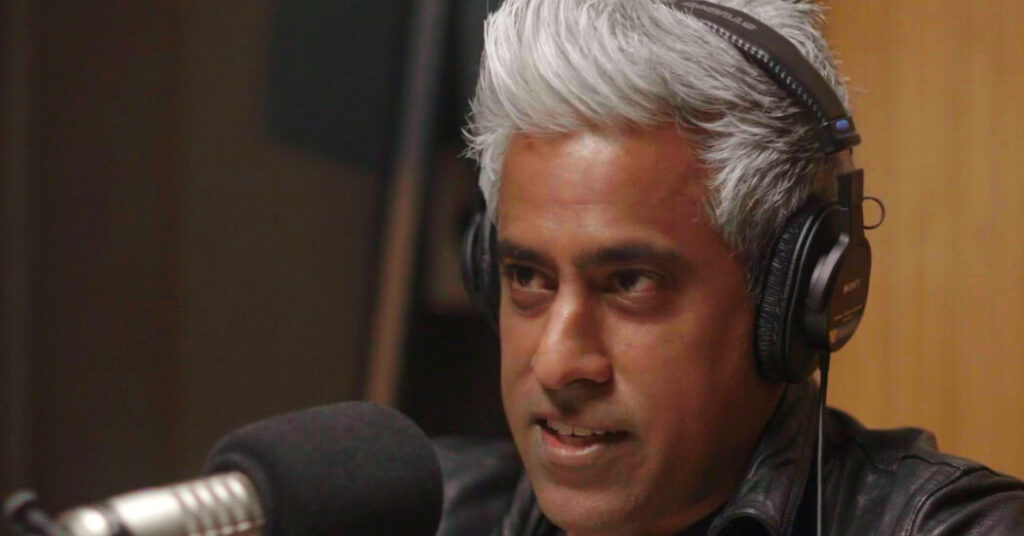
This is an edited transcript of “The Ezra Klein Show.” You can listen to the episode wherever you get your podcasts.
At the end of January, Trump’s Justice Department released what it said was the last tranche of the Epstein files: millions of emails and texts, F.B.I. documents and court records.
It’s a huge dump of information. Journalists, investigators and the public are sifting through them as we speak. What’s amazing, though, is how much we still don’t know — or, at least, don’t know yet.
Deputy Attorney General Todd Blanche, who was Trump’s personal lawyer before he joined the Justice Department, has said that investigators identified six million “potentially responsive” pages but released only about 3.5 million pages to the public. So what’s in the two-and-a-half million pages that haven’t been released?
Representatives Ro Khanna and Thomas Massie, who cosponsored the House legislation that mandated the files’ release, have argued that the Justice Department is engaged in a cover-up and is using redactions to protect powerful men who may have committed crimes.
Archived clip of Ro Khanna: Mr. Speaker, yesterday Congressman Massie and I went to the Department of Justice to read the unredacted Epstein files. We spent about two hours there, and we learned that 70 to 80 percent of the files are still redacted. In fact, there were six wealthy, powerful men that the D.O.J. hid for no apparent reason.
So we are still far from the end of this story — and from knowing much of what we want to know inside the story. But what has come into clear view is the incredible breadth of Epstein’s network — the huge range of people who relied on him, communicated with him, traded with him and the role he played in this network — and among the American elite — as a broker of information, connections, wealth and, ultimately, human beings.
This is what I think the files, along with a lot of amazing reporting and courageous testimony, have at least begun to answer: where Epstein’s mysterious influence came from. Why so many famous and powerful people, from so many walks of life, orbited around him even after he was convicted in 2008 of soliciting a minor for prostitution.
What has come into clear view is the infrastructure of Epstein’s power — and maybe through that the infrastructure of elite networks more generally.
Anand Giridharadas is a journalist who has written for The New York Times, The New Yorker and many other outlets. He publishes the great newsletter The.Ink, and is the author of, among other books, “Winners Take All: The Elite Charade of Changing the World,” which he published in 2018, and the forthcoming “Man in the Mirror: Hope, Struggle and Belonging in an American City.”
I often think of Anand’s work as a kind of sociology of American elites and power, and that has been the perspective he has brought to his coverage of these files. I think it is revelatory and worth hearing.
Note: This conversation was recorded on Tuesday, Feb. 10. On Thursday, Feb. 12, Kathryn Ruemmler announced she would be resigning from her role as chief legal officer and general counsel at Goldman Sachs.
Ezra Klein: Anand Giridharadas, welcome to the show.
Anand Giridharadas: Thanks for having me.
There have now been literally millions of pages of Epstein files released. There are possibly millions more that we have not seen. So we don’t know everything, and there are redactions that we don’t yet understand.
But when you try to step back from what we have seen, what is the picture that emerges?
There’s that proverb “It takes a village to raise a child.” I think we’ve learned that it takes a very powerful network to abuse so many children. We’re getting a glimpse of an absolutely barbaric pedophilia scandal at the heart of Jeffrey Epstein’s life and intimate circles.
But also I would think about his many concentric circles of networks, connections, friends — what Congressman Ro Khanna calls an Epstein class — one could say that made what he did possible. We’re getting a glimpse of how our world — how our country — is run, and it isn’t pretty.
The most striking thing about the files is the range of Jeffrey Epstein’s elite network. You have someone here who is intimate at different times with not only Steve Bannon and Donald Trump but an Emirati businessman, Elon Musk, Noam Chomsky and Peter Thiel.
At the same time, it crosses ideologies. It crosses industries. It crosses professions. It is an extraordinary range of contacts — Republicans and Democrats, globalists and antiglobalists.
How is this one guy at the center of so many different kinds of people?
This is the great mystery. I think because we live in such a partisan and tribal age, when these things started to come out, a lot of us did what we normally do in this era, which is looking for revelations that would help our team and hurt the other team.
There were a lot of people looking for the Trump connection who don’t like Trump, and there were people on the Republican and MAGA side trying to find which Democrats were implicated.
But that’s such a facile way of looking at what we’ve ended up getting, which is, as you say, coast to coast, industry to industry, right to left — as far left as you can go, as far right as you can go — different professions, different ways of moving through the world, some famous, some obscure.
As I wrote in my New York Times piece in November, this diversity masked a deeper solidarity. If you’re sitting at home, watching cable at the end of the day and you’re seeing these two talking heads fight, that’s the spectacle for you at home, to keep you entertained.
What they’re actually doing is revealed in these files — which is hanging out, breaking bread, colluding, sharing information, giving each other tips on deals, giving each other public relations advice, making introductions to each other.
You have these moments in the files where Jeffrey Epstein is asking Steve Bannon for help getting I think it was Brad Karp into the Augusta National Golf Club. And Steve Bannon says he’s going to help. He’s going to see if he can do some looking around, but he’s explaining to Epstein how hard it might be to get Brad Karp into this club.
Why would Steve Bannon have access to the Augusta National Golf Club that Brad Karp, an absolute scion of the establishment, doesn’t?
As a question of where power is, in a lot of these emails, it’s not where you’d expect.
Well, I think the Augusta National Club is not a normal part of the establishment. It’s in the Deep South, and it famously didn’t allow Black members, didn’t allow Jewish members.
So when you’re dealing with a club with a white nationalist history, you go to Steve Bannon for a little help to get in. You have to know who to go to for what.
This is so striking, Ezra. Steve Bannon describes the people who run the Augusta National Club to Jeffrey Epstein as “crackers.” He uses a racist term for white people, the specific demographics of white people that Steve Bannon used to get Donald Trump elected.
So in this moment, Steve Bannon, who deplores the globalists and people of high finance and this and that, is talking to financier Jeffrey Epstein, referring to white people in Georgia as crackers.
None of these people in these networks mean what they say when you hear them in public. They mean what they say when you’re not looking — and these emails are an extraordinary and rare chance to see what they really think about you, how they really move through the world, what their actual ends and projects are.
Maya Angelou was right: When people show you who they are, believe them.
You used the word “solidarity” a moment ago for this network. When you look at these communications, there are moments of solidarity.
You wrote, in some ways actually movingly, about Epstein having a talent for friendship. He has a talent for being of use to people. He becomes an adviser to them. You can’t be a great con man without understanding human beings at a very deep level.
But there’s also just an endless transactionalism. An endless trading of information, money, connections, favor, powers — ultimately, women and girls. And what feels oftentimes like it is attracting them to each other is not always what I would think of as solidarity or a fellowship but: What can you do for me?
If you can be the one who finds it for them, that’s real power.
And it’s different needs, right? The money people may not need money, although they always want more of it. They often want to seem and feel smart. If you have met people in those kinds of worlds — finance people — even if you make a lot of money in it, they’re often very boring people.
I don’t say this as slander. They know it. I’ve had so many conversations with people in this world where there’s an insecurity about how boring they are. So they want something else.
Then there’s a bunch of academics. Academics, I think, really figure in this story in a way that feels surprising. It’s a tough era to be an independent thinker, so the academics want money and access.
Larry Summers, a former Treasury secretary asked Epstein: “How is life among the lucrative and louche?” He wanted access to a party scene that’s not available to him.
Everybody had something they needed. But his gift, if it can be called that, was understanding and mapping that so well.
I want to go into some of the pieces of this. Another word for what you’re talking about is he’s a “broker.” I think it’s important to always remember that Epstein comes from finance.
In finance, they make markets, and they look for market irregularities or inconsistencies. They look for where one side needs to be matched up to another. I think you have to see money fundamentally as the source of his power. It is how he pays for and pays off women and girls. It’s how he impresses contacts, particularly early on.
One thing he understands really well is money as a signal. He’s got one of the largest private houses in Manhattan, he’s got an island, he’s got a jet. So if he’s got all that, how can he not be a success? How can he not be brilliant?
My colleagues on the news side did an amazing piece about Epstein’s relationship with JPMorgan Chase, which was his bank for a long time when he was coming up — and particularly his relationship with Jes Staley, who was very high up at the bank. Tell me a bit about Epstein’s relationship with Staley.
It’s an extraordinary story of all of this brokering that he was engaged in, occurring in one relationship of two people. So Staley and Epstein cultivate a mutually beneficial relationship between Epstein, the individual financier, and JPMorgan — now, in its current form, the largest financial institution in the world, if I’m not mistaken.
For folks listening to this at home, it may seem a little strange. What does JPMorgan need from a random finance man?
This is why this piece is so good.
But it turns out these things are complicated.
There’s a moment where Jeffrey Epstein has a lot of money and that money needs managing and the managing of that money brings in millions of dollars of fees. So that’s the base layer.
There’s some point at which JPMorgan becomes interested, and Jes Staley specifically becomes interested in the idea that JPMorgan is not doing enough business with regard to hedge funds.
Hedge funds were a growing category, and Jeffrey Epstein seems to have proximity to this ascendant world of hedge funds, where a lot more money is moving. So Jeffrey Epstein can make introductions in that world that then become very valuable.
And he does. Staley invests in a hedge fund that he’s connected to through Epstein, not Staley personally but through JPMorgan. It becomes — Staley says this later — the investment that fundamentally makes his career, because it opens that world to JPMorgan, and it’s considered a brilliant move.
Epstein introduces him to Sergey Brin, the co-founder of Google.
I think this is so interesting. But here’s how I explain it. The more powerful you are and the more you rise in these hierarchies, the more of a bureaucracy around you there becomes.
You, Ezra Klein, if I tried to reach out to you 20 years ago, I could have just probably emailed some gmail address. But now you have a podcast and everything, and I have to go through this person or that person.
Actually, the more important these stratospherically powerful people become — they have publicists, and the publicists have publicists, and there’s this person, there’s that person.
That’s why a TED conference or these kinds of worlds are valuable because Sergey Brin is actually in the bar at night, and some finance guy who wants to meet him — yes, he’s not without status, and he could go through the channels, but it’s work, and it’s cumbersome, and it’s awful.
But you’re overestimating TED if you think Sergey Brin is at the bar at night.
I have been with Sergey Brin at the bar.
Really?
Absolutely.
You know these worlds.
Absolutely. I was at the bar with him with my friend Esther Perel. She had just given her talk. I have never seen so many rich people flock to one person for personal consultations.
We were just having a drink. Everybody — all these guys — were on Esther: Help me with this situation, help me. It was an incredible thing to watch.
Because what they really need, and what they don’t have, are people they can trust with personal problems. And they probably have a lot of personal problems at that level.
Correct. That was actually a really revealing moment to me. They can contact anyone they want. They can fill out whatever. They have people. But actually, I think this notion that it’s lonely at the top — there’s truth in it.
This is really worth understanding: As the cultural figure that Epstein was, he exploited certain gaps in our culture. He was not only grooming teenage girls, he was grooming all of these people. This was all grooming, and it was a continuum of grooming from light consensual grooming of bankers all the way to the most depraved and criminal grooming of teenage girls.
But the behaviors of pulling people in, understanding, even caring and feeding. Virginia Giuffre writes about how he did that to her in her incredible book “Nobody’s Girl.”
But he does it with very powerful people who tell him when he is landing. Unlike many people in American culture today, he will say: Have you had food? I can get this made for you. Do you like that kind of food?
A lot of people at his level are not worried about people on that individual level. So there’s this strange thing where he’s running this giant criminal ring, and he’s exploiting and abusing people — and he’s also attending to human beings at the microlevel — where a lot of those powerful people, weirdly, are not being attended to.
The connections are doing two things at once for Epstein. One is he’s able to use them transactionally. They make being in a relationship with him profitable for other people.
But they also cross-subsidize him in credibility.
Epstein is taking out cash at a rhythm and in amounts that should flag investigations.
JPMorgan flagged more than a billion dollars in suspicious transactions.
Ultimately, there is a series of internal fights at JPMorgan about whether or not to keep Epstein.
Then he is eventually convicted of paying for sex with a minor, and there are more fights about whether or not to keep him. But JPMorgan keeps working with him.
There’s this amazing quote from Justin Nelson, Epstein’s personal banker. I’m quoting Nelson from the Times piece: He prepares a memo trumpeting Epstein’s large volume of business with JPMorgan, and noting that despite his status as a sex offender, he was “still clearly well-respected and trusted by some of the richest people in the world.”
His network is the proof that he is worth dealing with and not beyond the pale. Because if he was, well then how would he still have this network?
He is revealing how these elites make decisions about trust — that I think are really different from the way folks at home go through the world and make decisions. I think you make character judgments about people, about how honest they have been and therefore will be.
These billionaires, these superelites, these superlawyers are working on a whole different kind of system. Their system has to do, as you say, with how loaded with connections you are in this network, how high your stock is on a given day in this network.
What Epstein figured out was how to game this. He figured out the vulnerability of this entire network, which is that these people are actually not that serious about character. In fact, character may be a liability for some of them, may be an unnecessary source of friction.
These people are actually not that grounded in the evidence of how someone has lived. These people are making very thin-sliced judgments about how central you are in their same networks. Therefore, something as simple — and this is true — as dining at Michael’s here in Midtown can do extraordinary wonders for people in the superelite.
Now most people listening to this will not have heard of the restaurant Michael’s in Midtown, but Michael’s is an example of a restaurant — a perfectly nice restaurant — but also a place where, if you can arrange to have lunch there, you will create an impression among certain people in publishing in New York, certain people who are in network television in New York, certain people in finance in New York — that you are in a certain place.
And on your way in and out, someone might introduce you to this person or that person. I’ve seen this organism flourish. And then these people will just assume you must be fine. They’ll maybe ask you to come in for a meeting to promote your children’s book or whatever it is.
He exploited the facile nature of many of these elites who have the mental skills to be serious people who evaluate character, who look up people’s history, who might, for example, find a conviction for soliciting sex with a minor problematic — but who, in fact, if you dined at Michael’s, if you were at that party, if you were at Davos, if you were at TED, must be all right.
There’s this quote from Staley, then at JPMorgan and who later leads Barclays Bank: “Epstein relied on his network for his legitimacy,” Staley said. “And I, as running the largest investment bank in the world, was part of that network for him.”
What is unsaid in that quote is he was part of that network for Staley because it’s not just what they’re doing for him, it’s what he’s doing for them. So to cut Epstein out when he has proved repeatedly so able to introduce you to people you would want to know is also to cut yourself off from what he might be able to do for you in the future.
And, we haven’t said yet in this portion of the conversation, but Epstein was also helping to occasion sexual activities for Staley.
We’re going to get to that. Yeah.
So all aspects of this brokering were at work, and the kind of leverage that provides is obviously even more for someone with so much to lose. Deals come and go, but Epstein had the power to destroy potentially a lot of people.
We’re talking about him and other unfathomably rich people. But also the wealth itself was very impressive to people who offered him different kinds of credibility.
Peter Attia, the podcaster and doctor and longevity specialist, is in a bunch of these emails. Attia, in explaining why he was in such communication with Epstein in those years, writes: “At that point in my career, I had little exposure to prominent people, and that level of access was novel to me. Everything about him seemed excessive and exclusive, including the fact that he lived in the largest home in all of Manhattan, owned a Boeing 727 and hosted parties with the most powerful and prominent leaders in business and politics.”
There’s just such currency. We’ve been talking about the wealthy, but for the academics, for a lot of the other kinds of people that Epstein cultivated — one thing that is distinctive about him is that he cultivated very different kinds of people. The access to his wealth was very impressive.
He has a very close relationship with Kathryn Ruemmler, who’s a former White House counselor for President Barack Obama and who is now at Goldman Sachs. Epstein is constantly buying her fancy gifts — fancy designer bags. She calls him Uncle Jeffrey.
She’s somebody who, having done a lot of work in government at that point, is in richer circles than she is rich. So somebody who can give you a lot of things is valuable.
The connections are power to the wealthy, but the wealth is power to the connections.
First of all, the Peter Attia thing is so striking. I don’t mean to sound old-fashioned, but there are a lot of longevity experts now. Everybody is so interested in longevity. What about living well and honorably in the existing time, whatever that is?
It’s so interesting to me that this is someone whose mind was focused on elongating the period of time you get, who clearly had no judgment for the quality of the time, for the quality of your decisions, for the quality of your relationship.
See, I don’t think that’s fair, actually. Or I’ll say it in a different way.
From Attia’s perspective, you only get this one life, and here you’ve met somebody who has these parties with the most powerful and prominent leaders in business and politics. How could you pass that up? That’s his explanation for what he was doing.
A lot of people passed it up. There’s this incredible meme about all the people who didn’t meet Epstein.
[Laughs.] Yeah.
There are not a lot of people of color in these revelations, these three million documents. For obvious reasons, there are not a lot of women, although there are some, like Kathryn Ruemmler. A lot of people went to that house or met him at a party and were like: No thanks.
We forget that. We forget it because they didn’t end up in the files. But that guy was out and about. A lot of people whose names you and I don’t know had the judgment, saw photos of underage girls lining his walls — as Virginia Giuffre describes it — and were like: This ain’t right.
Different levels of things were known to different people, but none of it was a deal breaker to many of these people we’re talking about.
Let me take that as a moment to ask something cautionary. Because as you’re saying, you look at these files, and there are a lot of people named in them. The number of people actually close to him, about whom you can get a lot by reading the files, we’re talking in the low dozens, maybe.
We’re talking about the elites, the power networks, but actually most people didn’t know Jeffrey Epstein. Most elites didn’t have much to do with him. Plenty of people saw him for what he was.
Tina Brown has this great line where she’s invited to a dinner with Epstein, Prince Andrew and Woody Allen. And she responded: What the [expletive] is this — the pedophiles’ ball?
Melinda Gates sees him perfectly clearly.
So is Epstein a way you see “the elite,” or is this a subcategory? It’s not telling us that much about power. It’s telling us something about some set of powerful people, in which — as in any other culture or network — there are going to be people of better and worse judgment, higher and lower character, more and less transactional.
Even in this JPMorgan Chase example I’ve been using, there are people in the bank who are fighting hard to cut ties with him. They lose until it becomes completely untenable for the bank to keep going. But they’re there.
I think that’s right. It’s an important point to dwell on for a second because you could take a narrow view that only the people who are actively involved in crimes of pedophilia here are really this group of people we should focus on, and everything else is a distraction.
You could take the opposite view that this is an indictment of every person with more than $10 million in the bank.
I think both of those are incorrect. I believe in this notion, and I’ve seen it in so many forms over the course of my years of reporting, of what I think about as concentric circles of enablement.
There is no doubt that there is a core group of people who were knowledgeable about, engaged in and shared participation in crimes of pedophilia at the burning heart of this story — that is, obviously, its own circle of hell.
We know from testimony of survivors that it was more people than just him. He was trafficking them to other people. We have some of the names, we don’t have all the names, but that was happening, and that’s the burning heart of this story that can’t be forgotten.
And then there’s what made that possible. Very practically, that means: Who were the other people who didn’t do that but who were aware of it, who facilitated it, for whom it was not a problem, who were not later discouraged by it when deciding whether to let him into something?
Then: What was the circle around that? Universities that maybe knew that Larry Summers was pally with him or that were accepting money and just didn’t stop the thing.
Then you can keep going out from there. Sometimes it’s helpful to shift the metaphor. I think about when I was in India as a reporter for The Times, and you would have a problem of so-called honor killings in rural villages in North India. A young woman dares to have a boyfriend or some kind of dalliance before marriage, and her own father might kill her or men in her family might kill her or people in her village might kill her. It happens a lot.
If you take every instance where that happens, there’s often one guy who committed murder. So one guy.
But I think anybody looking at it would say it took a lot of other things going on to make it possible for that guy to commit the murder — and a lot of other people who didn’t commit murder, who would never commit murder, who were not OK with murder, who maybe opposed the murder — but a lot of people and systems and institutions and values are conspiring to make that murder possible.
So if you shift back to this example, I think if you just had a pedophile in Jeffrey Epstein who wanted to procure 15-year-old girls and rape them, and that was all you had, it would have been very difficult for him. This is not an easy thing to pull off.
It’s not just Kathryn Ruemmler, who presumably had nothing to do with that burning heart of the story. It’s the fact that today, Kathryn Ruemmler, as you and I speak, is still the chief lawyer at Goldman Sachs. It’s the fact that association is not something — forget one individual — that institutionally, Goldman Sachs does not think today is a problematic association.
The fact that not just some professor at Harvard or some professor at M.I.T. was involved but that those institutions, two of the world’s most august learning institutions, essentially had this guy able to swim through their networks and be central to them. I remember talking to women at the M.I.T. Media Lab who were forced to give tours to Jeffrey Epstein at the Media Lab.
It’s these law firms that, before they were capitulating to Donald Trump, were able to be gamed by, again, not just individuals but entire organizations that were not able to have an appropriate histamine reaction to one of their lawyers being too close to such a depraved person.
Even when there were so many reasons to know he was a problem. Even when Tina Brown knew enough to call him a pedophile.
Even when Donald Trump was giving quotes to New York Magazine saying: Jeffrey Epstein likes them on the younger side.
It was, as you say, a quite small number of people who presumably were involved in the worst crimes. It was a larger number who maybe knew about them and looked the other way. It was a larger number still who maybe were just at parties where things happened.
But, eventually, you’re talking about all or many of the most prestigious institutions in this country — universities, corporations, law firms, conferences, down the line.
I do think, as you talk about these concentric circles in all these different institutions, how much each one of them knew is different. Though the way they were all leveraged against each other into one mass network of legitimacy is all connected.
Larry Summers has talked about the way he got to know Epstein, and they clearly developed a very intimate and friendly relationship. But he said: I was president of Harvard and people told me — and I’m paraphrasing him here — my job is fund-raising — if you don’t talk to this guy, you’re crazy.
This is why I do want to keep sight of, before we move on from it, the money at the heart of the story.
But where is his money from initially? And here you get into pretty weird territory. So tell me a bit about Epstein and Les Wexner.
It’s a remarkable story, and The Times has done extraordinary reporting on this. Let’s start at the beginning.
Jeffrey Epstein is from Coney Island, New York. He comes of age with a burning desire to have money, to be in the elite.
By the way, I think this is such an interesting thing — this is not being in Alabama and wanting to make it in New York. This is an outer-borough thing. I think this emotion of the outer borough right near Manhattan, the desire to make it in Manhattan, has become one of the defining political forces of our age.
Donald Trump.
Donald Trump.
Epstein gets a job teaching at Dalton, an elite private school on the Upper East Side of Manhattan. There’s been a bunch of different reporting on how he was the kind of guy that a lot of the dads somehow seemed to want to help. He was a popular teacher. They’d say: Have you thought about working in this? Can I give you a job here?
And he somehow gets this opportunity to interview at Bear Stearns on Wall Street and gets this job at Bear Stearns. At some point, Bear Stearns finds out that he has lied about his education, being a college graduate.
Again, we’re talking about his grasp of human acupressure points. Epstein sort of perfectly frames it to this boss, who himself had an attitude of being an outsider. A sense of: I proved my way here — a sense of the school of hard knocks.
Epstein convinces them: I lied because I knew I’d never get a chance if I told the truth of my biography. And this resonates with his school of hard knocks boss.
And he’s also, by the way, dating the daughter of one of the key figures at Bear Stearns at this exact moment.
Yes.
So the connections are operating in his favor, too.
You’re starting to see this understanding. Having once been a foreign correspondent myself in India, I think of Epstein as operating in New York like a foreign correspondent from Coney Island. I think this is really, really important because he’s socially mapping, anthropologically mapping, what is happening here in New York but is not named out loud.
Like the way that charity galas function in New York: If you’re rich and eighth-generation rich in New York, you don’t think about what they are, you just go to them. But if you’re an outsider, you understand the gala is doing a very specific thing.
On the surface, it seems to give back money to people who don’t have it or take care of needy people. But what it’s actually doing is cementing power, relationships and allowing people to display their share price in a social market. So he understands that stuff because he’s not from it.
You see him. He’s going to this gala, he’s going to that gala, he’s hosting this party, he’s having these people over, and he starts to build this mystique.
And then he meets Les Wexner, who built The Limited clothing company and other companies, and talks his way into helping to manage money for him. Over the course of time, he manages more and more money for him — and it appears now, he basically was stealing a lot of money.
Can I stop you for one moment?
We’ve been bringing Trump in and out a little bit, and reading this Times piece about how Epstein built his money, he reminds me of Trump in another way.
You would think, in business — and we’re talking a lot here about relationships and what it takes to tend them over time and connections and being of use to people.
An amazing thing to me about Trump, when you go into his background of how many people he stiffs, how often he doesn’t pay up and turns partners into enemies, and you think if you do that a bunch and you get a reputation for that, at some point you’re ejected, right? You can’t find people to work with.
But somehow, for Trump, that wasn’t true. And for Epstein that wasn’t true.
We’re about to get into what he does both for and to Wexner. But before that, he just steals money from a bunch of people. He pulls people into deals that never pay out. He ends up getting sued and winning the lawsuits, or the lawsuits get overturned on a technicality, whatever it is.
But he is running around. He actually ends up pushed out of Bear Stearns. He is amassing what would seem to me, for somebody who does not have much power at that point, to be a lethal reputation. But somehow he just keeps moving in a way that I find perplexing from the outside. Because you would think when things are so relational that would get around.
But he’s a con man, and he is leaving people broken in his wake. He is lying to them. He is running schemes, and he is taking their money. And yet he’s somehow able to keep rising and moving on to the next one. He’s always one step ahead of his own catastrophe.
There’s a very catch-me-if-you-can aspect to it. I think what The Times reporting showed so masterfully is that this was not someone who made a bunch of money in business who also did some shady things. The scamming is how he made his money.
At this point, the reporting bears out the notion that the fortune was inseparable from the scamming and the stealing. This is not someone with brilliant business ideas.
This is jumping ahead in your story, but he becomes Wexner’s money manager. He basically just moves Wexner’s money into his own accounts.
It’s not that complicated of a con. He has power over the money.
I never think of simple ideas like that. That’s my problem.
[Both laugh.]
You’re trying to write books, man.
I always do things the hard way.
No, but you’re right. Think about something we’ve now had more time to metabolize as a society — think about Harvey Weinstein. It’s the same story. In the end — now, today, 2026 — how many people knew? Maybe thousands knew enough?
And you think about this guy, Harvey Weinstein, being able to operate at the highest levels of the Democratic Party, obviously Hollywood, finance, everything, right?
But it’s not the same story because Weinstein is loathsome and a criminal and a rapist. But the thing at the center of his power was real. He really did produce those movies. He really did make that studio.
With Epstein, it is a con all the way through.
What I’m saying is I think the human capacity to not want to stick your neck out, to not be the skunk at the garden party, to wait for someone else to say something — I’m talking about a more basic human thing that creates immense vulnerability.
Let me give an example of this. We’ve mentioned Kathy Ruemmler, the former White House chief counsel under Obama.
Which, for the folks at home, is the lawyer who represents the American presidency.
And there is no human being in America — this is probably maybe not true for chief counsel under President Trump but certainly under a very rule-following presidency like Obama’s — what that person is charged with doing is operating at such a high level of procedural fidelity, such a high level of crossing your T’s and dotting your I’s, such a high level of overseeing: Could anything blow up in our face later? Is there a risk here — legal risk, reputational risk? The White House counsel’s job is to keep the White House out of trouble.
This email I want to read to you is from Ruemmler to Epstein in 2014, so after her work at the White House. She’s writing in response to some things she’s dealing with:
Most girls do not have to worry about this crap.
Epstein writes back:
‘girl=?’., careful i will renew an old habit, . this week, thiel, summers,bill burns, gordon brown, Jagland, ( council of europe and nobel chairman ). mongolia pres , hardeep puree ( india) boris ( gates). jabor ( qatar ). sultan ( dubai, ), kosslyn ( harvard), leon black, woody. you are a welcome guest at ny…… also if you think there are interesting people in town, everyone here for climate summit , clinton ,security council, holy shit im——
And he gives her his telephone number for the next 30 minutes.
It’s like in that email you have him saying to a former Democratic White House counsel: Hey, look, we can all joke. I mean, this is after his conviction.
She refers to herself as a “girl” jokingly. And he says: Careful, don’t call yourself ——
This is after his conviction for soliciting sex from a minor, which she knows ——
Don’t use that word “girl” around me, otherwise I might renew an old habit.
And then: Hey, look at all these people I can put you next to.
It’s just remarkable. You see it all there in one.
It really is.
And with somebody who, of anybody in this country, would understand risk. Yet even for her, the possibilities outweigh whatever voice there should have been inside, that should have been an alarm going off.
How you go from a lawyer representing the American presidency that George Washington and Thomas Jefferson and Abraham Lincoln once occupied to — and we think this is normal — cashing in at big law firms, which is fine, to going to a convicted sex offender — of sex crimes against a minor — for advice, as she does, about whether she should accept Obama’s job offer to be attorney general.
So she’s going to Epstein: Do you think I should be attorney general?
And as you see there, the way it glides from a joke about how he’s a criminal pedophile, to a kind of Mad Libs of the Davos elite.
When they invented the U.N. in the mid-1940s and had chosen New York as the location, and whenever that September gathering of the U.N. General Assembly came together, I don’t think what they had in mind was creating opportunities for a disgraced pedophile financier to have all these different global people coming over for dinners or salons or whatever it is they were doing, and then offering to this lawyer, whom he would give career advice, the chance to meet whomever.
Of course, now she’s at Goldman Sachs. And I hope the public relations department there will get in touch with you and let her come on the show. She makes $20 million a year, so she has a good life.
I think a lot of people listening to this live downstream of people like this. All you may know on a day-to-day basis is that your pay doesn’t feel like it’s enough or the adjustable-rate mortgage you got feels like it’s screwing you over or your union doesn’t have the leverage it used to have or your kid’s school keeps having these funding cuts, and you’re really scared for whether your kid is going to be able to make it in this new economy, or A.I. is going to — and you’re just swimming in the muck.
These are the people deciding upstream how you live, what your pay is like, what kind of companies, the quality and timber of the companies you end up working for, what kind of pension you have or don’t have, what kind of prices you pay or not, whether you get foreclosed on or not because their bank bets against itself in the run-up to a financial crisis and imperils the whole system.
You are just trying to swim through. And you don’t normally get a glimpse of how these people talk among themselves. This is a glimpse, and it turns out to not be particularly brilliant, not be particularly insightful. They don’t know a bunch of stuff that you don’t know.
They’re literally gliding from jokes about how one of them used to be a pedophile to advice about taking an attorney general job to her requesting an Hermès Apple Watch band as a gift from Epstein.
This is what they’re doing as you struggle to just eke out your life.
So I want to talk about the “girl” side of Epstein. And I want to do this in a way escalating from how he used that reputation as power and currency, all the way to how it was criminal.
One of the things that really struck me reading the emails is how everywhere, Epstein’s reputation — mystique, is probably the thing to call it — that he cultivates is as the rich guy covered in women. Richard Branson saying to him, “You’re welcome back anytime, so long as you bring your harem.”
So I want to read to you an email between Elon Musk and Epstein. It is 2013. Epstein writes to Musk:
any plans for ny. the opening of the general assembly has many interesting people coming to the house.
Here you see Epstein thinking that what he can do with Musk is offer connections to important people.
Musk writes back — it’s actually kind of funny:
I run and lead product design/engineering for two complicated companies. Moreover, SpaceX is about to launch what is arguably the most advanced rocket in history. Flying to N.Y. to see U.N. diplomats do nothing would be an unwise use of time.
Epstein has misjudged what Musk wants, and pivots.
I’m going to read this the way Epstein writes it, even though it’s not a word I normally use, because I think it’s important to see the signaling:
do you think i am retarded, . ? just kidding , there is no one over 25 and all very cute
So Epstein shifts to say: No, no, this party isn’t going to be you and diplomats. It’s going to be girls 25 and under.
There’s no evidence that Musk comes to this party. But this is another kind of currency you see Epstein using a lot with the rich, which is: You may have thought you would get rich and you would have access to all the fun parties, and you would be a playboy, and you would have girls all over you. And for a lot of them, it didn’t work out that way. And you can come into it, and he will give you entree into this, which for the people who don’t need more money, but who maybe want this, is a kind of power and leverage and transactionalism.
I want to read you a quote from Virginia Giuffre’s book, “Nobody’s Girl,” that gets at this in a really powerful way. She makes an observation. This is in the really early days when she’s, I think 16, and she is first forced into sex by Epstein with Epstein and Ghislaine Maxwell themselves, and then he starts to force her to have sex with other men. And she makes an observation about these other men. She writes:
My impression of many of these men is that they didn’t know how to pursue women. Awkward and socially immature, it was as if their big brains were missing the ability to interact with other people.
I don’t think this is true about Epstein himself. I think it is true about some of these other guys, and it’s absolutely at the heart of this appeal. You see it with a lot of these guys, whether they were involved in sexual activity that Epstein arranged or not.
Or, in the case of Larry Summers, just reaching out to Epstein for dating advice. You reach out to a convicted pedophile for dating advice about how to sleep with a young Chinese economist as a married man, I guess, because, in Larry Summers’s mind, Epstein is a guy who knows a lot about sex or something. It’s like he’s in a category.
A lot of these guys are very smart in the area that they’re smart in, and, as Virginia Giuffre wrote, maybe not very deft in other areas — and didn’t want to have to be deft in those areas. I think in a lot of that stratospheric world, whether you’re a powerful academic or a superrich person, you don’t want resistance. You don’t want pushback. These are guys who, when they have some idea for something they want to do at their university or, if they’re very rich, some place they want to go, they’re not standing in line at the airport. They’re not dealing with meetings and committees. They’re acting on the world.
I think this extended, as Virginia Giuffre wrote, to their encounters with women. They didn’t want adult, sentient, conscious, complex, full women who could talk back to them, who might have thoughts, might have opinions that they would share with them, might have the self-confidence to be another person in the room.
What they seemed drawn to, whether it was consensual or, in some cases, rape, whether it was underage or overage, they seemed drawn to women who, to quote Virginia Giuffre again: Epstein “liked to tell friends that women were merely ‘a life-support system for a vagina.’” Women whose personhood had been either taken away or was limited through the fear they were living in.
And I think it is, again, revealing about the men to whom this was appealing.
I think that quote from her is important because I do think this helps solve a mystery about him, which is: How is this guy who is a criminal sex offender for soliciting sex with a minor, who is later the subject of — and many of these people are sticking with him even after this — massive reporting in the Miami Herald, amazing reporting ——
By Julie Brown.
About how many underage women and girls he’s abused. And I think you can’t understand him unless you flip what you think the polarity of that would actually be.
Not for everybody. As we’ve talked about before, many people had nothing to do with this guy after that. Many people never had anything to do with this guy. But for some this was actually part of his mystique — that he was the one leading the life that they thought they had been promised.
Summers puts it in there: “lucrative and louche.” There are a lot of rich people — you’ve run into them, I’ve run into them — who made it to “lucrative,” and they thought at some point that would create “louche.” They were the grinds in school. They’re smart, they’re hard-working. They’re resentful. Maybe they had a tough time in high school. And they made it.
And all there was at the top was — I mean, there was money, which is great — but there are more meetings and more work and more work and more work. And that thing they were promised never showed up.
And here comes Epstein — and part of his whole mystique is that for him, it did. He has an island where there are parties, and those parties are legendary. Maybe you don’t really even know what goes on at them, but you’ve heard intimations — they’re pretty wild.
And that becomes not what is pushing people away from him, at least prior to the Miami Herald reporting. In these emails, what I see is it’s pulling people toward him. Because even that conviction is part of his loucheness. I mean, he describes it to people as he didn’t know she was underage.
But he’s living the life they do not feel themselves unleashed enough or capable of living.
Yes. For folks who haven’t spent time adjacent to any of these worlds, you might think that these people live in a kind of “Great Gatsby” fantasy. They don’t. Epstein was highly unusual.
This elite, as I described in The Times piece, is a kind of merito-aristocracy where they have aristocratic powers. But for most people, it’s not inheriting land or a family title that gets you into that world today. These are highly educated, credentialed people, for the most part.
I always think this is so telling: The elite used to work less hours than the working class. And now they work more.
This is one of the most striking facts in modern American life. Yes.
So this is a group of people who, as it is in Washington, so it is across a lot of this American elite, that they work really hard and their life consists of not making mistakes. It’s conservative, it’s safe, it’s the straight and narrow. And they often lead quite boring lives.
I think a lot of them are in bed by 8:30 p.m., and they’re listening to longevity experts and are on weird diets ——
Scrolling X.
And don’t drink alcohol because they’re trying to do this and that.
So when Epstein came along — again, we talked about exploiting vulnerabilities — he offered these people, as you said so well, a life that maybe at some earlier point they thought would be the endpoint of making a lot of money in finance, but, in fact, they’re just sitting in some house in Connecticut, alone and scrolling X and maybe offering a toxic opinion on something. And this was this entree into something maybe different, maybe something they felt they were owed.
And so this is, I think, where you get going into the concentric circles toward the heart of the actual criminality.
Epstein is raising this flag. He’s like: I’m the rich guy who’s covered in women. I’m the rich guy with a harem, with an island, with these crazy parties. I’m the rich guy with rumors about me — rumors, which push some people away but actually act as an attractor for others.
So then you begin to see the people who maybe what they want isn’t just a party where there are models. Maybe what they actually want is direct access.
Here’s an email between Steve Tisch, the scion of a billionaire family and co-owner of the New York Giants football team. This is from 2013:
Hi Jeffrey
I just had lunch with your assistant’s friend [redacted] who I met at your house Wed morning
Very sweet girl
Do you know anything about her?
Epstein says:
no,_but i will ask [redacted], ( all confidential ) I will get all info, did you contact the great ass fake tit [redacted], shes a character, short term, has an older boyfriend going to acting school, a 10 ass. I am happy to have you as a new but obviosly shared interest friend
And then Tisch writes back:
Thanks Jeffrey
Curious to know about [redacted]
I will contact [redacted]…pro or civilian?
And Epstein writes back:
send me a number to call I dont like records of these conversations,
And I wanted to read that for two reasons. First, because you see in this moment, when he recognizes somebody who has a shared interest, he begins to pull them in and is acting as a pimp here.
The other is all we know right now is what was written down. There was a lot here that should have been investigated that hasn’t been. This is an ongoing story in that way. There was a lot that was said in phone calls. Epstein clearly has some situational awareness of what shouldn’t be in an email chain.
So what we are seeing here — and there are emails and files and texts we don’t yet have that have not been released — is very, very incomplete. But you can see how it goes from the reputation as the guy who is always covered in women, all the way down to the procurer of women. And then those people are woven in with him. Then they share something that the rest of the world is not supposed to know about. And that creates an intimacy that is going to be very different.
I think it’s a very important point. Because people like Steve Tisch don’t actually email like this a lot. Again, this is an obviously reckless email, and the ultimate recklessness is that Ezra Klein is reading your emails about soliciting women on a podcast, so obviously, it didn’t work out for him. [Chuckles.]
However, generally these people are very careful, and so it is worth remembering, as you point out, that whatever you’re seeing, imagine 10 times more than that. Imagine 10 times more names. Imagine that it’s happening in phone calls, that it’s happening in things that we will never see and never know. Imagine what is happening in rooms that is not documented in a legal paper trail. That’s really important. Not to mention just documents that the Trump administration will not release.
In my book, “Winners Take All,” which is a lot about this class of people, one of my characters is Laurie Tisch, who’s Steve’s sister.
When I was writing that book, it was really important to me to not simply judge this world from the outside but to talk to people who are in this world about how they see the world. And I did that with many different types of people.
Laurie was one of the billionaires I spoke to, who I was very grateful came on the record and basically talked about the world from her point of view. She said things like: It’s a very unfair world. It’s a very unequal world. This kind of power is unjust.
She talked about when she thinks about how that family fortune was made, including cigarettes and other things, she feels sick to her stomach. Sometimes people thank her for her philanthropic gifts. She feels bad because, in that moment, she thinks about where the money came from.
But she also said: Look, we are here now. The best I can do is give things away and try to be a good person.
But it’s very striking that at the end of that section I had with her, she said: At the end of the day, it’s hard to convince someone like me to give up power.
So I said: Then how do you change this kind of thing? How could this kind of thing ever change?
And her words were: “Revolution, maybe.”
I’m not encouraging any particular approach here, but I think it’s revealing that someone in the heart of that world ultimately is like: It’s very difficult to ask us to be different from the way we are when this is the power distance, when these are the incentives, when this is the way politics works. It’s very, very difficult to get people to behave contrary to the way the system is encouraging them to behave and allowing them to behave.
I want to stay for a minute, though, on discretion. You were saying a minute ago: Why would Steve Tisch do this with Jeffrey Epstein?
But probably for a bunch of people, it actually seemed that if anybody was going to know the discreet way to do it, it was going to be Jeffrey Epstein. Either because he seems to be doing it and getting away with it, or because he’s been burned once, so he’d be careful now — whatever it might be. I don’t know how Jeffrey Epstein signaled safety to people.
What I will say is that of all of the documents that have come out here, the strangest and most suggestive and, in some ways most revealing, is the birthday book, which is 2003, so it’s prior to his conviction for soliciting sex from a minor.
What is so remarkable about it and what will make it forever incredible fodder for, I want to say, conspiracies — but there’s clearly something here, so I don’t mean that pejoratively — is in it you have some of the most powerful people in the world.
And so many of these entries, these notes to Epstein, combine an extreme lewdness, a deep incaution — I’m surprised to see these people writing and talking this way — with reference to mystery, secrets, something that cannot be told or shared.
I want to read the one from Donald Trump that is framed by an outline of a woman’s body. And I should note Trump says this letter is fake. He denies signing it, but what appears to be Trump’s signature is a woman’s pubic hair. It reads:
Voice Over:
There must be more to life than having everything.
Donald: Yes, there is, but I won’t tell you what it is.
Jeffrey: Nor will I since I also know what it is.
Donald: We have certain things in common, Jeffrey.
Jeffrey: Yes, we do, come to think of it.
Donald: Enigmas never age. Have you noticed that?
Jeffrey: As a matter of fact, it was clear to me the last time I saw you.
Donald. A pal is a wonderful thing. Happy Birthday — and may every day be another wonderful secret.
Donald J. Trump.
What do you make of it?
There has been this whole attempt by people who were caught up in various levels and durations of friendship with Epstein where the only defense is: I didn’t know. I met him after this point. Or: I only met him here. I didn’t know.
But what the birthday book shows — and you just read one, Donald Trump’s, but there were messages like this from various people. And again, Republicans, Democrats, all kinds of people.
And they were consistent.
Exactly. One has to assume that on a technical level, everyone there knew different facts and different amounts of things. And yet, if you were to read them as a text together — and it’s a book — there’s a cloud of common sense about who this guy is. That’s what’s so interesting, right? It’s contained in that.
Maybe it is a coincidence that they all talk about him and women. Maybe he was equally interested in classical music, and they all just forgot to mention it.
Maybe when Donald Trump talks about enigmas never aging, maybe it had nothing to do with the age of girls. Maybe. Could be. I don’t believe that — but sure, it’s possible.
You have to really strain yourself to argue that the people around him in these financial, political, legal, academic and other institutions shouldn’t have known better than to consort with and enable him.
And fast-forward to years later, when he’s convicted in 2008. And then after that time, he comes back and tries to rehabilitate them himself. And these friends, who, if they had access to Google, as you and I did in 2009, had reason to know who he was. These stories are developing.
And I really want to stress this: They’re not just failing to vet someone properly. They’re befriending him or sustaining friendships with him, they’re allowing him to give to their university, they’re allowing him into these worlds, enabled future predation. This was not only about what had happened before that.
So a lot of them who had prestige to spare — these universities that take money from dodgy people and then they give them the glow of the university — they were kind of selling him these reputation laundering services that weren’t just about getting the reputational stink off him. Getting the reputational stink off made it easier for him to move through the world, and do it again and do it more.
This was not about an earlier phase of criminality and then some reputational cleansing after. The reputational cleanse allowed this to keep going.
I think that is right. It is clearly right. But I want to stay on Trump and Epstein here for a minute. One thing I’ve been thinking about across the course of this conversation is the weird symmetries between them, the kind of outer-borough resentment, the stiffing of people over and over and over again.
They are very, very close at some point in time. Later on, they’re not as close. Trump does seem to drop the relationship at a certain juncture. But here, at this moment, 2003, they’re very close: “Every day is another wonderful secret.”
And the thing I’ve been trying to track through this conversation is the way that power acts as its own fact and shifts what other facts mean to other people.
There’s much that is known, suspected, intimated, seen about Jeffrey Epstein during all these periods, but as long as there is enough power around him, enough connections, enough money, enough social cachet, it’s both inconvenient for anybody to act on it, but in a way, it becomes almost, for many of them, unthinkable.
I mean, Jeffrey Epstein is himself a kind of social fact. His power, his wealth, his connections. If he knows all these people, who are you to go against that? Who are you to not get your cut of that?
And I think Trump, at this point, is that on a much larger scale. He’s tremendously corrupt. The way he’s using the White House for profit is completely visible now to the naked eye. Dozens of women have accused him of sexual misconduct. He has bragged about it on tape. He was found liable in a case in court. He acts in ways that obviously you would likely not allow anyone in your life to act. There’s Jan. 6.
But there’s just so much power around him now that it’s like there’s nothing to be done about it. So he just accepts him as a kind of social fact. I mean, he is — he’s the president, and he’s the center of the system itself.
If Trump had fallen apart after 2020, people would have really turned on him. If he had become powerless, all these people, who you know in their hearts kind of hate him — and there are plenty of those still in the Republican Party, there certainly were a couple of years ago — they could have acted on that. But as long as he was the deciding figure in primaries and so on, they all get in line.
And I don’t mean to draw this too tightly, but I always think about it when I look at this note from Trump and Epstein. They do have a similar genius to me, which is the recognition that power is what makes you invincible.
Power can come through many different mechanisms. It could be money, it could be connections, it could be literal political power in Donald Trump’s case. But if you have enough of it, you become functionally immune — or at least immune up until a certain point.
Trump rose in part by weaponizing the mistrust of this kind of power, the sense that you needed a champion to take it apart. But, of course, he’s completely part of it, was best friends or very close friends with this guy at one point, and their suggestive relationship just still sits there completely unexplained, with none of what this message is legible, really.
Even now we don’t know what’s being held back by the Trump Department of Justice, which, I trust that Justice Department as far as I can throw it. It’s all so on point.
It is. I think if I had to think about what I have most learned from what is now 13 months of the second Trump term — most learned about this country and the character of this country and the way this country functions right now — perhaps the biggest surprise for me is about the distribution or the paucity of bravery.
This country is full of people today — and I’m speaking specifically of leaders and elites — with opportunities to form some sort of resistance to the loss of democracy in this country. Our elite, including some of the people we’ve talked about today, is full of people whose grandfathers stormed Normandy and who are lionized in those families, and who don’t have the bravery, as the grandchildren of those people, to put out a statement at their law firm.
I mean it’s in the song: “Land of the free, home of the brave.” I think it’s a really important part of American self-conception — bravery, courage.
I think we have found out that it is in really short supply, and that people who actually have the things that you would think would make you courageous — I think that if I had Harvard’s endowment at my back, I would be more courageous than Anand sitting here with you right now.
It turns out that’s not what it seemed to do for people. If I owned a law firm, I would think that would make me more courageous. But we found otherwise.
And then you look at these people in Minneapolis whose names no one even knows, except for the two that they shot. And people who, after they were shot, go out again and again and again, and you look at their courage. And it’s incredible that all of these people in academia, in law firms, in corporations — you and I go out enough, we hear these people talk about Donald Trump at parties. They have the same contempt for him that you and I might have. But no courage.
I think you’re right that Epstein exploited that at an earlier phase — obviously on a smaller, but barbaric, scale. But in some ways it’s a dress rehearsal for now: Someone who’s a con artist in the same vein, same kinds of business dealings and misdealings, who has been able to hijack the American Republic itself because of how timid people with a voice to actually say something turn out to be.
It’s great that you and I are talking about this and that, frankly, the whole country and world are talking about this story right now. This is a story of a magnitude that comes around but rarely. That’s progress in and of itself. All these women who risked everything to tell this story, who ruined their own lives to tell this story. Virginia Giuffre, whom I’ve been quoting, is not with us anymore, having committed suicide.
But talking about it or being angry about it will not on its own lead to a world that is different from this. This outrage could be harvested for clickbait and politicians who, exactly as you say, like Trump, could very much harvest this anger against the network only to get into power and deepen the hold of these networks.
Or this outrage could actually lead to transformative places, of saying: We don’t have to be run by people who operate in networks like these. Our political parties don’t need to be dominated by donors who are at the heart of these networks. There are so many amazing people in this country, including some who were exposed to the opportunity to be friends with Jeffrey Epstein, who said: No, thank you.
There are so many people outside of these networks, outside of these ways of thinking. And again and again, we turn to people to run our companies, to run our political organizations, who happen to have the mentalities, the kind of immorality, the mercenary mentality, the view of other people who don’t have power as kind of disposable things to kind of get past on the way to your own quest.
We have a choice of who we elevate in so many spheres of American life. And I hope this story doesn’t just become the greatest clickbait of all time and actually becomes a wake-up call.
I do think that this story is a lesson of what power does. There is a lot we don’t yet know, and I think we’re going to know a lot more over the coming months and even years. I think we’ll know more if Democrats win the House and all of a sudden have subpoena power.
But to what you were saying a minute ago about the cowardice of elites in the second Trump term, which has, I would also say, been one of the most striking facts about it — what has been, to me, more striking about it is it is cowardice on behalf of elites who were not cowardly in the first Trump term. People like Jeff Bezos, who approached it very differently the first time.
Trump got worse in between the two terms. It’s not like he gave up his undemocratic or corrupt ways. It all became more baldfaced, more violent, more strange, more abhorrent to the virtues that are supposed to sit with the leaders of our system.
And I just think this is such an important lesson of all of it. There is so much people can know and choose not to act on simply because no one else seems to them to be acting — or, more to the point, because no one else like them, or not enough people like them, are acting.
I saw Greg Brockman, the president of OpenAI. He gave $25 million to a Trump super PAC. Did he do that because he’s so excited about Trump’s policies or corruption or attacks on democracy? Maybe. I don’t know his politics. Or did he do it because he’s buying access and those are the rules of the game right now, and it would be good for OpenAI to have that relationship with Donald Trump? Either way, I find it reprehensible.
You have really watched so much reorganize itself around the fact of Trump’s power. I don’t mean to take this entirely off of Epstein. At this moment, there is more we’re going to have to learn about Epstein.
I actually think it does tie back to Epstein in this really profound way.
We started this conversation as being about the network dynamics that made what he did possible. I think we live in an age of — and there have been a lot of books about this — network power. That the way in which power works now has more to do with networks and the dynamics of networks.
And that has many implications. That means your connections are more of a source of power. If you go back a couple hundred years, the land you owned was a really big source of power.
I wonder if part of what is happening is, in an age of network power, courage becomes harder. Because if you think back to that person whose power came from being rooted in the community — they had some land, they were somebody in the town, maybe they were the deacon in the church on the weekend. They had multiple kinds of clout. They had some money they gave to the local civic thing. They maybe had a bunch of different things that might make them courageous about some other thing, so that if someone started to take over their political party who was a fascist, they would have support from their church community or from the sports league they were associated with — these other things.
A lot of those things have vanished. And your power really consists of your position and your number of connections and the density and quality and lucrativeness of those connections in the network.
And if you go to a place like TED or the Aspen Institute, you see this working. No one cares about the land you have or your family name or these other things that have mattered for most of human history. It is really about: Do you know this person? Do you know this person?
I just wonder if courage is a value that has suffered in a network age, because to be courageous is to break ties. And the more valuable ties become — the more exponentially valuable more ties become — the more exponentially expensive it is to cut off that tie, to burn that bridge.
And it seems to me we are surrounded by elites who are much more afraid than their parents and grandparents were to take a stand to say: This crosses a line. Because maybe they fear, at some deep level, if you are out of the network, you go to zero very quickly.
Always our final question: What are three books you’d recommend to the audience?
I have been deeply myself going back to narrative nonfiction. My first two books were very much reported in stories, and I did two that were more opinion advocacy, and then I’ve gone back to more stories. So I’ve been rereading books that were really important to me in terms of that kind of journalism that can deeply inhabit people’s lives.
So two of my classics: “Random Family” by Adrian Nicole LeBlanc. One of the greatest works of 10 years of immersive reporting, of deeply understanding community in the Bronx.
And “Behind the Beautiful Forevers” by Katherine Boo, another one that I think of in that field.
I think one of my top five or 10 books of all time.
And then I’m going to tell you a third one that maybe the listening audience can help with. This book is not published yet because no one will publish it. It is by a woman, an incredible woman, who shows up a lot in the Epstein files. She’s one of the only people who shows up in a way that makes her look good. Her name is Conchita Sarnoff. She’s a lifelong campaigner against trafficking.
In the Epstein files, you see lots of people afraid of her, scheming about how to keep her quiet: Does someone know her? She even talked to Epstein. She’s been doing heroic work.
She has a book that she’s working on that I am reliably told no one in New York will publish. That it is like an explosive version of the really big story here — a lot of the things that you and I have been talking about. Not just this piece, not just that piece.
And I have been fascinated to learn that while people have been willing to publish individual stories of individual survivors and this and that, when it gets to these really big banks, some of the stuff we’ve been talking about, some of these bigger international forces, there’s a silence.
So I want to read Conchita Sarnoff’s book, and I hope someone will publish it.
Anand Giridharadas, thank you very much.
Thank you.
You can listen to this conversation by following “The Ezra Klein Show” on the NYTimes app, Apple, Spotify, Amazon Music, YouTube, iHeartRadio or wherever you get your podcasts. View a list of book recommendations from our guests here.
This episode of “The Ezra Klein Show” was produced by Jack McCordick. Fact-checking by Michelle Harris, with Kate Sinclair and Mary Marge Locker. Our senior engineer is Jeff Geld, mixing by Aman Sahota and Isaac Jones. Our executive producer is Claire Gordon. The show’s production team also includes Marie Cascione, Annie Galvin, Rollin Hu, Kristin Lin, Emma Kehlbeck, Marina King and Jan Kobal. Original music by Pat McCusker and Aman Sahota. Audience strategy by Kristina Samulewski and Shannon Busta. The director of New York Times Opinion Audio is Annie-Rose Strasser. Transcript editing by Sarah Murphy, Andrea Gutierrez and Marlaine Glicksman.
The Times is committed to publishing a diversity of letters to the editor. We’d like to hear what you think about this or any of our articles. Here are some tips. And here’s our email: [email protected].
Follow the New York Times Opinion section on Facebook, Instagram, TikTok, Bluesky, WhatsApp and Threads.
The post The Infrastructure of Jeffrey Epstein’s Power appeared first on New York Times.