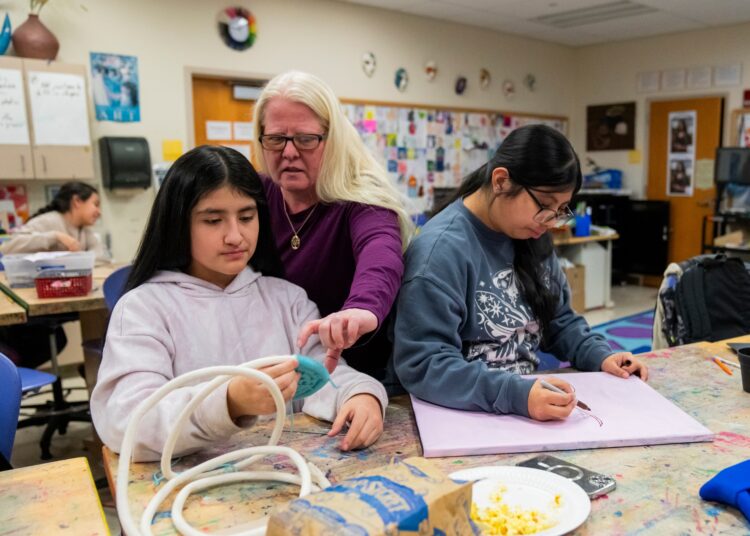
Last week, Thomas E. Dans, the recently appointed chair of the U.S. Arctic Research Commission, showed up unexpectedly in Tromsø, Norway, at an annual conference about the Arctic’s future. He had flown in from Mar-a-Lago and, he told me, was there to observe. The next day, he watched as Åsa Rennermalm, a Rutgers University professor who studies polar regions, sat onstage with European foreign ministers and spoke out against cuts to U.S. science funding.
“A leading US Arctic scientist is on stage absolutely ripping her country to the delight of the audience,” Dans wrote on X. “Embarassing.” He punctuated his post with an American-flag emoji.
When I asked him at the conference about his plans in his new job—the commission’s main function is advising the federal government on what Arctic science to pursue—he said that future research will put America first and focus on the economic opportunities of the north. In a later email, he emphasized investments in Arctic military and energy security. “Under President Trump, our expansive Arctic research enterprise, across the entirety of the U.S. government enterprise, is increasing not decreasing,” he wrote.
But his comments were also consistent with the Trump administration’s posture toward Arctic climate research in particular: The United States has been doing too much of it. The Trump administration’s choices are leading to an odd predicament, in that the more the U.S. takes a geopolitical interest in the Arctic, the less it’s contributing to the world’s basic understanding of the region. By slashing any science related to climate change, the U.S. is willfully remaining ignorant about the place key to the world’s future.
In the past year, the government’s own scientists, as well as scientists who depended on federal funding, have had to leave the region in droves, while thousands of federal data sets have vanished without warning, including many key to climate research. One day last May, the National Oceanic and Atmospheric Administration announced that the Sea Ice Index, a nearly half-century-long archive kept by one of its centers, would no longer be maintained or updated. In December, when NOAA quietly published its 20th-anniversary Arctic Report Card, it not only detailed record-high temperatures and record-low winter sea-ice cover, but also indexed the report’s own at-risk projects, threatened by U.S. staffing and budget cuts—including, for instance, a sea-ice-monitoring satellite system already scheduled for decommission.
Not long ago, the U.S. was the world’s greatest public funder of Arctic research, and the most frequent research-project initiator, according to an analysis by UArctic, a network of universities and research institutions studying the high north. “Frighteningly, a lot of the world’s critical climate data is being stored in data centers in the U.S.,” Morven Muilwijk, an oceanographer at the Norwegian Polar Institute who studies sea ice, told me. Scientists around the world have been scrambling to fill in gaps and make space on their servers for American data sets, before more of them suddenly disappear.
Polar peace, and the scientific collaboration it’s enabled, is a relatively recent idea; the eight Arctic nations created the Arctic Monitoring and Assessment Programme (AMAP) in 1991, at the Cold War’s end. More than a decade later, AMAP published the first ever international and multidisciplinary report on Arctic climate change and its driving role in planetary warming. At its height, AMAP grew to a network involving more than 800 global scientists and experts.
Arctic research always required diplomacy, and even before Donald Trump took office, it had been in a rough stretch. In March 2022, one week after Russia’s full-scale invasion of Ukraine, Western nations started issuing sanctions against Russia that limited cross-border science and data-sharing, effectively wiping half of the geographical Arctic from climate models. The Arctic Council, the diplomatic forum that directs AMAP, paused its work. Practically overnight, hundreds of projects were halted, and once-daily contact among colleagues ceased. Scientists co-signed editorials pleading with their governments to end the sanctions for the sake of tracking planetary change. Only in mid-2024 did AMAP shakily open conversations about how to resume data-sharing.
Rolf Rødven, AMAP’s executive secretary, told me that today he’s optimistic and that the “intentions are there on both sides” to reopen the data channels. Still, he noted that, in recent years, attitudes toward data-sharing have changed. All environmental data shared across borders have the potential to be used for civilian technology or for military purposes. For example, high-resolution permafrost maps are key to understanding Arctic changes, but also reveal strategic details about a country’s terrain. In 2024, a Newsweek investigation found that a Chinese atmospheric station on Svalbard was using instruments owned by a state military-electronics group, which is also known for developing radar that can spot submarines and missiles at great distances. Just this week, The Barents Observer reported that a Russian AMAP scientist was arrested in January, accused of state treason by security services who say they found information in his publications on the Arctic environment that could be used by Norwegian intelligence. According to the First Report, a group of Russian human-rights lawyers in exile, the scientist has denied the charges.
Given the Trump administration’s aggressive approach to Arctic politics, any wariness about continuing to share data would be unsurprising. But not even American scientists can access the decades-long data sets they’ve removed, nor is it clear that those data sets exist anymore. To Rødven, “the U.S. situation is much worse” than the 2022 breakdown in Russian science collaboration. Russia is still collecting key data, even if other countries can’t currently access the information. The Trump administration has been planning to pull carbon-measuring satellites out of the sky. European institutions are now preparing for a future without American data: The Norwegian Meteorological Institute, for example, has been downloading still-online NOAA and NASA data sets to its own servers; the European Space Agency, Muilwijk said, “is really stepping up” with its satellite data sets. But these efforts may not be enough to patch the holes the U.S. is leaving behind.
Late last year, at the American Geophysical Union’s annual conference, Rennermalm, the Rutgers scientist, gave a talk titled “The End of the Golden Era of Polar and Cryosphere Science in the United States?” In it, she raised concerns that the administration’s disinvestments could seriously hurt the global understanding of the poles, and discourage an entire generation of young researchers. At the conference, one of the most important gatherings for climate research, she noticed that fewer attendees had come from outside the U.S. than she’d expected, she told me. Scientists from other countries—Muilwijk and his colleagues among them—have started skipping American conferences. They’ve also stopped submitting to American academic journals, Muilwijk told me, in part because as available American peer reviewers shrink, these journals are running monthslong backlogs. The U.S. continues to pull away from international collaboration, too: In January, the Trump administration formally announced that it would withdraw the United States from the United Nations Intergovernmental Panel on Climate Change, just two years before initial reports from its next comprehensive, meticulous account of planetary changes and forecasts are due to be published.
The impact of losing American involvement in the IPCC report is difficult to quantify. But one consequence is fairly straightforward: The National Center for Atmospheric Research, which the Trump administration wants to dismantle entirely, produces a major model of the Earth system that the report depends on. NCAR has been a leader in improving the accuracy of climate predictions, Muilwijk told me. The science has been moving toward linking Arctic changes to other regions and predicting hyperlocal impacts—future storms, erosion, sea-level rise—with greater specificity. Losing NCAR models and data may make those predictions a lot harder. (The White House did not respond to a request for comment.)
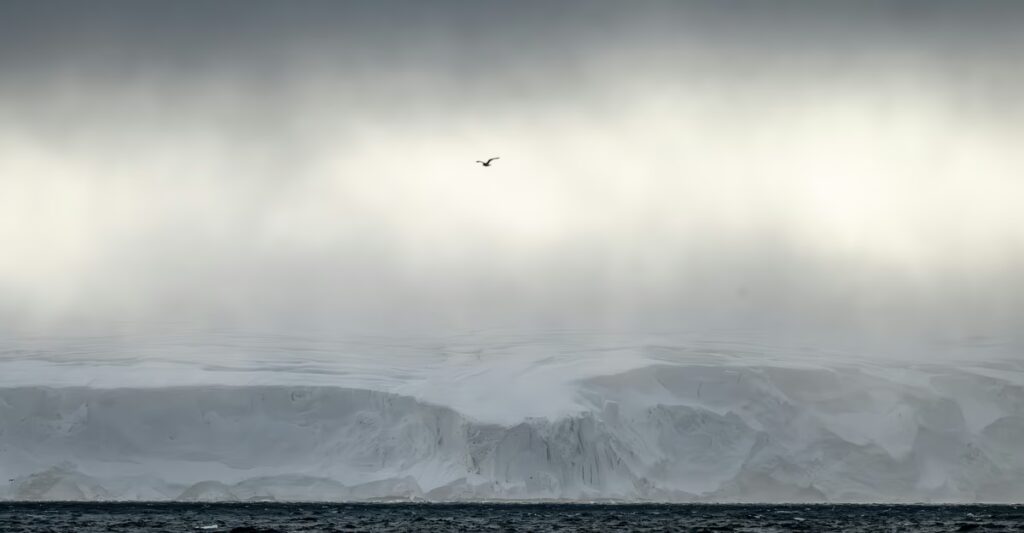
Rennermalm took what she thinks may be her final research trip to Greenland last summer. She’s been studying changes to the ice sheet there for two decades, during which it has lost 5,000 billion tons of ice, and at a research station that was once full of American scientists, she saw only two other senior researchers like herself, “there to pack down the science,” she told me. At the harbor, she could see naval ships. “This Greenland-occupation rhetoric is now a world issue consuming every conversation,” she said, when I called three weeks before the Tromsø conference, “when what we should be focusing on is what’s happening to our Earth system and our ability to live on this planet.”
That’s what happened at the conference, too—an exchange between Dans and Aaja Chemnitz, a Greenlandic member of the Danish Parliament, became the talk of the week. Dans had just given an interview to Norwegian national TV, in which he expounded on America’s designs on Greenland. Afterward, when his mic was still on, he glibly told Chemnitz that the “check is in the mail.” The next night Chemnitz recounted the whole exchange at a talk with, among others, Michael Sfraga, who chaired the U.S. Arctic Research Commission under Joe Biden; he told Chemnitz to “rip the check up.” (In his email, Dans told me that he’d encourage people to listen to the full interview, and that “Greenlanders themselves deserve better and they have no greater friend in America.”)
When I spoke with Sfraga about the exchange, he said that “it’s getting harder to stay measured in my reactions.” But he noted that in mid-January, Congress passed a bipartisan bill restoring much of the climate-science funding cut from NOAA, NASA, and the National Science Foundation last year. And even an administration pursuing an “America First” strategy in the Arctic should see some value in investing in polar science. “You can not divorce basic research from national security, homeland security, energy security, community security, or economic security,” Sfraga told me. Whatever U.S. leaders might think about climate change, that reality will affect their future plans, too.
The post The Blind Spot at the Top of the World appeared first on The Atlantic.