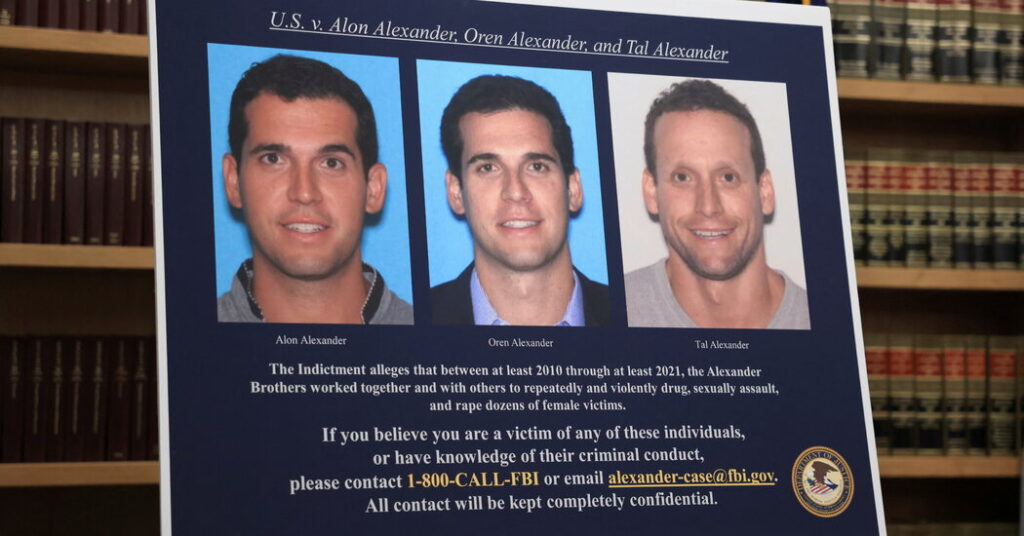
The third week of the Alexander brothers trial ended on Friday, capping days of emotional testimony from accusers and the removal of a juror who had already decided on a verdict in the case.
Tal Alexander, 39, along with twins Oren and Alon Alexander, both 38, were charged in a 12-count indictment that includes conspiracy to commit sex trafficking and other crimes. If convicted, they face up to life in prison.
The trial will resume on Feb. 24.
Here are five takeaways from the third week of the trial.
The jury was gripped by one woman’s testimony, the judge said.
The judge, Valerie Caproni, said that the jurors appeared to be “hanging on to every word” of one woman’s testimony.
Judge Caproni made the remark after the jury left the room and after Maylen Gehret said she was drugged and raped by Alon Alexander in Aspen, Colo., in 2017 when she was 17 years old.
On cross-examination, Alon Alexander’s lawyer, Howard Srebnick elicited testimony that Ms. Gehret had not pushed him away or told him “no.”
Another woman, Lindsey Acree choked up while testifying about being raped by Tal Alexander and another man in a home in the Hamptons in 2011. She said that her memory of the rape became like a flipbook with missing pages.
Tal Alexander’s lawyer Deanna Paul questioned Ms. Acree about her recollection of events, specifically focusing on details she remembered after she originally reported the assault to law enforcement.
The women addressed the defense’s accusation that they just want money.
Defense attorneys have argued in and out of court that the accusers are part of a coordinated cash grab in the form of civil lawsuits against the Alexander brothers.
Both Ms. Gehret and Ms. Acree said this week that their lawsuits against the brothers were not about making themselves rich.
Ms. Gehret, who said her father is a billionaire, said she didn’t need the money. Instead, she said, she sued them because “they took something from me that I didn’t really want to give. And now I want to take something from them that I know they don’t really want to give.”
Ms. Acree also testified that she would “never need their money,” but decided to sue after hearing one of the brothers’ defense attorneys call the accusers gold diggers and con artists.
“To do that to women who came forward with sexual assault is cruel and horrible,” Ms. Acree said, adding that she hoped to use whatever damages she eventually might receive to establish a foundation to help victims.
Two women said they saw others being assaulted at parties.
An accuser using the pseudonym Isa Brooks testified on Thursday that she was raped in a bedroom by Tal and Alon Alexander, as well as two other men, at a party held during Memorial Day weekend in 2009, when she was 16 years old. The same weekend, she said she saw a group of men on top of a different girl.
Avishan Bodjnoud also testified this week that she saw a woman being assaulted by Tal Alexander and one of the twins that weekend. Before she left the house, Ms. Bodjnoud said she wrote “rapists,” “you need to apologize” and “I’ll call 911” in eyeliner on the door and walls, hoping that one day it would be used as evidence.
Ms. Bodjnoud said a mutual friend contacted her to tell her that the brothers were well connected and that “nothing happened to you.” She later said she never contacted the police about the rape until the brothers were arrested in 2024.
An expert testified that victims can freeze during an assault.
On Thursday, Dr. Lisa Rocchio, a psychologist, testified that people who are sexually assaulted by someone they know typically freeze rather than fighting them or running away.
“When someone is giving up resistance or complying in response to intense fear, danger, threat and you’re having these automatic survival mechanisms, that’s absolutely not consent,” Dr. Rocchio said. “These are involuntary responses to fear.”
Dr. Rocchio added that victims of sexual assault tend to narrow their focus on safety and survival, but have less awareness of wider and broader details of the event.
During cross-examination by Zach Intrater, a lawyer for Oren Alexander, Dr. Rocchio said she had not personally interviewed any witnesses in this case and therefore wouldn’t know if a witness was fabricating or exaggerating their testimony.
The judge replaced a juror who said he had made up his mind.
At the start of the trial, the jury was composed of six women and six men. Six alternate jurors were also selected.
But over the last three weeks, several jurors have left unexpectedly because of work, family matters and illnesses. This week, the judge dismissed one man who said he had made his mind up about the case before it was over.
The jury is now composed of seven women and five men. Notably, only two alternates are left on the jury as they head into a 10-day break.
Kate Christobek is a reporter covering breaking news for The Times.
The post Takeaways From the Third Week of the Alexander Brothers Trial appeared first on New York Times.