NEW HAVEN, Conn. — When more than 400 children returned from winter break last month, their New Haven public school had changed.
The care coordinator who helped families in crisis was gone. A class for parents who were getting certified to work in child care centers had been scrapped. A dance club, where 13-year-old Miguel Gonzalez practices the moves that will hopefully help him get into a performing arts high school next year, was in its final weeks.
These programs at Family Academy of Multilingual Exploration (FAME) were funded by the Full-Service Community Schools grant, a federal program that prioritized helping students found to be the most underserved. The Education Department abruptly canceled the grant in mid-December, affecting programs in 11 states and D.C., because the grantees had mentioned diversity, equity and inclusion in their applications. The programs do not align with the Trump administration’s priorities, according to an agency spokesperson.
The cancellations cut off $168 million in funding for after-school clubs, tutoring, dental exams, parenting classes and more, advocates say. The five-year grant aimed to transform campuses into community schools, a model for public schools that offers services beyond those of a typical school, such as health care, laundry services, or classes for senior citizens.
The money was suspended Jan. 1, leaving principals and superintendents scrambling for spare cash in the middle of the school year, when it tends to be the hardest to find. State leaders have had to dig into their coffers to keep programs afloat, but only after the sudden cuts wreaked havoc on schools, causing layoffs and interrupting services such as mental health care.
Students who need the most help — including poor children, immigrants and students of color — are getting less programming since the Trump administration has shut off funding because it aimed to specifically help them.
“Our kids, unfortunately, they have limited experiences because families may not be able to provide them with that. So this is just an extension of our school day and what we do,” Marisol Rodríguez, FAME’s principal, said of the after-school programs. “They look forward to it, and it keeps the kids off the streets.”
FAME joined the community schools program this school year as part of a five-year, $2.5 million project with nearby Fair Haven School and several community partners. The school enrolls about 440 students, most of whom speak Spanish. Three-quarters qualify for free and reduced-price lunch.
A growing body of research indicates that well-implemented community school models can lead to better attendance, boost test scores, reduce disciplinary incidents and improve school climate. Under the Biden administration, annual funding for the community schools grant shot up from $25 million in fiscal 2020 to $150 million, according to the most recent data published by the Education Department.
Like other schools that have seen federal dollars vanish, the New Haven schools got caught in a government flip-flop. Under the Biden administration, the Education Department said it would prioritize community schools projects that focused on “improving outcomes for underserved students,” and fostering supportive and inclusive settings “with regard to race, ethnicity, culture, language, and disability status,” among other efforts, according to a notice posted in June 2023.
Clifford Beers Community Care Center, a New Haven nonprofit, was managing the grant at FAME and Fair Haven School. Its executive director, Ilaria Filippi, said the group’s grant application included language “about advancing racial equity and trauma-informed practice.” And they got the grant money.
After President Donald Trump took office last year, the Education Department said DEI policies were harmful and discriminatory. And the community schools money was clawed back.
The grants that ended clashed with the Trump administration’s focus on “prioritizing merit, fairness, and excellence in education,” Ellen Keast, an agency press secretary, said in a statement. “Many of these use overt race preferences or perpetuate divisive concepts and stereotypes, which no student should be exposed to.”
Fillipi said the organization appealed the department’s decision, but it was denied.
“This program did not end because it failed. It did not end because outcomes were poor. It did not end because it was ineffective,” Filippi said at a recent news conference.
In Illinois, where more than 30 schools lost grant funding, local and national groups are fighting back in court. In two separate lawsuits, the American Federation of Teachers, the nation’s second-largest teachers union, and three Illinois nonprofits argue the federal government’s actions are unlawful.
“What community schools do is, they try to mitigate all of those other things that impede students’ school-day learning,” said Susan Stanton, executive director of ACT NOW, one of the plaintiffs. “If you’re walking into a school building and your parents don’t have a job, or access to laundry services, or breakfast that morning, it’s going to be really hard to get a B in math class that day.”
Opportunities dwindle
At dance rehearsal, Stephanie White, a math coach at FAME who helps to run the club, and her co-adviser, Jennifer Ortiz, discussed the children’s costumes for an upcoming Michael Jackson-themed performance in front of the school — potentially their last. Black fedoras, white shirts, white socks, black shoes.
Miguel, positioned at the center of the stage, would wear a sparkly glove.
Each child owned a pair of black pants, but none that matched what Michael Jackson used to wear.
“One of the things that was notable about his pants, he had the white stripe that went down them,” White told the students. “We can do that the day of the performance. We’re going to do it the way Ms. Ortiz and I do everything: duct tape.”
The community schools grant was supposed to eliminate these kinds of problems.
Rodríguez had hoped to double the number of children participating in after-school programs, from about 60 to 120 students. Between FAME and Fair Haven School — which was in the second year of its grant — students would have access to fencing, theater, arts and crafts, dance, and a math and soccer program. They’d also get more staff.
Much of that is gone or going.
“This is pretty much it right here, in the school,” Miguel’s mom, Jeanette Gonzalez, said about arts education. Outside of the dance club, Miguel practices at home, where Jeanette can hear every creak of the floorboard as the eighth-grader choreographs routines in his bedroom.
“They don’t have as many opportunities as they should, or what I believe should be available to the students,” she said.
At Fair Haven School, less than a mile down the street from FAME, students were learning music, making art and playing sports after school. Michael Soares, an English as a Second Language teacher, said he thinks time-strapped teachers, who are already spread thin, may be asked to replace the eliminated staff.
“When you give kids these opportunities, they really grasp on, and then to have them taken away is shameful,” Soares said. “What I see is the kids coming in my classroom on Tuesday, talking about how fun and engaging after-school program was on Monday.”
Among the biggest losses for FAME was Keishla Sanchez, who was laid off from her job as a care coordinator responsible for helping students and families navigate challenges at school or at home. One of her first cases was a mother who had immigration documents but whose child did not. Sanchez helped the family find a lawyer and, eventually, obtain a green card. “For me, that was big,” Sanchez said.
Since leaving in December, Sanchez said she’s been getting calls and texts from families, many of whom still need help. “I was their main person to go to,” she said.
In a handwritten letter, one parent wrote that Sanchez had been helping her son apply to high schools and that he was “devastated” when his after-school program at Fair Haven School was eliminated.
“Now he’s constantly in his room, bored,” the mother wrote. “I don’t allow him to run the streets or hang out with questionable people, so taking the after-school program away completely cut off his socialization with positive influences.”
‘A happy, safe space’
Not everything is disappearing.
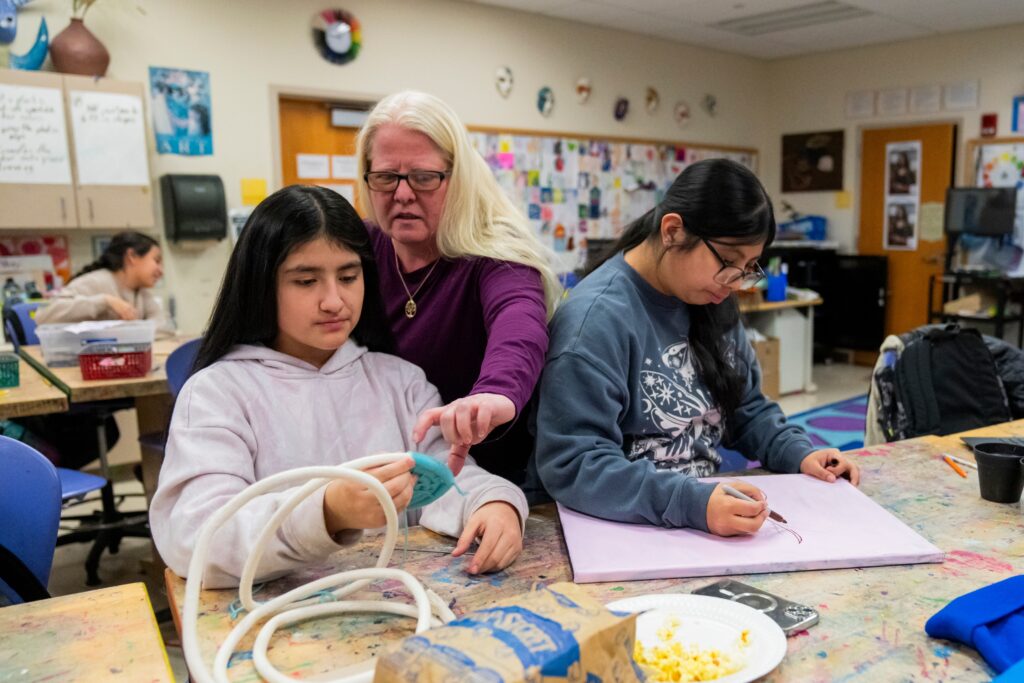
In a classroom filled with crayon stubs, papier-mâché masks, racks of colored paper and more, students tinkered at art projects. ARTE, Inc., a nonprofit that was part of the community schools effort, kicked in enough funding to keep FAME’s after-school arts program afloat for the rest of the year, said Melissa Sands, who runs the activity.
“I like that we have a choice to do what we want,” said Dayanna Torres, 13, while making origami. If it weren’t for art class, she’d probably be sitting at home bored after school, she added. Her friends nodded their heads in agreement.
Down the hall from the buzzing art class, dancers missed a cue to clap in unison for the Michael Jackson number. “Again,” Ortiz responded, before restarting the music.
“She says it’s one more time, but it’s 12,000 more times,” said Destiny Algarin, 12.
White, the club’s co-adviser, saw the bittersweetness of the moment.
“It’s a happy, safe space for them,” White said of the club. “Hopefully, we’ll be able to finish the year out.”
As of this week, FAME’s community schools program appeared likely to continue, at least for a while. Connecticut Gov. Ned Lamont (D) got approval to use $4.5 million in emergency state funding to preserve programs in New Haven, Waterbury and Hartford through next school year. The federal grant was supposed to provide funding through 2028.
The money, however, has not reached FAME yet, Rodriguez said Thursday. “I’m hoping they do something sooner than later.”
The post School clubs, sports, tutoring vanish after midyear Trump DEI cuts appeared first on Washington Post.